
Penny Dreadfuls, 1849 · page 182 of 394
The Mysteries of the Court of London — page 182: what you’re looking at
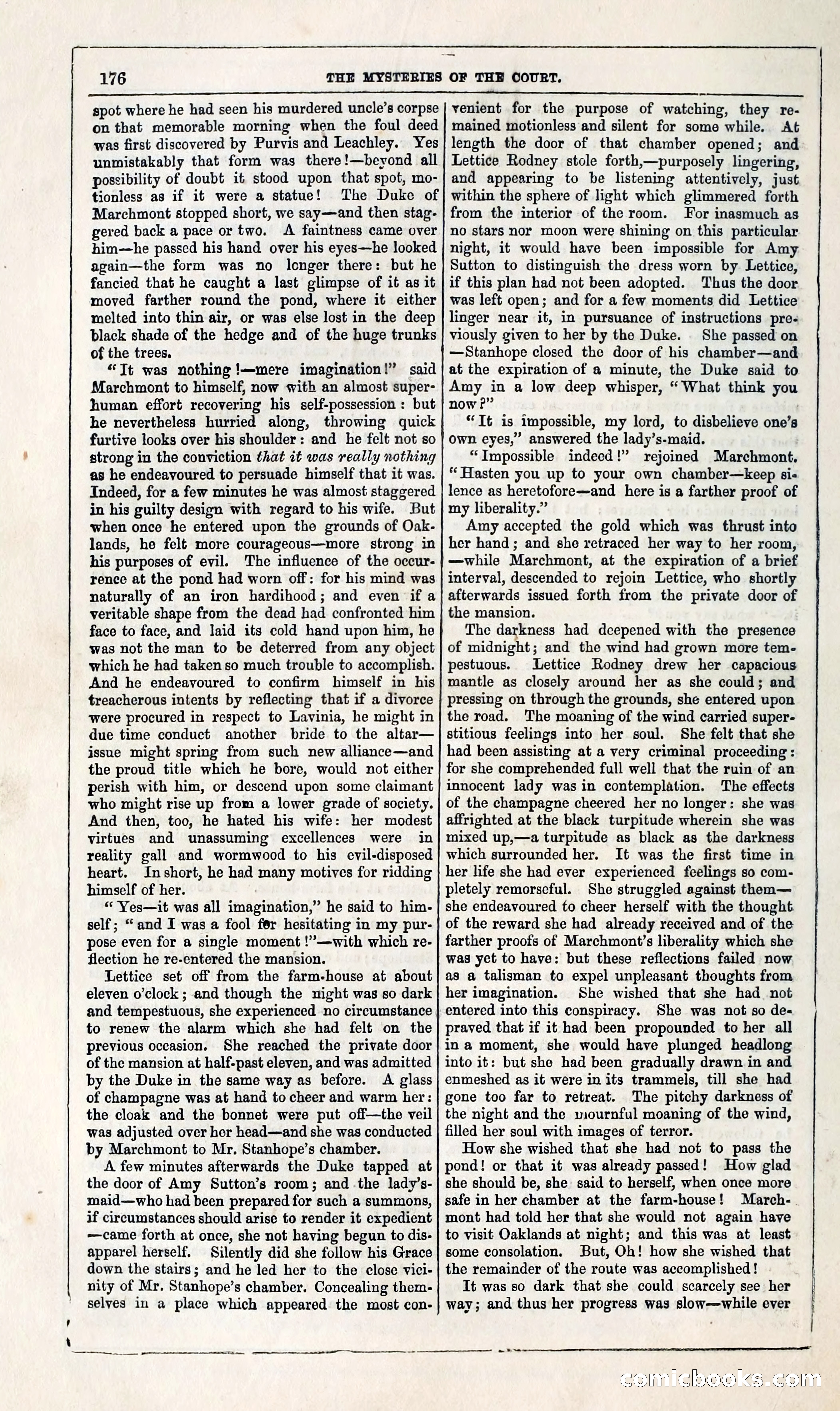
A restored page from Penny Dreadfuls, 1849. Page through the whole issue in the reader above.
📄 Transcribed text from this page (OCR, searchable)
Machine-transcribed from the original scan — historical spelling and the odd misread are preserved.
176 spot where he had seen his murdered uncle’s corpse on that memorable morning when the foul deed was first discovered by Purvis and Leachley. Yes unmistakably that form was there!—beyond all possibility of doubt it stood upon that spot, mo- tionless as if it were a statue! The Duke of Marchmont stopped short, we say—and then stag- gered back a pace or two. A faintness came over him—he passed his hand over his eyes—he looked again—the form was no longer there: but he fancied that he caught a last glimpse of it as it moved farther round the pond, where it either melted into thin air, or was else lost in the deep black shade of the hedge and of the huge trunks of the trees. “Tt was nothing !-mere imagination!” said Marchmont to himself, now with an almost super- human effort recovering his self-possession : but he nevertheless hurried along, throwing quick furtive looks over his shoulder: and he felt not so strong in the conviction that it was really nothing as he endeavoured to persuade himself that it was. Indeed, for a few minutes he was almost staggered in his guilty design with regard to his wife. But when once he entered upon the grounds of Oak- lands, he felt more courageous—more strong in his purposes of evil. The influence of the occur- rence at the pond had worn off: for his mind was naturally of an iron hardihood; and even if a veritable shape from the dead had confronted him face to face, and laid its cold hand upon him, he was not the man to be deterred from any object which he had taken so much trouble to accomplish. And he endeavoured to confirm himself in his treacherous intents by reflecting that if a divorce were procured in respect to Lavinia, he might in due time conduct another bride to the altar— issue might spring from such new alliance—and the proud title which he bore, would not either perish with him, or descend upon some claimant who might rise up from a lower grade of society. And then, too, he hated his wife: her modest virtues and unassuming excellences were in reality gall and wormwood to his evil-disposed heart. Inshort, he had many motives for ridding himself of her. ““ Yes—it was all imagination,” he said to him- self; “and I was a fool fer hesitating in my pur- pose even for a single moment !”—with which re- flection he re-entered the mansion. Lettice set off from the farm-house at about eleven o’clock ; and though the night was so dark and tempestuous, she experienced no circumstance to renew the alarm which she had felt on the previous occasion. She reached the private door of the mansion at half-past eleven, and was admitted by the Duke in the same way as before. A glass of champagne was at hand to cheer and warm her: the cloak and the bonnet were put off—the veil was adjusted over her head—and she was conducted by Marchmont to Mr. Stanhope’s chamber. A few minutes afterwards the Duke tapped at the door of Amy Sutton’s room; and the lady’s- maid—who had been prepared for such a summons, if circumstances should arise to render it expedient —came forth at once, she not having begun to dis- apparel herself. Silently did she follow his Grace down the stairs; and he led her to the close vici- nity of Mr. Stanhope’s chamber. Concealing them- selves in a place which appeared the most con- THE MYSTERIES OF THE COURT. venient for the purpose of watching, they re- mained motionless and silent for some while. At length the door of that chamber opened; and Lettice Rodney stole forth,—purposely lingering, and appearing to be listening attentively, just within the sphere of light which glimmered forth from the interior of the room. For inasmuch as no stars nor moon were shining on this particular night, it would have been impossible for Amy Sutton to distinguish the dress worn by Lettice, if this plan had not been adopted. ‘Thus the door was left open; and for a few moments did Lettice linger near it, in pursuance of instructions pre- viously given to her by the Duke. | She passed on —Stanhope closed the door of his chamber—and at the expiration of a minute, the Duke said to Amy in a low deep whisper, “ What think you now P” ) “It is impossible, my lord, to disbelieve one’s own eyes,” answered the lady’s-maid. “Impossible indeed!” rejoined Marchmont. “Hasten you up to your own chamber—keep si- lence as heretofore—and here is a farther proof of my liberality.” Amy accepted the gold which was thrust into her hand; and she retraced her way to her room, —while Marchmont, at the expiration of a brief interval, descended to rejoin Lettice, who shortly afterwards issued forth from the private door of the mansion. The darkness had deepened with the presence of midnight; and the wind had grown more tem- pestuous. lLettice Rodney drew her capacious mantle as closely around her as she could; and pressing on through the grounds, she entered upon the road. The moaning of the wind carried super- stitious feelings into her soul. She felt that she had been assisting at a very criminal proceeding: for she comprehended full well that the ruin of an innocent lady was in contemplation. The effects of the champagne cheered her no longer: she was affrighted at the black turpitude wherein she was mixed up,—a turpitude as black as the darkness which surrounded her. It was the first time in her life she had ever experienced feelings so com- pletely remorseful. She struggled against them— she endeavoured to cheer herself with the thought of the reward she had already received and of the farther proofs of Marchmont’s liberality which she was yet to have: but these reflections failed now as a talisman to expel unpleasant thoughts from her imagination. She wished that she had not entered into this conspiracy. She was not so de- praved that if it had been propounded to her all in a moment, she would have plunged headlong into it: but she had been gradually drawn in and enmeshed as it were in its trammels, till she had gone too far to retreat. The pitchy darkness of the night and the mournful moaning of the wind, filled her soul with images of terror. How she wished that she had not to pass the pond! or that it was already passed! How glad she should be, she said to herself, when once more safe in her chamber at the farm-house! March-. mont had told her that she would not again have to visit Oaklands at night; and this was at least some consolation. But, Oh! how she wished that the remainder of the route was accomplished! It was so dark that she could scarcely see her way; and thus her progress was slow—while ever (C©) “S JOO (20)