
Penny Dreadfuls, 1849 · page 194 of 394
The Mysteries of the Court of London — page 194: what you’re looking at
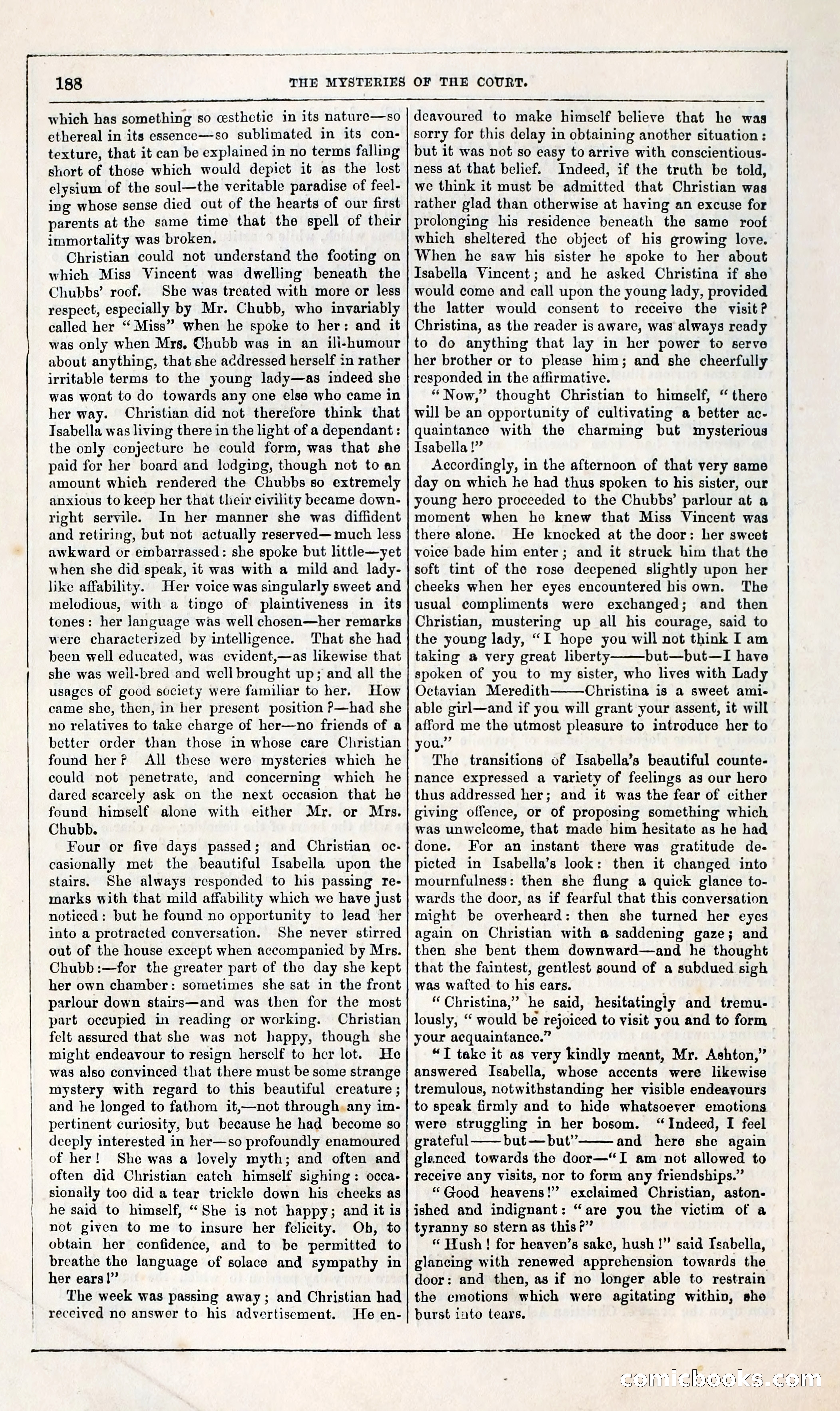
A restored page from Penny Dreadfuls, 1849. Page through the whole issue in the reader above.
📄 Transcribed text from this page (OCR, searchable)
Machine-transcribed from the original scan — historical spelling and the odd misread are preserved.
- 188 which has something so cesthetic in its nature—so ethereal in its essence—so sublimated in its con- texture, that it can be explained in no terms falling short of those which would depict it as the lost elysium of the soul—the veritable paradise of feel- ing whose sense died out of the hearts of our first parents at the same time that the spell of their immortality was broken. Christian could not understand the footing on which Miss Vincent was dwelling beneath the Chubbs’ roof. She was treated with more or less respect, especially by Mr. Chubb, who invariably called her “‘ Miss” when he spoke to her: and it was only when Mrs, Chubb was in an ili-humour about anything, that she acdressed herself in rather irritable terms to the young lady—as indeed she was wont to do towards any one else who came in her way. Christian did not therefore think that Tsabella was living there in the light of a dependant : the only conjecture he could form, was that she paid for her board and lodging, though not to an amount which rendered the Chubbs so extremely anxious to keep her that their civility became down- right servile. In her manner she was diffident and retiring, but not actually reserved— much less awkward or embarrassed: she spoke but little—yet when she did speak, it was with a mild and lady- like affability. Her voice was singularly sweet and melodious, with a tinge of plaintiveness in its tones: her Janguage was well chosen—her remarks were characterized by intelligence. That she had been well educated, was evident,—as likewise that she was weil-bred and well brought up; and all the usages of good society were familiar to her. How came she, then, in her present position P—had she no relatives to take charge of her—no friends of a better order than those in whose care Christian found her? All these were mysteries which he could not penetrate, and concerning which he dared scarcely ask on the next occasion that he found himself alone with either Mr. or Mrs. Chubb. Four or five days passed; and Christian oc- casionally met the beautiful Isabella upon the stairs. She always responded to his passing re- marks with that mild affability which we have just noticed: but he found no opportunity to lead her into a protracted conversation. She never stirred out of the house except when accompanied by Mrs. Chubb:—for the greater part of the day she kept her own chamber: sometimes she sat in the front parlour down stairs—and was then for the most part occupied in reading or working. Christian felt assured that she was not happy, though she might endeavour to resign herself to her lot. He was also convinced that there must be some strange mystery with regard to this beautiful creature ; and he longed to fathom it,—not through. any im- pertinent curiosity, but because he had become so deeply interested in her—so profoundly enamoured of her! She was a lovely myth; and often and often did Christian catch himself sighing: occa- sionally too did a tear trickle down his cheeks as he said to himself, “She is not happy; and it is not given to me to insure her felicity. Ob, to obtain her confidence, and to be permitted to breathe the language of solace and sympathy in her ears!” The week was passing away; and Christian had received no answer to his advertisement. He en- THE MYSTERIES OF THE COURT. i ——— deavoured to make himself believe that he was sorry for this delay in obtaining another situation : but it was not so easy to arrive with conscientious- ness at that belief. Indeed, if the truth be told, we think it must be admitted that Christian was rather glad than otherwise at having an excuse for prolonging his residence beneath the same roof which sheltered the object of his growing love. When he saw his sister he spoke to her about Isabella Vincent; and he asked Christina if she would come and call upon the young lady, provided the latter would consent to receive the visit? Christina, as the reader is aware, was always ready to do anything that lay in her power to serve her brother or to please him; and she cheerfully responded in the affirmative. “Now,” thought Christian to himself, “ there will be an opportunity of cultivating a better ac- quaintance with the charming but mysterious Isabella!” Accordingly, in the afternoon of that very same day on which ke had thus spoken to his sister, our young hero proceeded to the Chubbs’ parlour at a moment when he knew that Miss Vincent was there alone. He knocked at the door: her sweet voice bade him enter; and it struck him that the soft tint of the rose deepened slightly upon her cheeks when her eyes encountered his own. The usual compliments were exchanged; and then Christian, mustering up all his courage, said to the young lady, “I hope you will not think I am taking a very great liberty but—but—I have spoken of you to my sister, who lives with Lady Octavian Meredith Christina is a sweet ami- able girl—and if you will grant your assent, 1 will afford me the utmost pleasure to introduce her to you.” The transitions of Isabella’s beautiful counte- nance expressed a variety of feelings as our hero thus addressed her; and it was the fear of either giving offence, or of proposing something which was unwelcome, that made him hesitate as he had done. For an instant there was gratitude de- picted in Isabella’s look: then it changed into mournfulness: then she flung a quick glance to- wards the door, as if fearful that this conversation might be overheard: then she turned her eyes again on Christian with a saddening gaze; and then she bent them downward—and he thought that the faintest, gentlest sound of a subdued sigh was watted to his ears. “Christina,” he said, hesitatingly and tremu- lously, “ would be rejoiced to visit you and to form your acquaintance.” “T take it as very kindly meant, Mr. Ashton,” answered Isabella, whose accents were likewise tremulous, notwithstanding her visible endeavours to speak firmly and to hide whatsoever emotions were struggling in her bosom. “Indeed, I feel grateful —— but — but” and here she again glanced towards the door—“I am not allowed to receive any visits, nor to form any friendships.” “Good heavens!” exclaimed Christian, aston- ished and indignant: “are you the victim of a tyranny so stern as this?” “ Hush ! for heaven’s sake, hush !” said Isabella, glancing with renewed apprehension towards the door: and then, as if no longer able to restrain the emotions which were agitating within, she burst into tears. Go IO S (C6)