
Penny Dreadfuls, 1849 · page 196 of 394
The Mysteries of the Court of London — page 196: what you’re looking at
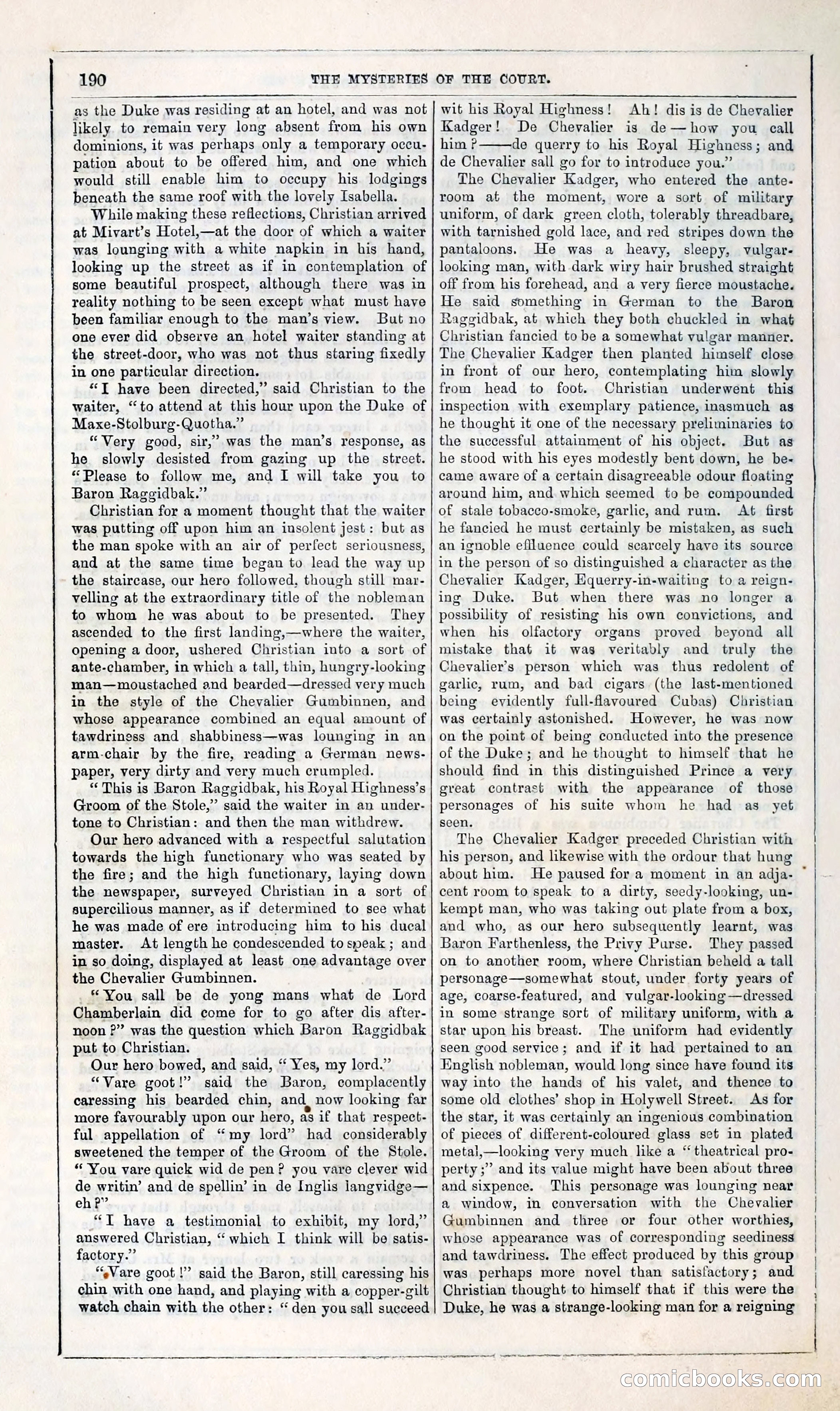
A restored page from Penny Dreadfuls, 1849. Page through the whole issue in the reader above.
📄 Transcribed text from this page (OCR, searchable)
Machine-transcribed from the original scan — historical spelling and the odd misread are preserved.
ees —— — ee = - _ - <n 190 as the Duke was residing at an hotel, and was not likely to remain very long absent from his own dominions, it was perhaps only a temporary occu- pation about to be offered him, and one which would still enable him to occupy his lodgings beneath the same roof with the lovely Isabella. While making these reflections, Christian arrived at Mivart’s Hotel,—at the door of which a waiter was lounging with a white napkin in his hand, looking up the street as if in contemplation of some beautiful prospect, although there was in reality nothing to be seen except what must have been familiar enough to the man’s view. But no one ever did observe an hotel waiter standing at the street-door, who was not thus staring fixedly in one particular direction. “T have been directed,” said Christian to the waiter, “to attend at this hour upon the Duke of Maxe-Stolburg-Quotha.” “Very good, sir,’ was the man’s response, as he slowly desisted from gazing up the street. “Please to follow me, and I will take you to Baron Raggidbak.” Christian for a moment thought that the waiter was putting off upon him an insolent jest: but as the man spoke with an air of perfect seriousness, and at the same time began to lead the way up the staircase, our hero followed, though still mavr- velling at the extraordinary title of the nobleman to whom he was about to be presented. They ascended to the first landing,—where the waiter, opening a door, ushered Christian into a sort of ante-chamber, in which a tall, thin, hungry-looking man—moustached and bearded—dressed very much in the style of the Chevalier Gumbinnen, and whose appearance combined an equal amount of tawdriness and shabbiness—was lounging in an arm-chair by the fire, reading a German news- paper, very dirty and very much crumpled. “This is Baron Raggidbak, his Royal Highness’s Groom of the Stole,” said the waiter in an under- tone to Christian: and then the man withdrew. Our hero advanced with a respectful salutation towards the high functionary who was seated by the fire; and the high functionary, laying down the newspaper, surveyed Christian in a sort of supercilious manner, as if determined to see what he was made of ere introducing him to his ducal master. At length he condescended tospeak ; and in so doing, displayed at least one advantage over the Chevalier Gumbinnen. * You sall be de yong mans what de Lord Chamberlain did come for to go after dis after- noon P” was the question which Baron Raggidbak put to Christian. Our hero bowed, and said, ‘“‘ Yes, my lord.” “Vare goot!” said the Baron, complacently caressing his bearded chin, and_ now looking far “% more favourably upon our hero, as if that respect- ful appellation of “my lord” had considerably sweetened the temper of the Groom of the Stole. “You vare quick wid de pen? you vare clever wid de writin’ and de spellin’ in de Inglis iangvidge— eh P” “TI have a testimonial to exhibit, my lord,” answered Christian, “ which I think will be satis- factory.” “Vare goot |’? said the Baron, still caressing his chin with one hand, and playing with a copper-gilt watch chain with the other: “den you sall succeed rw ee ess THE MYSTERIES OF THE COURT. wit his Royal Highness! Kadger! De Chevalier is de—how you call him ? de querry to his Royal Highness; and de Chevalier sall go for to introduce you.” The Chevalier Kadger, who entered the ante- room at the moment, wore a sort of military uniform, of dark green cloth, tolerably threadbare, with tarnished gold lace, and red stripes down the pantaloons. He was a heavy, sleepy, vulgar- looking man, with dark wiry hair brushed straight off from his forehead, and a very fierce moustache. He said something in German to the Baron Raggidbak, at which they both chuckled in what Christian fancied to be a somewhat vulgar manner, The Chevalier Kadger then planted himself close in front of our hero, contemplating him slowly from head to foot. Christian underwent this inspection with exemplary patience, inasmuch as he thought it one of the necessary preliminaries to the successful attainment of his object. But as he stood with his eyes modestly bent down, he be- came aware of a certain disagreeable odour floating around him, and which seemed to be compounded of stale tobacco-smoke, garlic, and rum. At first he fancied he must certainly be mistaken, as such an ignoble eflluence could scarcely have its source in the person of so distinguished a character as the Chevalier Kadger, Equerry-in-waiting to a reign- ing Duke. But when there was no longer a possibility of resisting his own convictions, and when his olfactory organs proved beyond all mistake that it was veritably and truly the Chevalier’s person which was thus redolent of garlic, rum, and bad cigars (the last-mentioned being evidently full-flavoured Cubas) Christian was certainly astonished. However, he was now on the point of being conducted into the presence of the Duke; and he thought to himself that he should find in this distinguished Prince a very great contrast with the appearance of those personages of his suite whom he had as yet seen. The Chevaher Kadger preceded Christian with his person, and likewise with the ordour that hung Ah! dis is de Chevalier about him. He paused for a moment in an adja- ~ cent room to speak to a dirty, seedy-looking, un- kempt man, who was taking out plate from a box, and who, as our hero subsequently learnt, was Baron Farthenless, the Privy Purse. They passed on to another room, where Christian beheld a tall personage—somewhat stout, under forty years of age, coarse-featured, and vulgar-looking —dressed in some strange sort of military uniform, with a star upon his breast. The uniform had evidently seen good service; and if it had pertained to an English nobleman, would long since have found its way into the hands of his valet, and thence to some old clothes’ shop in Holywell Street. As for the star, it was certainly an ingenious combination of pieces of different-coloured glass set in plated metal,—looking very much like a “theatrical pro- perty ;” and its value might have been about three and sixpence. This personage was lounging near a window, in conversation with the Chevalier Gumbinnen and three or four other worthies, whose appearance was of corresponding seediness and tawdriness. The effect produced by this group was perhaps more novel than satisfactory; and Christian thought to himself that if this were the Duke, he was a strange-looking man for a reigning _ —— ewe PO TE UE RT ——— COMMICELOC SS em Be oe ee —~ ~~ — — . - —_—— et — =|