
Penny Dreadfuls, 1849 · page 198 of 394
The Mysteries of the Court of London — page 198: what you’re looking at
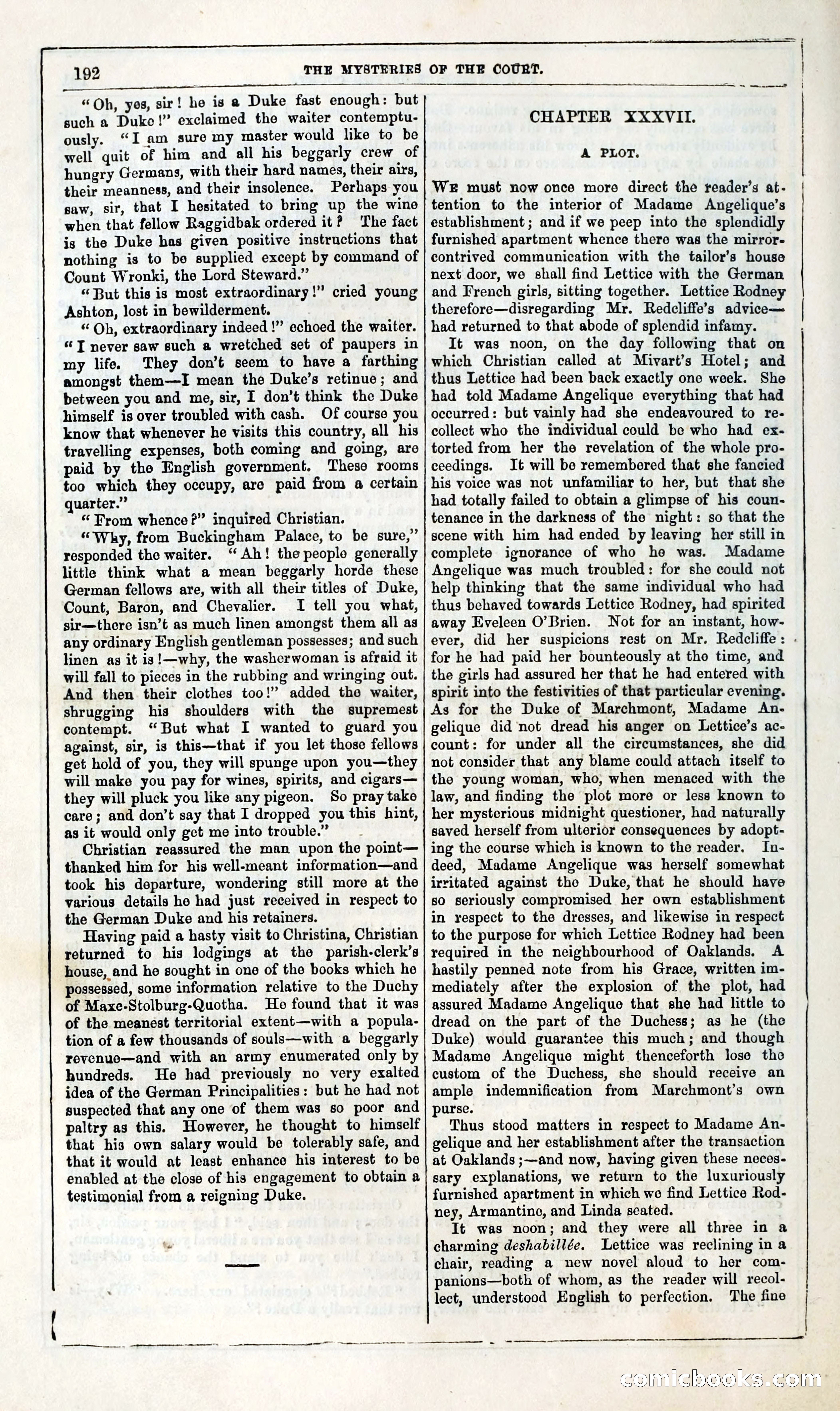
A restored page from Penny Dreadfuls, 1849. Page through the whole issue in the reader above.
📄 Transcribed text from this page (OCR, searchable)
Machine-transcribed from the original scan — historical spelling and the odd misread are preserved.
a ants nnn Se —— THE MYSTERIES OF THE COURT. 192 “Oh, yes, sir! he is @ Duke fast enough: but such a Duke!” exclaimed the waiter contemptu- ously. “I am sure my master would like to be well quit of him and all his beggarly crew of hungry Germans, with their hard names, their airs, their meanness, and their insolence. Perhaps you saw, sir, that I hesitated to bring up the wine when that fellow Raggidbak ordered it? The fact ig the Duke has given positive instructions that nothing is to be supplied except by command of Count Wronki, the Lord Steward.” “ But this is most extraordinary!” cried young Ashton, lost in bewilderment. “Oh, extraordinary indeed!” echoed the waiter. ‘ T never saw such a wretched set of paupers in my life. They don’t seem to have a farthing amongst them—I mean the Duke’s retinue; and between you and me, sir, I don’t think the Duke himself is over troubled with cash. Of course you know that whenever he visits this country, all his travelling expenses, both coming and going, are paid by the English government. These rooms too which they occupy, are paid from a certain quarter.” ‘From whence ?” inquired Christian. “Why, from Buckingham Palace, to be sure,” responded the waiter. “Ah! the people generally little think what a mean beggarly horde these German fellows are, with all their titles of Duke, Count, Baron, and Chevalier. I tell you what, sir—there isn’t as much linen amongst them all as any ordinary English gentleman possesses; and such linen as it is!—why, the washerwoman is afraid it will fall to pieces in the rubbing and wringing out. And then their clothes too!” added the waiter, shrugging his shoulders with the supremest contempt. “But what I wanted to guard you against, sir, is this—that if you let those fellows get hold of you, they will spunge upon you—they will make you pay for wines, spirits, and cigars— they will pluck you like any pigeon. So pray take care; and don’t say that I dropped you this hint, as it would only get me into trouble.” Christian reassured the man upon the point— thanked him for his well-meant information—and took his departure, wondering still more at the various details he had just received in respect to the German Duke and his retainers. Having paid a hasty visit to Christina, Christian returned to his lodgings at the parish-clerk’s house, and he sought in one of the books which he possessed, some information relative to the Duchy of Maxe-Stolburg-Quotha. He found that it was of the meanest territorial extent—with a popula- tion of a few thousands of souls—with a beggarly revenue—and with an army enumerated only by hundreds. He had previously no very exalted idea of the German Principalities: but he had not suspected that any one of them was so poor and paltry as this. However, he thought to himself that his own salary would be tolerably safe, and that it would at least enhance his interest to be enabled at the close of his engagement to obtain a testimonial from a reigning Duke. TTT ee ee oF CHAPTER XXXVII. A PLOT. WE must now once more direct the reader’s at- tention to the interior of Madame Angelique’s establishment; and if we peep into the splendidly furnished apartment whence there was the mirror- contrived communication with the tailor’s house next door, we shall find Lettice with the German and French girls, sitting together. Lettice Rodney therefore—disregarding Mr. Redcliffe’s advice— had returned to that abode of splendid infamy. It was noon, on the day following that on which Christian called at Mivart’s Hotel; and thus Lettice had been back exactly one week. She had told Madame Angelique everything that had occurred: but vainly had she endeavoured to re- collect who the individual could be who had ex- torted from her the revelation of the whole pro- ceedings. It will be remembered that she fancied his voice was not unfamiliar to her, but that she had totally failed to obtain a glimpse of his coun- tenance in the darkness of the night: so that the scene with him had ended by leaving her still in complete ignorance of who he was. Madame Angelique was much troubled: for she could not help thinking that the same individual who had thus behaved towards Lettice Rodney, had spirited away Eveleen O’Brien. Not for an instant, how- ever, did her suspicions rest on Mr. Redcliffe: . for he had paid her bounteously at the time, and the girls had assured her that he had entered with spirit into the festivities of that particular evening. As for the Duke of Marchmont, Madame An- gelique did not dread his anger on Lettice’s ac- count: for under all the circumstances, she did not consider that any blame could attach itself to the young woman, who, when menaced with the law, and finding the plot more or less known to her mysterious midnight questioner, had naturally saved herself from ulterior consequences by adopt- ing the course which is known to the reader. In- deed, Madame Angelique was herself somewhat irritated against the Duke, that he should have so seriously compromised her own establishment in respect to the dresses, and likewise in respect to the purpose for which Lettice Rodney had been required in the neighbourhood of Oaklands. A hastily penned note from his Grace, written im- mediately after the explosion of the plot, had assured Madame Angelique that she had little to dread on the part of the Duchess; as he (the Duke) would guarantee this much; and though Madame Angelique might thenceforth lose the custom of the Duchess, she should receive an ample indemnification from Marchmont’s own purse. Thus stood matters in respect to Madame An- gelique and her establishment after the transaction at Oaklands ;—and now, having given these neces- sary explanations, we return to the luxuriously furnished apartment in which we find Lettice Rod- ney, Armantine, and Linda seated. It was noon; and they were all three in a charming deshabillée. Lettice was reclining in a chair, reading a new novel aloud to her com- panions—both of whom, as the reader will recol- lect, understood English to perfection. The fine ET TT ST | | COMMICLOO© @ S (20)