
Penny Dreadfuls, 1849 · page 202 of 394
The Mysteries of the Court of London — page 202: what you’re looking at
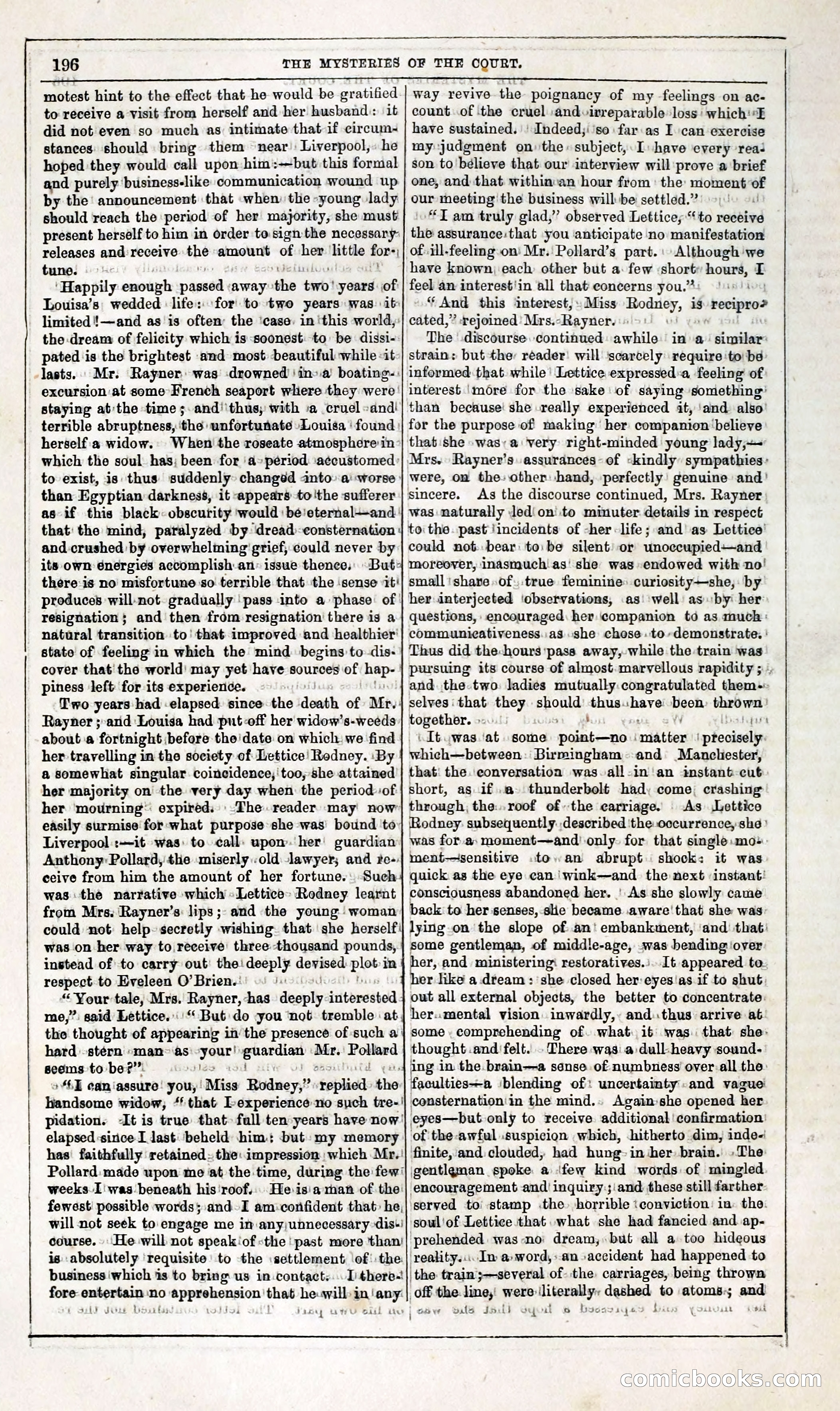
A restored page from Penny Dreadfuls, 1849. Page through the whole issue in the reader above.
📄 Transcribed text from this page (OCR, searchable)
Machine-transcribed from the original scan — historical spelling and the odd misread are preserved.
THE MYSTERIES motest hint to the effect that he would be gratified. to receive a visit from herself and her husband: ‘it did not even so much as intimate that if circum- stances should bring them near’: Liverpool,. he hoped they would call upon him:—but this formal and purely business-like communication wound up by the announcement that when the -young lady Roald reach the period of her majority, she must present herself to him in order to sign the necessary: releases and receive. the som of her little for tune. 9 ‘Happily enough nasted AWAY: wie tb years of Louisa’s' wedded life: for to two years was it limited !!—and as is often’ the ‘case. in ‘this world, the dream of felicity which is soonest to be dissi- pated is the brightest and most beautiful while «it lasts. Mr. Rayner was drowned |in».a boating-: excursion at some French seaport where they were! staying at the time ;.and''thus, with ‘a cruel «and! terrible abruptness, ‘the unfortunate Louiéa ‘found herself'a widow. When the roseate atmosphere in which the soul has; been for a» period ‘a¢customed: to exist, is thus suddenly changed anto» a worse: than Egyptian darkness, it appears to'the sufferer as if this black: obscurity would | bé'eternal—and | that: the mind, paralyzed by dreadconsternation and crushed by overwhelming ‘grief, could never by its own energies accomplish an: issue thence, But- there is no misfortune so terrible that the ‘sense ‘it! produces will-not gradually ‘pass into a phase of resignation; and then from resignation there is a natural transition to’ that improved and healthier’ state of feeling in which the mind begins to dis- cover that the world: may yet have sources of ous piness left for its experience. Two years had elapsed since the death of Mr.: Rayner ;arid Louisa had put-off her widow’s-weeds about a fortnight before the'date on which. we find her travelling in the society of Lettice' Redney. ‘By _ a somewhat singular coincidence, 'too, she attained her majority on the very day when the period of her mourning: expired: \-The. reader may now easily surmise for what purpose she was bound to: Liverpool :—it was: to call: upon. her guardian Anthony: Pollard, the miserly old lawyer; and te-: ceive from him the amount of her fortune.: Such was the narrative which »Lettice> Rodney learnt from Mrs. ‘Rayner’s: lips; and the young ‘woman could not help~ secretly wishing. that she herself! was on her way to receive three thousand pounds, instead of to carry out the: aoe devised ha in respect to Eveleen O’ Brien. “Your tale, Mrs. Rayner, -has deoplly snitorasteld me,”: said Léttice, But do you ‘not tremble ‘at, the thought of appearing in the presence of such a hard -stérn «man~ as “yenr! pe oe Joao seems to be?” 3 »“6£ caniassure! you, Miss Rodney,” ‘eeiplicd: the handsome widow, “f that Lexperience no such tre-' pidation. -It is true that fall ten-years have now! elapsed since I last beheld him: but: my memory has faithfully retained - the: impression which Mr.! Pollard: made upon me at the time, during the few’ weeks. I' was beneath his'roof...He.is'a man of the: fewest possible words; and-I am: confident that: he, will not seek to engage me in any)unnecessary dis! course. ‘He will not speakiof =the past more ‘than’ is absolutely ‘requisite to the settlement ‘of’ the: business ‘which 2s to bring us in.contact:... I) there~' fore: ee no ‘Se. armen that or ics im! anyl OF THE COURT. way revive the poignancy of my feelings on ac- count of the cruel andvirreparable loss: which" E have sustained. ' Indeed;' ‘so far as I can exercise my judgment on the: subject, I have every rea- son to bélieve that our interview will prove a brief one, and that within.an hour from: the moment of our meeting the business willbe settled.” | “T am truly glad,’ observed Lettice,; “to receive the assurance:that you ‘anticipate no manifestation of ill-feeling on’ Mr.'Pollard’s part. Although ‘we have known, each other but a. few short: hours, r feel an interest'in all that eoncerns you.”*: “And this interest,» Miss tte is s recipros cated,” ‘rejoined Mrs.-Rayner. The discourse continued awhile in a similar strain: but the: reader’ will ‘scarcely require ‘to! be informed that while ' Lettice expressed:a feeling of interest |\more for the sake of saying something’ than because! she -really experienced it, ‘and also’ for the purpose of making her companion ‘believe that she -was;a very right-minded young lady, Mrs. Rayner’s. assurances- of «kindly sympathies: were, on the» other: hand, perfectly’ genuine and’ sincere. As the discourse continued, Mrs. Rayner was naturally Jed'on' to mimuter details in respect to: the. past incidents of -her life; and as Lettice’ could not bear: to: be silent: or unoecupied—and moreover, inasmuch as' she was endowed with no! small ishareof..true feminine: curiosity—she, by her interjected ‘observations, as’ well as by her questions, encouraged her companion td as much: communicativeness..as she chese .to,demonstrate. ' Thus did the-hours pass away, while the train was pursuing its course of almost. marvellous rapidity ; . and. the.two. ladies mutually congratulated them- selves ‘that they Bons seats ak aeons bhel vert together. » pure It .was ‘at. some Pi PRES, atten cnieciadlip which—between: Birmingham-and Manchester, that: the conversation was all-in ‘an instant cub short, as if .a thunderbolt had; come, crashing through, the:..roof ofthe carriage. As Lettice Rodney: subsequently: described ‘the occurrence, she ' was for a: moment—and’ only. for that single:mo+: ment—sensitive .to.an abrupt shock: it was quick as the eye can 'wink—and the next instant’ consciousness abandoned her. ' As she slowly came back to her senses, she became .aware'that she was lying.on the slope of. an! embankment, ‘and that: some gentleman, of middle-age, was bending ‘over re and ministering: restoratives.).. It appeared to. er hke a dream: she closed her:eyes'as if to shut out all external objects, the better to concentrate. her..mental vision inwardly,. and.thus arrive at some . comprehending of. what 16 was. that she: thought and felt. . There was: a dull-heavy sound- | ing in the. brain—-a sense of numbness over all the: faculties+a blending of: uncertainty.and vague consternation'in the mind. Again:she opened her eyes—but only to receive additional confirmation of the awful .suspicion which, hitherto dim, inde- finite, and clouded, had hung- in ‘her brain. »The gentleman spoke a (few kind words of mingled encouragement and inquiry:;iand these still farther served toi stamp .the horrible ‘conviction: in: the. soul'of Lettice that what she had fancied and ap- prehended was-no' dream, but all a too hideous reality..:._Inm a word,» an accident had happened to ‘the train;—several of the carriages, being thrown off the line,' were: age cee to atoms-; and ® hyo i+ er ha it \ DAS vj caw Sale Jodd oyu DOO =} S (CO)