
Penny Dreadfuls, 1849 · page 214 of 394
The Mysteries of the Court of London — page 214: what you’re looking at
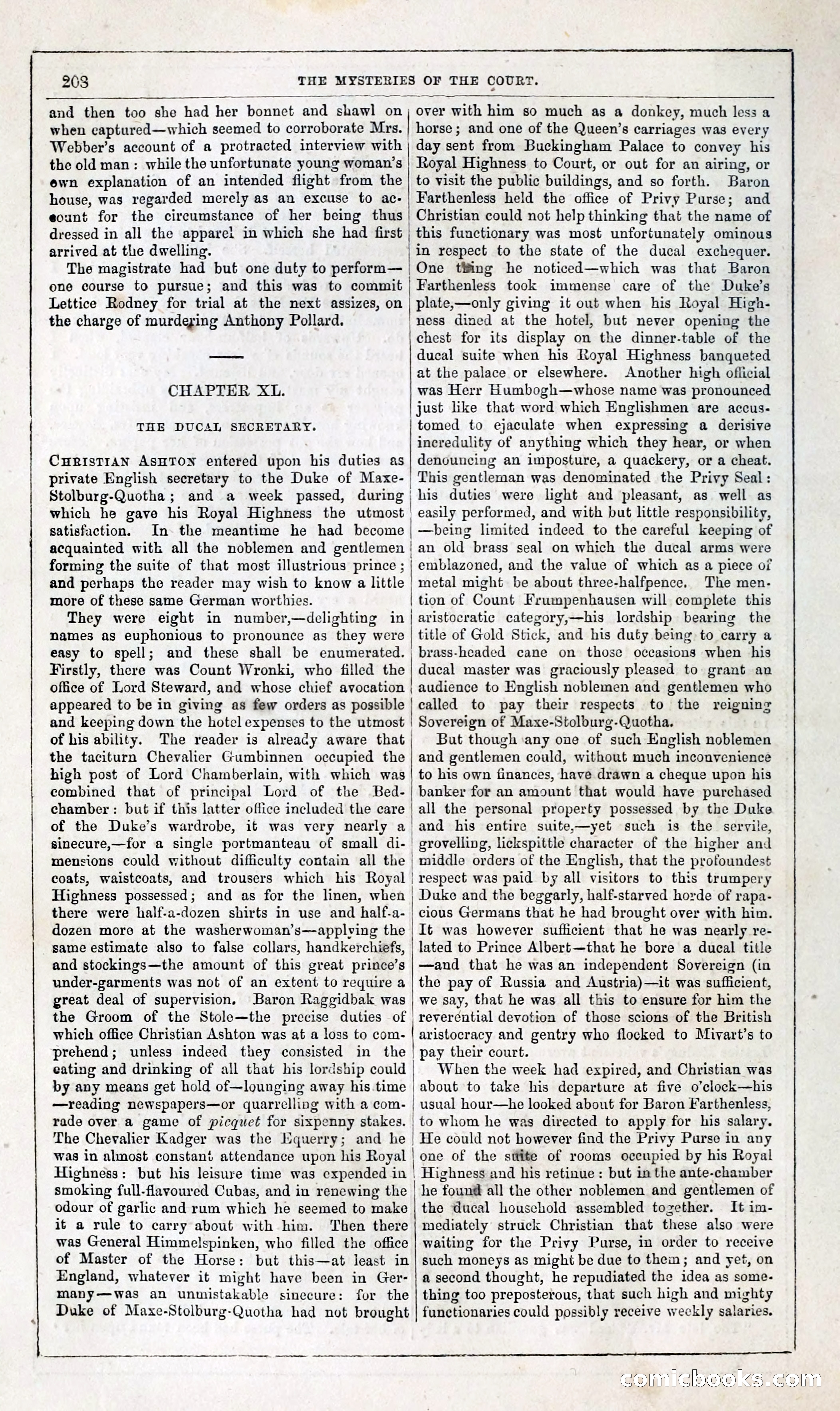
A restored page from Penny Dreadfuls, 1849. Page through the whole issue in the reader above.
📄 Transcribed text from this page (OCR, searchable)
Machine-transcribed from the original scan — historical spelling and the odd misread are preserved.
* me ee a ee ee a ee 2038 and then too she had her bonnet and shawl on when captured—which seemed to corroborate Mrs. Webber’s account of a protracted interview with the old man: while the unfortunate young woman's ewn explanation of an intended flight from the house, was regarded merely as an excuse to ac- eount for the circumstance of her being thus dressed in all the apparel in which she had first arrived at the dwelling. The magistrate had but one duty to perform— one course to pursue; and this was to commit Lettice Rodney for trial at the next agsizes, 23] the charge of murdeying Anthony Pollard. CHAPTER XL. THE DUCAL SECRETARY. THE MYSTERIES OF THE COURT. over with him so much as a donkey, much less a horse ; and one of the Queen’s carriages was every day sent from Buckingham Palace to convey his Royal Highness to Court, or out for an airing, or to visit the public buildings, and so forth. Baron Farthenless held the office of Privy Purse; and Christian could not help thinking that the name of this functionary was most unfortunately ominous in respect to the state of the ducal exchequer. One t®ing he noticed—which was that Baron | Farthenless took immense care of the Duke’s plate,—only giving it out when his Royal High- ness dined at the hotel, but never openiug the chest for its display on the dinner-table of the ducal suite when his Royal Highness banqueted at the palace or elsewhere. Another high oflicial was Herr Humbogh—whose name was pronounced just like that word which Englishmen are accus- tomed to ejaculate when expressing a derisive incredulity of anything which they hear, or when CurisTrIAN ASHTON entered upon his duties as | denouncing an imposture, a quackery, or a cheat. private English secretary to the Duke of Maxe- | This gentleman was denominated the Privy Seal: Stolburg-Quotha ; and a week passed, during | which he gave his Royal Highness the utmost | satisfaction. In the meantime he had become acquainted witk all the noblemen and gentlemen | forming the suite of that most illustrious prince ; and perhaps the reader may wish to know a little more of these same German worthies. They were eight in number,—delighting in names as euphonious to pronounce as they were easy to spell; and these shall be enumerated. Firstly, there was Count Wronki, who filled the office of Lord Steward, and whose chief avocation | appeared to be in giving as few orders as possible and keeping down the hotel expenses to the utmost of his ability. The reader is already aware that | the taciturn Chevalier Gumbinnen occupied the high post of Lord Chamberlain, with which was combined that of principal Lord of the Bed- chamber: but if this latter office included the care of the Duke’s wardrobe, it was very nearly a'! his duties were light and pleasant, as well as easily performed, and with but little responsibility, —being limited indeed to the careful keeping of an old brass seal on which the ducal arms were emblazoned, and the value of which as a piece of metal might be about three-halfpence. The men- tion of Count Frumpenhausen will complete this aristocratic category,—his lordship bearing the title of Gold Stick, and his duty being to carry a brass-headed cane on those occasions when his ducal master was graciously pleased to grant an audience to English noblemen and gentlemen who called to pay their respects to the reigning Sovereign of Maxe-Stolburg-Quotha. But though ‘any one of such English noblemen and gentlemen could, without much inconvenience to his own finances, have drawn a cheque upon his banker for an amount that would have purchased all the personal property possessed by the Duke and his entire suite,—yet such is the servile, sinecure,—for a single portmanteau of small di-! grovelling, lickspittle character of the higher and mensions could without difficulty contain all the ; middle orders of the English, that the profoundest coats, waistcoats, and trousers which his Royal | respect was paid by all visitors to this trumpery Highness possessed; and as for the linen, when | there were half-a-dozen shirts in use and half-a- dozen more at the washerwoman’s—applving the same estimate also to false collars, handkerchiefs, and stockings—the amount of this great prince’s under-garments was not of an extent to require a great deal of supervision. Baron Raggidbak was the Groom of the Stole—the precise duties of which office Christian Ashton was at a loss to com- | prehend; unless indeed they consisted in the eating and drinking of all that his lordship could | Duke and the beggarly, half-starved horde of rapa- cious Germans that he had brought over with him. It was however sufficient that he was nearly re- lated to Prince Albert—that he bore a ducal title —and that he was an independent Sovereign (in the pay of Russia and Austria)—it was sufficient, we say, that he was all this to ensure for him the reverential devotion of those scions of the British aristocracy and gentry who flocked to Mivart’s to pay their court. When the week had expired, and Christian was by any means get hold of—lounging away his time | about to take his departure at five o’clock—his —reading newspapers—or quarrelling with a com- | usual hour—he looked about for Baron Farthenless, rade over a game of picguet for sixpenny stakes. | to whom he was directed to apply for his salary. The Chevalier Kadger was the Equerry; and he | He could not however find the Privy Purse in any was in almost constant attendance upon his Royal | Highness: but his leisure time was expended in | smoking full-flavoured Cubas, and in renewing the odour of garlic and rum which he seemed to make it a rule to carry about with him. Then there was General Himmelspinken, who filled the office of Master of the Horse: but this—at least in England, whatever it might have been in Ger- many—was an unmistakable sinecure: for the Duke of Maxe-Stolburg-Quotha had not brought A EE EE EE one of the sttite of rooms occupied by his Royal Highness and his retinue: but in the ante-chamber he fount all the other noblemen and gentlemen of the ducal household assembled together. It im- mediately struck Christian that these also were waiting for the Privy Purse, m order to receive such moneys as might be due to them; and yet, on a second thought, he repudiated the idea as some- thing too preposterous, that such high and mighty functionaries could possibly receive weckly salaries. (ORNICLOOOKS (E(©)