
Penny Dreadfuls, 1849 · page 22 of 394
The Mysteries of the Court of London — page 22: what you’re looking at
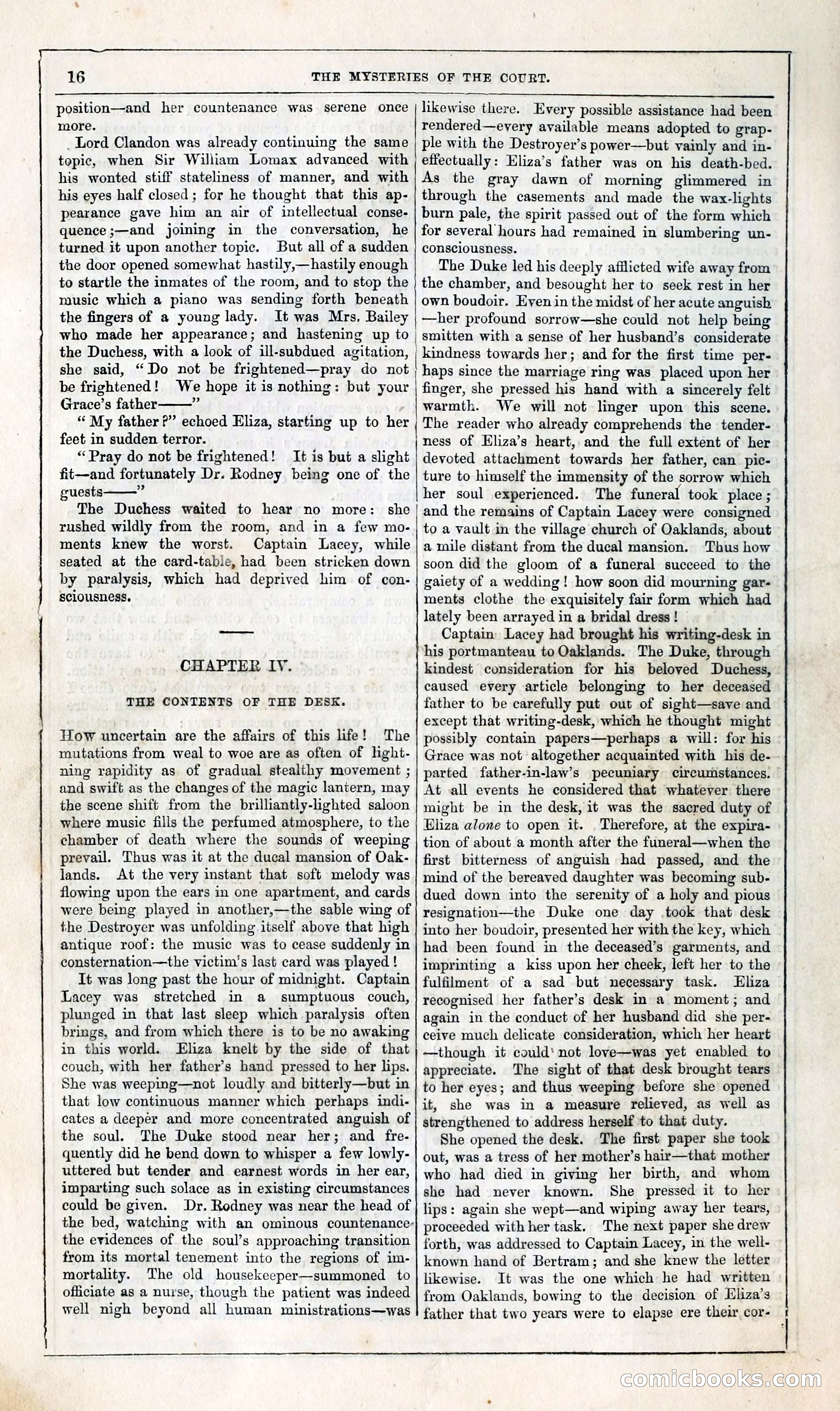
A restored page from Penny Dreadfuls, 1849. Page through the whole issue in the reader above.
📄 Transcribed text from this page (OCR, searchable)
Machine-transcribed from the original scan — historical spelling and the odd misread are preserved.
16 THE MYSTERIES OF THE COURT. ohana rence earns ca eccc ncn cecre nnn eccnnc anna ence Tr ae or EE ———Eee position—and her countenance was serene once | likewise there. Every possible assistance had been more. Lord Clandon was already continuing the same topic, when Sir William Lomax advanced with his wonted stiff stateliness of manner, and with his eyes half closed; for he thought that this ap- pearance gave him an air of intellectual conse- quence ;—and joining in the conversation, he turned it upon another topic. But all of a sudden the door opened somewhat hastily,—hastily enough to startle the inmates of the room, and to stop the music which a piano was sending forth beneath the fingers of a young lady. It was Mrs, Bailey who made her appearance; and hastening up to | the Duchess, with a look of ill-subdued agitation, she said, “Do not be frightened—pray do not be frightened! We hope it is nothing: but your Grace’s father ¥ “« My father ?” echoed Eliza, starting up to her feet in sudden terror. “Pray do not be frightened! It is but a slight fit—and fortunately Dr. Rodney being one of the guests £ The Duchess waited to hear no more: she rushed wildly from the room, and in a few mo- ments knew the worst. Captain Lacey, while seated at the card-table, had been stricken down by paralysis, which had deprived him of con- sciousness. CHAPTER IY. THE CONTENTS OF THE DESK. Wow uncertain are the affairs of this life! The mutations from weal to woe are as often of hght- ning rapidity as of gradual stealthy movement ; and swift as the changes of the magic lantern, may the scene shift from the brilliantly-ighted saloon where music fills the perfumed atmosphere, to the chamber of death where the sounds of weeping prevail. Thus was it at the ducal mansion of Oak- lands. At the very instant that soft melody was flowing upon the ears in one apartment, and cards were being played in another,—the sable wing of the Destroyer was unfolding itself above that high antique roof: the music was to cease suddenly in consternation—the victim's last card was played ! It was long past the hour of midnight. Captain Lacey was stretched in a sumptuous couch, plunged in that last sleep which paralysis often brings, and from which there is to be no awaking in this world. Eliza knelt by the side of that couch, with her father’s hand pressed to her lips. She was weeping—not loudly and bitterly—but in that low continuous manner which perhaps indi- cates a deeper and more concentrated anguish of the soul. The Duke stood near her; and fre- quently did he bend down to whisper a few lowly- uttered but tender and earnest words in her ear, imparting such solace as in existing circumstances could be given. Dr. Rodney was near the head of the bed, watching with an ominous countenance- the evidences of the soul’s approaching transition from its mortal tenement into the regions of im- mortality. The old housekeeper—summoned to officiate as a nurse, though the patient was indeed well nigh beyond all human ministrations—was rendered—every available means adopted to grap- ple with the Destroyer’s power—but vainly and in- effectually: Eliza’s father was on his death-bed. As the gray dawn of morning glimmered in through the casements and made the wax-lights burn pale, the spirit passed out of the form which for several hours had remained in slumbering un- consciousness. The Duke led his deeply afflicted wife away from the chamber, and besought her to seek rest in her own boudoir. Even in the midst of her acute anguish —her profound sorrow—she could not help being smitten with a sense of her husband’s considerate kindness towards her; and for the first time per- haps since the marriage ring was placed upon her finger, she pressed his hand with a sincerely felt warmth. We will not linger upon this scene. The reader who already comprehends the tender- ness of Eliza’s heart, and the full extent of her devoted attachment towards her father, can _pic- ture to himself the immensity of the sorrow which her soul experienced. The funeral took place; and the remains of Captain Lacey were consigned to a vault in the village church of Oaklands, about a mile distant from the ducal mansion. Thus how soon did the gloom of a funeral succeed to the gaiety of a wedding! how soon did mourning gar- ments clothe the exquisitely fair form which had lately been arrayed in a bridal dress ! Captain Lacey had brought his writing-desk in his portmanteau to Oaklands. The Duke, through kindest consideration for his beloyed Duchess, caused every article belonging to her deceased father to be carefully put out of sight—save and except that writing-desk, which he thought might possibly contain papers—perhaps a will: for his Grace was not altogether acquainted with his de- parted father-in-law’s pecuniary circumstances. At all events he considered that whatever there might be in the desk, it was the sacred duty of Eliza alone to open it. Therefore, at the expira- tion of about a month after the funeral—when the first bitterness of anguish had passed, and the mind of the bereaved daughter was becoming sub- dued down into the serenity of a holy and pious resignation—the Duke one day .took that desk into her boudoir, presented her with the key, which had been found in the deceased’s garments, and imprinting a kiss upon her cheek, left her to the fulfilment of a sad but necessary task. Eliza recognised her father’s desk in a moment; and again in the conduct of her husband did she per- ceive much delicate consideration, which her heart —though it could’ not love—was yet enabled to appreciate. The sight of that desk brought tears to her eyes; and thus weeping before she opened it, she was in a measure relieved, as well as strengthened to address herself to that duty. She opened the desk. The first paper she took out, was a tress of her mother’s hair—that mother who had died in giving her birth, and whom she had never known. She pressed it to her lips: again she wept—and wiping away her tears, proceeded with her task. The next paper she drew forth, was addressed to Captain Lacey, in the well- known hand of Bertram; and she knew the letter likewise. It was the one which he had written from Oaklands, bowing to the decision of Eliza’s father that two years were to elapse ere thei cor- 1 E® )OO S (C()