
Penny Dreadfuls, 1849 · page 227 of 394
The Mysteries of the Court of London — page 227: what you’re looking at
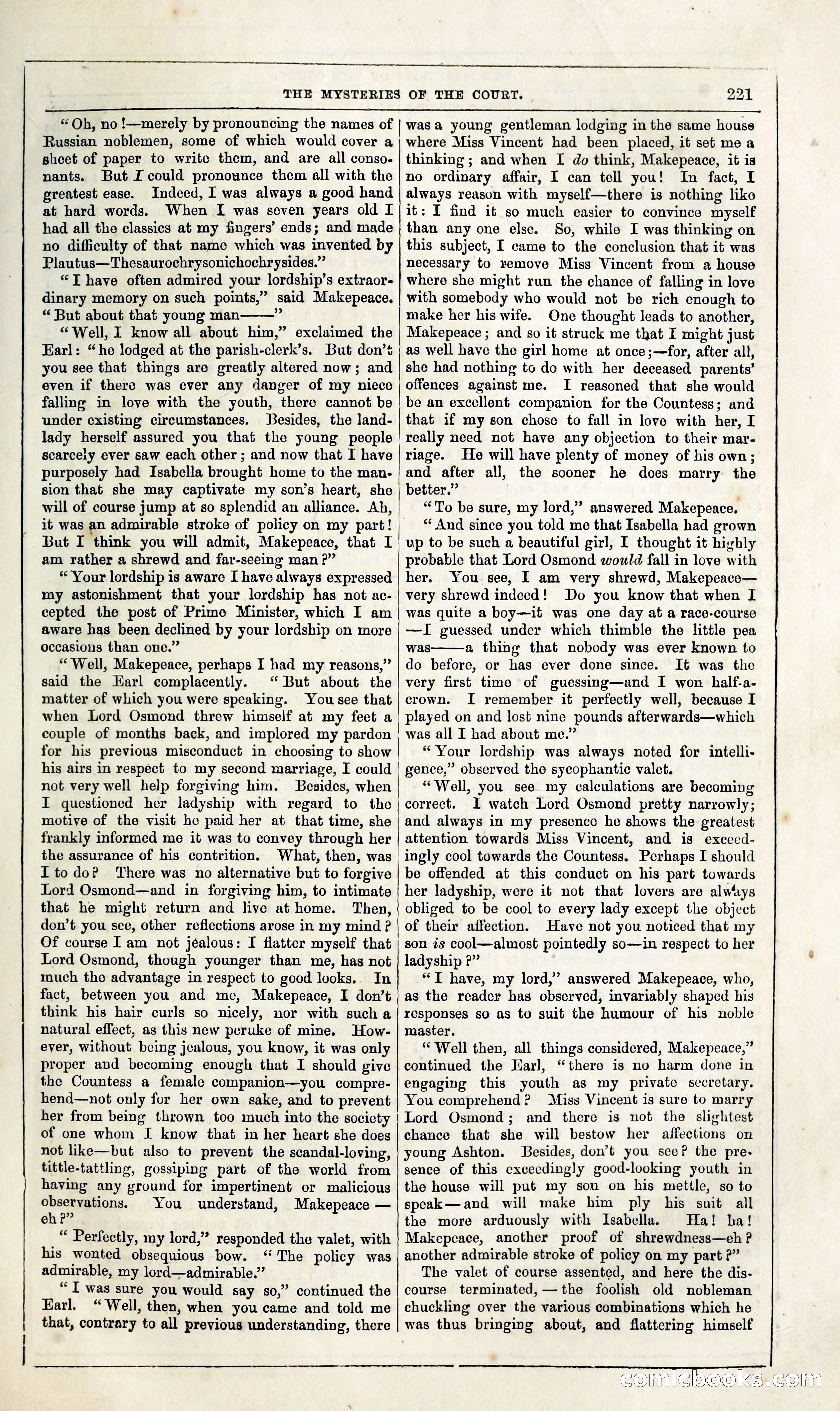
A restored page from Penny Dreadfuls, 1849. Page through the whole issue in the reader above.
📄 Transcribed text from this page (OCR, searchable)
Machine-transcribed from the original scan — historical spelling and the odd misread are preserved.
| THE MYSTERIES OF THE COURT. 221 Nee “Oh, no !—merely by pronouncing the names of Russian noblemen, some of which would cover a sheet of paper to write them, and are all conso- nants. But I could pronounce them all with the greatest ease. Indeed, I was always a good hand at hard words. When I was seven years old I had all the classics at my fingers’ ends; and made no difficulty of that name which was invented by Plautus—Thesaurochrysonichochrysides.” *T have often admired your lordship’s extraor- dinary memory on such points,” said Makepeace. “But about that young man “Well, I know all about him,” exclaimed the Earl]: “he lodged at the parish-clerk’s. But don’t you see that things are greatly altered now; and even if there was ever any danger of my niece falling in love with the youth, there cannot be under existing circumstances. JBesides, the land- lady herself assured you that the young people scarcely ever saw each other ; and now that I have purposely had Isabella brought home to the man- sion that she may captivate my son’s heart, she will of course jump at so splendid an alliance. Ah, it was an admirable stroke of policy on my part! But I think you will admit, Makepeace, that I am rather a shrewd and far-seeing man ?” ‘Your lordship is aware I have always expressed my astonishment that your lordship has not ac- cepted the post of Prime Minister, which I am aware has been declined by your lordship on more occasions than one.” ““ Well, Makepeace, perhaps I had my reasons,” said the Earl complacently. ‘“ But about the matter of which you were speaking. You see that when Lord Osmond threw himself at my feet a couple of months back, and implored my pardon for his previous misconduct in choosing to show his airs in respect to my second marriage, I could not very well help forgiving him. Besides, when I questioned her ladyship with regard to the motive of the visit he paid her at that time, she frankly informed me it was to convey through her the assurance of his contrition. What, then, was Ito do? There was no alternative but to forgive Lord Osmond—and in forgiving him, to intimate that he might return and live at home. Then, don’t you see, other reflections arose in my mind ? Of course I am not jealous: I flatter myself that Lord Osmond, though younger than me, has not much the advantage in respect to good looks. In fact, between you and me, Makepeace, I don’t think his hair curls so nicely, nor with such a natural effect, as this new peruke of mine. How- ever, without being jealous, you know, it was only proper and becoming enough that I should give the Countess a female companion—you compre- hend—not only for her own sake, and to prevent her from being thrown too much into the society of one whom I know that in her heart she does not like—but also to prevent the scandal-loving, tittle-tattling, gossiping part of the world from having any ground for impertinent or malicious observations. eh P” ) “ Perfectly, my lord,” responded the valet, with his wonted obsequious bow. “The policy was admirable, my lord—admirable.” “I was sure you would say so,” continued the Earl, “Well, then, when you came and told me that, contrary to all previous understanding, there You understand, Makepeace — was a young gentleman lodging in the same house where Miss Vincent had been placed, it set me a thinking ; and when I do think, Makepeace, it is no ordinary affair, I can tell you! In fact, I always reason with myself—there is nothing like it: I find it so much easier to convince myself than any one else. So, while I was thinking on this subject, I came to the conclusion that it was necessary to remove Miss Vincent from a house where she might run the chance of falling in love with somebody who would not be rich enough to make her his wife. One thought leads to another, Makepeace ; and so it struck me that I might just as well have the girl home at once;—for, after all, she had nothing to do with her deceased parents’ offences against me. I reasoned that she would be an excellent companion for the Countess; and that if my son chose to fall in love with her, I really need not have any objection to their mar- riage. He will have plenty of money of his own; and after all, the sooner he does marry the better.” | “To be sure, my lord,” answered Makepeace. “‘ And since you told me that Isabella had grown up to be such a beautiful girl, I thought it highly probable that Lord Osmond would fall in love with her. You see, I am very shrewd, Makepeace— very shrewd indeed! Do you know that when I was quite a boy—it was one day at a race-course —I guessed under which thimble the little pea was a thing that nobody was ever known to do before, or has ever done since. It was the very first time of guessing—and I won half-a- crown. I remember it perfectly well, because I played on and lost nine pounds afterwards—which was all I had about me.” “Your lordship was always noted for intelli- gence,” observed the sycophantic valet. “Well, you see my calculations are becoming correct. I watch Lord Osmond pretty narrowly; and always in my presence he shows the greatest attention towards Miss Vincent, and is exceed- ingly cool towards the Countess. Perhaps I should be offended at this conduct on his part towards her ladyship, were it not that lovers are alwhys obliged to be cool to every lady except the object of their affection. Have not you noticed that my son 7s cool—almost pointedly so—in respect to her ladyship ?” “TI have, my lord,’ answered Makepeace, who, as the reader has observed, invariably shaped his responses so as to suit the humour of his noble master. Well then, all things considered, Makepeace,” continued the Earl, “there ig no harm done in engaging this youth as my private secretary. You comprehend? Miss Vincent is sure to marry Lord Osmond; and there is not the slightest chance that she will bestow her affections on young Ashton. Besides, don’t you see? the pre- sence of this exceedingly good-looking youth in the house will put my son on his mettle, so to speak—and will make him ply his suit all the more arduously with Isabella. Ha! ha! Makepeace, another proof of shrewdness—eh ?P another admirable stroke of policy on my part ?” The valet of course assented, and here the dis- course terminated,—the foolish old nobleman chuckling over the various combinations which he was thus bringing about, and flattering himself (2) nn) (C 0)(0)(0) KS CO)