
Penny Dreadfuls, 1849 · page 238 of 394
The Mysteries of the Court of London — page 238: what you’re looking at
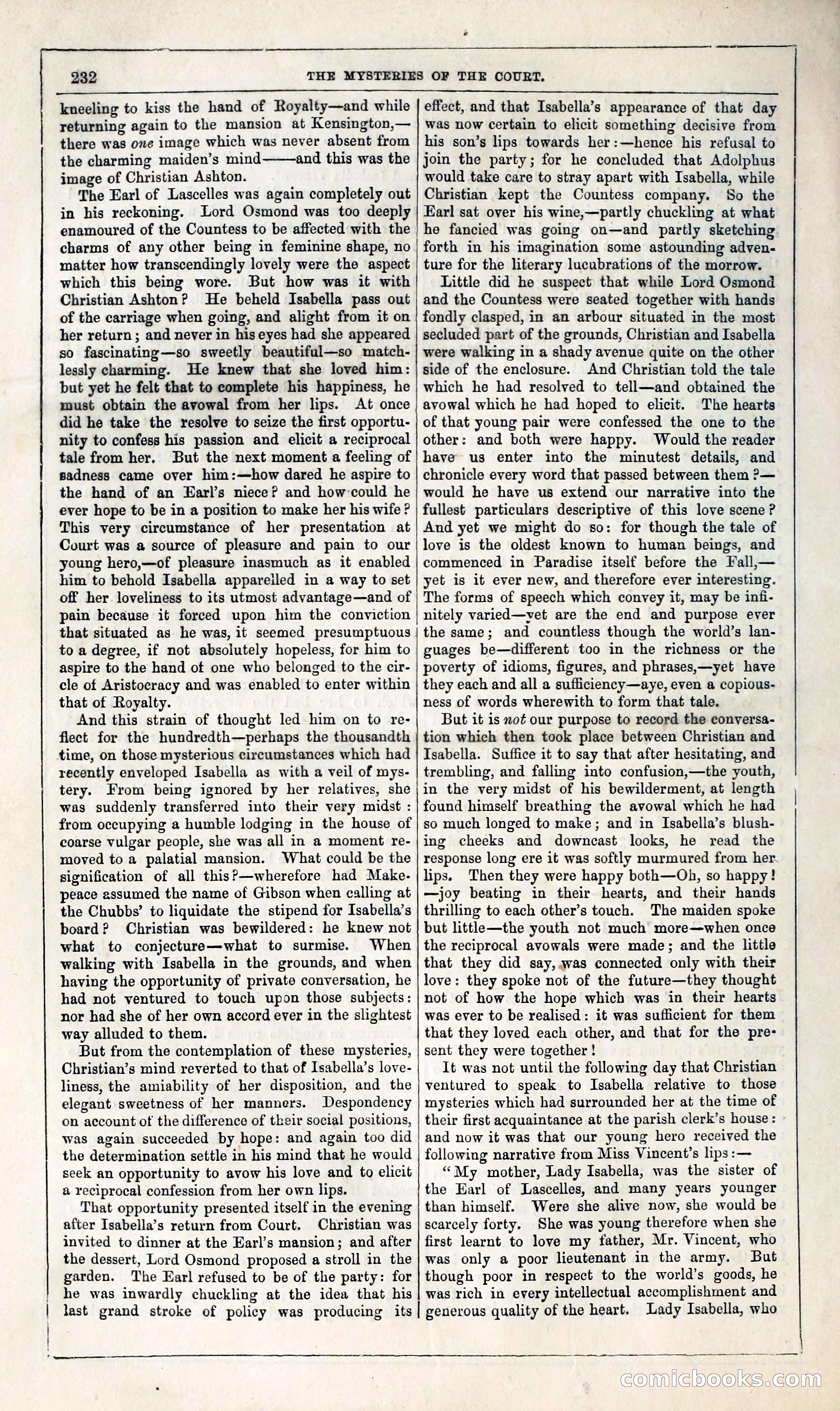
A restored page from Penny Dreadfuls, 1849. Page through the whole issue in the reader above.
📄 Transcribed text from this page (OCR, searchable)
Machine-transcribed from the original scan — historical spelling and the odd misread are preserved.
232 kneeling to kiss the hand of Royalty—and while returning again to the mansion at Kensington,— there was one image which was never absent from the charming maiden’s mind and this was the image of Christian Ashton. The Earl of Lascelles was again completely out in his reckoning. Lord Osmond was too deeply enamoured of the Countess to be affected with the charms of any other being in feminine shape, no matter how transcendingly lovely were the aspect which this being wore. But how was it with Christian Ashton? He beheld Isabella pass out of the carriage when going, and alight from it on her return ; and never in his eyes had she appeared so fascinating—so sweetly beautiful—so match- lessly charming. He knew that she loved him: but yet he felt that to complete his happiness, he must obtain the avowal from her lips. At once did he take the resolve to seize the first opportu- nity to confess his passion and elicit a reciprocal tale from her. But the next moment a feeling of sadness came over him:—how dared he aspire to the hand of an Earl’s niece? and how-could he ever hope to be in a position to make her his wife ? This very circumstance of her presentation at Court was a source of pleasure and pain to our young hero,—of pleasure inasmuch as it enabled him to behold Isabella appareiled in a way to set off her loveliness to its utmost advantage—and of pain because it forced upon him the conviction that situated as he was, it seemed presumptuous to a degree, if not absolutely hopeless, for him to aspire to the hand of one who belonged to the cir- cle of Aristocracy and was enabled to enter within that of Royalty. And this strain of thought led him on to re- fiect for the hundredth—perhaps the thousandth time, on those mysterious circumstances which had recently enveloped Isabella as with a veil of mys- tery. From being ignored by her relatives, she was suddenly transferred into their very midst : from occupying a humble lodging in the house of coarse vulgar people, she was all in a moment re- moved to a palatial mansion. What could be the signification of all this?—wherefore had Make- peace assumed the name of Gibson when calling at the Chubbs’ to liquidate the stipend for Isabella’s board? Christian was bewildered: he knew not what to conjecture—what to surmise. When walking with Isabella in the grounds, and when having the opportunity of private conversation, he had not ventured to touch upon those subjects: nor had she of her own accord ever in the slightest way alluded to them. But from the contemplation of these mysteries, Christian’s mind reverted to that of Isabella’s love- liness, the amiability of her disposition, and the elegant sweetness of her manners. Despondency on account of the difference of tkeir social positions, was again succeeded by hope: and again too did the determination settle in his mind that he would seek an opportunity to avow his love and to elicit a reciprocal confession from her own lips. That opportunity presented itself in the evening after Isabella’s return from Court. Christian was invited to dinner at the Earl’s mansion; and after the dessert, Lord Osmond proposed a stroll in the garden. The Earl refused to be of the party: for he was inwardly chuckling at the idea that his THE MYSTERIES OF THE COURT. effect, and that Isabella’s appearance of that day was now certain to elicit something decisive from his son’s lips towards her:—hence his refusal to join the party; for he concluded that Adolphus would take care to stray apart with Isabella, while Christian kept the Countess company. ‘So the Earl sat over his wine,—partly chuckling at what he fancied was going on—and partly sketching forth in his imagination some astounding adven- ture for the literary lucubrations of the morrow. Little did he suspect that while Lord Osmond and the Countess were seated together with hands fondly clasped, in an arbour situated in the most secluded part of the grounds, Christian and Isabella were walking in a shady avenue quite on the other side of the enclosure. And Christian told the tale which he had resolved to tell—and obtained the avowal which he had hoped to elicit. The hearts of that young pair were confessed the one to the other: and both were happy. Would the reader have us enter into the minutest details, and chronicle every word that passed between them ?— would he have us extend our narrative into the fullest particulars descriptive of this love scene ? And yet we might do so: for though the tale of love is the oldest known to human beings, and commenced in Paradise itself before the Fall,— yet is it ever new, and therefore ever interesting. The forms of speech which convey it, may be infi- nitely variled—vet are the end and purpose ever the same; and countless though the world’s lan- guages be—different too in the richness or the poverty of idioms, figures, and phrases,—yet have they each and all a sufficiency—aye, even a copious- ness of words wherewith to form that tale. But it is not our purpose to record the conversa- tion which then took place between Christian and Isabella. Suffice it to say that after hesitating, and trembling, and falling into confusion,—the youth, in the very midst of his bewilderment, at length found himself breathing the avowal which he had so much longed to make; and in Isabella’s blush- ing cheeks and downcast looks, he read the response long ere 1t was softly murmured from her lips. Then they were happy both—Oh, so happy! —joy beating in their hearts, and their hands thrilling to each other’s touch. The maiden spoke but littlek—the youth not much more—when once the reciprocal avowals were made; and the little that they did say,.was connected only with their love: they spoke not of the future—they thought not of how the hope which was in their hearts was ever to be realised: it was sufficient for them that they loved each other, and that for the pre- sent they were together ! It was not until the following day that Christian ventured to speak to Isabella relative to those mysteries which had surrounded her at the time of their first acquaintance at the parish clerk’s house: and now it was that our young hero received the following narrative from Miss Vincent’s lips :— “My mother, Lady Isabella, was the sister of the Earl of Lascelles, and many years younger than himself. Were she alive now, she would be scarcely forty. She was young therefore when she first learnt to love my father, Mr. Vincent, who was only a poor lieutenant in the army. But though poor in respect to the world’s goods, he was rich in every intellectual accomplishment and | last grand stroke of policy was producing its| generous quality of the heart. Lady Isabella, who | BA OUTS a) | ‘ —————— > + CT YT OOO —- —_———_———— MICLOOC a) <SEiGO (C@)