
Penny Dreadfuls, 1849 · page 260 of 394
The Mysteries of the Court of London — page 260: what you’re looking at
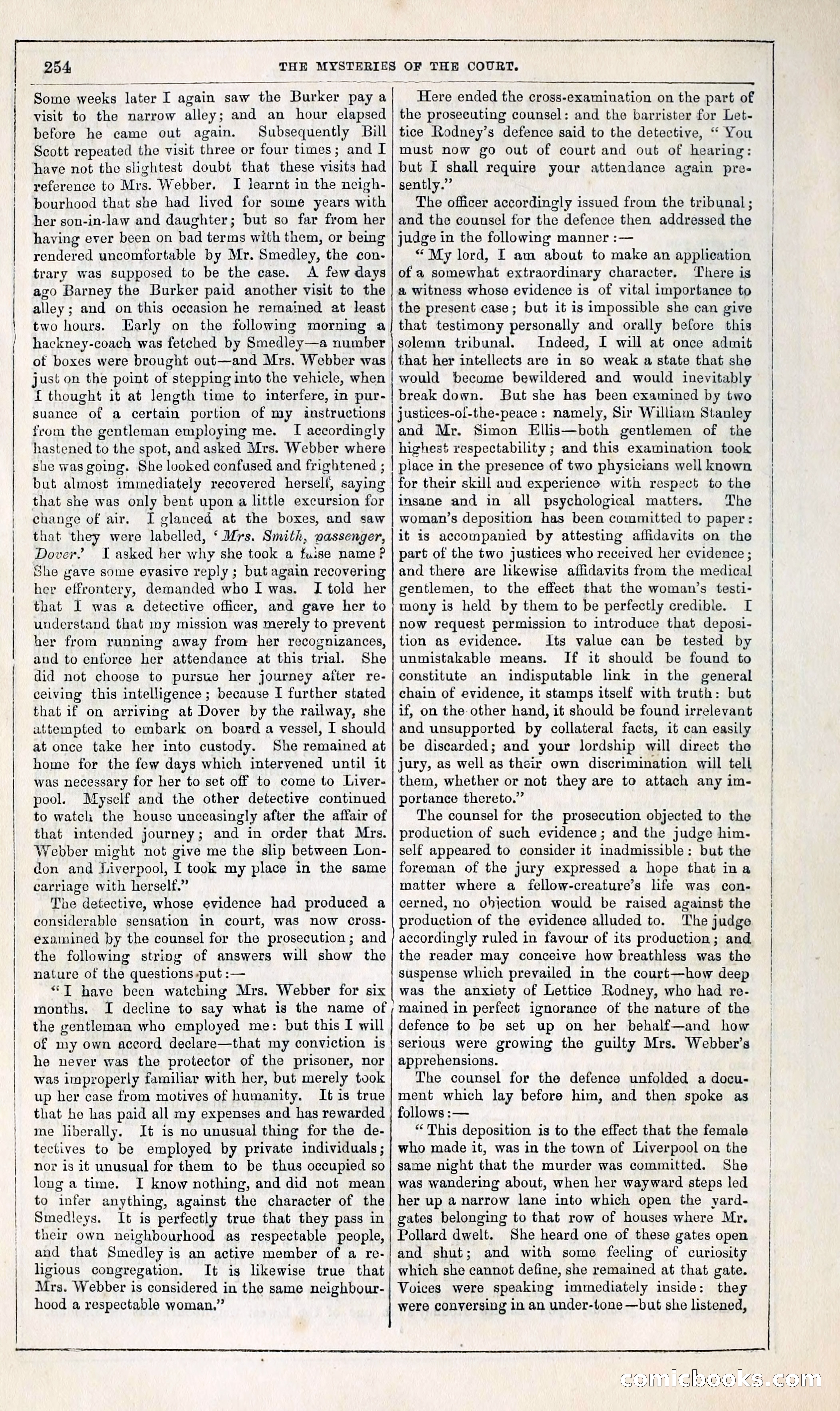
A restored page from Penny Dreadfuls, 1849. Page through the whole issue in the reader above.
📄 Transcribed text from this page (OCR, searchable)
Machine-transcribed from the original scan — historical spelling and the odd misread are preserved.
SS SS 2 ee ne eS a a Some weeks later I again saw the Burker pay a visit to the narrow alley; and an hour elapsed before he came out again. Subsequently Bill Scott repeated the visit three or four times; and I have not the slightest doubt that these visits had reference to Mrs. Webber. I learnt in the neigh- bourhood that she had lived for some years with her son-in-law and daughter; but so far from her having ever been on bad terms with them, or being rendered uncomfortable by Mr. Smedley, the con- trary was supposed to be the case. A few days ago Barney the Burker paid another visit to the alley; and on this occasion he remained at least two hours. arly on the following morning a hackney-coach was fetched by Smedley—a number of boxes were brought out—and Mrs. Webber was just on the point of stepping into the vehicle, when { thought it at length time to imterfere, in pur- suance of a certain portion of my instructions from the gentleman employing me. I accordingly hastened to the spot, and asked Mrs. Webber where she was going. She looked confused and frightened ; but almost immediately recovered herself, saying that she was only bent upon a little excursion for cuange of air. I glanced at the boxes, and saw that they were labelled, ‘ Mrs. Smith, eassenger, Dover’ I asked her why she took a fuise nameP She gave some evasive reply; but again recovering her effrontery, demanded who I was. I told her that I was a detective officer, and gave her to understand that my mission was merely to prevent her from running away from her recognizances, and to enforce her attendance at this trial. She did not choose to pursue her journey aiter re- ceiving this intelligence ; because I further stated that if on arriving at Dover by the railway, she attempted to embark on board a vessel, I should at once take her into custody. She remained at home for the few days which intervened until it was necessary for her to set off to come to Liver- pool. Myself and the other detective continued to watcli the house unceasingly after the affair of that intended journey; and in order that Mrs. Webber might not give me the slip between Lon- don and Liverpool, I took my place in the same carriage with herself.” The detective, whose evidence had produced a considerable sensation in court, was now cross- examined by the counsel for the prosecution; and the following string of answers will show the nature of the questions put :— “T have been watching Mrs. Webber for six months. I decline to say what is the name of the gentleman who employed me: but this I will of my own accord declare—that my conviction is he never was the protector of the prisoner, nor was improperly familiar with her, but merely took up her case from motives of humanity. It is true tliat he has paid all my expenses and has rewarded me liberally. It is no unusual thing for the de- tectives to be employed by private individuals ; nor is it unusual for them to be thus occupied so long a time. I know nothing, and did not mean to infer anything, against the character of the Smedleys. It is perfectly true that they pass in their own neighbourhood as respectable people, and that Smedley is an active member of a re- ligious congregation. It is likewise true that Mrs. Webber is considered in the same neighbour- hood a respectable woman.” | 254 THE MYSTERIES OF THE COURT. Here ended the cross-examination on the part of the prosecuting counsel: and the barrister for Let- tice Rodney’s defence said to the detective, “ You must now go out of court and out of hearing: but I shall require your attendance again pre- sently.” The officer accordingly issued from the tribunal ; and the counsel for the defence then addressed the judge in the following manner :— “ My lord, I am about to make an application of a somewhat extraordinary character. There is a witness whose evidence is of vital importance to the present case; but it is impossible she can give that testimony personally and orally before this solemn tribunal. Indeed, I will at once admit that her intellects are in so weak a state that she would became bewildered and would inevitably break down. But she has been examined by two justices-of-the-peace : namely, Sir William Stanley and Mr. Simon Ellis—both gentlemen of the highest respectability ; and this examination took place in the presence of two physicians well known for their skill and experience with respect to the insane and in all psychological matters. The woman’s deposition has been committed to paper: it is accompanied by attesting affidavits on the part of the two justices who received her evidence ; and there are likewise affidavits from the medical gentlemen, to the effect that the woman’s testi- mony is held by them to be perfectly credible. I now request permission to introduce that deposi- tion as evidence. Its value can be tested by unmistakable means. If it should be found to constitute an indisputable link in the general chain of evidence, it stamps itself with truth: but if, on the-other hand, it should be found irrelevant and unsupported by collateral facts, it can easily be discarded; and your lordship will direct the jury, as well as their own discrimination will tell them, whether or not they are to attach any im- portance thereto.” The counsel for the prosecution objected to the production of such evidence; and the judge him- self appeared to consider it inadmissible: but the foreman of the jury expressed a hope that ina matter where a fellow-creature’s life was con- cerned, no objection would be raised against the production of the evidence alluded to. The judge accordingly ruled in favour of its production; and the reader may conceive how breathless was the suspense which prevailed in the court—how deep was the anxiety of Lettice Rodney, who had re- mained in perfect ignorance of the nature of the defence to be set up on her behalf—and how serious were growing the guilty Mrs. Webber’s apprehensions. The counsel for the defence unfolded a docu- ment which lay before him, and then spoke as follows :— “This deposition is to the effect that the female who made it, was in the town of Liverpool on the same night that the murder was committed. She was wandering about, when her wayward steps led her up a narrow lane into which open the yard- gates belonging to that row of houses where Mr. Pollard dwelt. She heard one of these gates open and shut; and with some feeling of curiosity which sbe cannot define, she remained at that gate. Voices were speaking immediately inside: they were conversing in an under-tone—but she listened, EO JOO S (E(O)