
Penny Dreadfuls, 1849 · page 265 of 394
The Mysteries of the Court of London — page 265: what you’re looking at
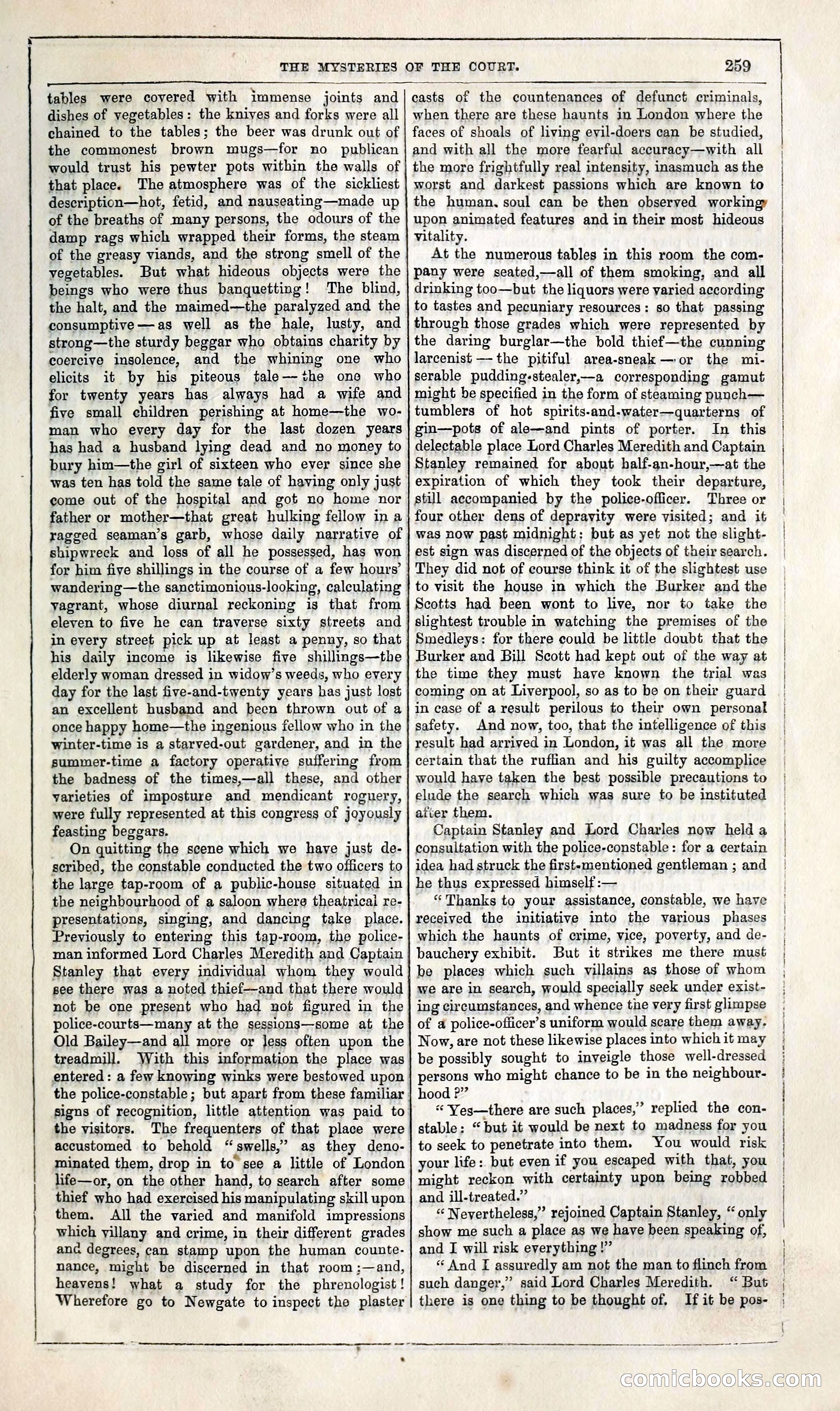
A restored page from Penny Dreadfuls, 1849. Page through the whole issue in the reader above.
📄 Transcribed text from this page (OCR, searchable)
Machine-transcribed from the original scan — historical spelling and the odd misread are preserved.
THE MYSTERIES OF THE COURT. ge ee ll tables were covered with immense joints and dishes of vegetables: the knives and forks were all chained to the tables; the beer was drunk out of the commonest brown mugs—for no publican would trust his pewter pots within the walls of that place. The atmosphere was of the sickliest description—hot, fetid, and nauseating—made up of the breaths of many persons, the odours of the damp rags which wrapped their forms, the steam of the greasy viands, and the strong smell of the vegetables. But what hideous objects were the beings who were thus banquetting! The blind, the halt, and the maimed—the paralyzed and the consumptive—as well as the hale, lusty, and strong—the sturdy beggar who obtains charity by coercive insolence, and the whining one who elicits it by his piteous tale—-the one who for twenty years has always had a wife and five small children perishing at home—the wo- man who every day for the last dozen years has had a husband lying dead and no money to bury him—the girl of sixteen who ever since she was ten has told the same tale of having only just come out of the hospital and got no home nor father or mother—that great hulking fellow in a ragged seaman’s garb, whose daily narrative of shipwreck and loss of all he possessed, has won for him fiye shillings in the course of a few hours’ wandering—the sanctimonious-looking, calculating yagrant, whose diurnal reckoning is that from eleven to five he can traverse sixty streets and in every street pick up at least a penny, so that his daily income is likewise five shillings—the elderly woman dressed in widow’s weeds, who every day for the last five-and-twenty years has just lost an excellent husband and been thrown out of a once happy home—the ingenious fellow who in the winter-time is a starved-out gardener, and in the summer-time a factory operative suffering from the badness of the times,—all these, and other varieties of imposture and mendicant roguery, were fully represented at this congress of joyously feasting beggars. On quitting the scene which we have just de- scribed, the constable conducted the two officers to the large tap-room of a public-house situated in the neighbourhood of a saloon where theatrical re- presentations, singing, and dancing take place. Previously to entering this tap-room, the police- man informed Lord Charles Meredith and Captain Stanley that every individual whom they would see there was a noted thief—and that there would not be one present who had not figured in the police-courts—many at the sessions—some at the Old Bailey—and all more or less often upon the treadmill. With this information the place was entered: a few knowing winks were bestowed upon the police-constable; but apart from these familiar | signs of recognition, little attention was paid to the visitors. The frequenters of that place were accustomed to behold “ swells,’ as they deno- minated them, drop in to see a little of London life—or, on the other hand, to search after some thief who had exercised his manipulating skill upon them. All the varied and manifold impressions which yillany and crime, in their different grades ana degrees, can stamp upon the human counte- nance, might be discerned in that room ;—and, heavens! what a study for the phrenologist! Wherefore go to Newgate to inspect the plaster are 259 — ——_ as casts of the countenances of defunct criminals, when there are these haunts in London where the faces of shoals of living eyil-doers can be studied, and with all the more fearful accuracy—with all the more frightfully real intensity, inasmuch as the worst and darkest passions which are known to the human, soul can be then observed workingy upon animated features and in their most hideous vitality. At the numerous tables in this room the com- pany were seated,—all of them smoking, and all drinking too—but the liquors were varied according to tastes and pecuniary resources: so that passing through those grades which were represented by the daring burglar—the bold thief—the cunning larcenist —-the pitiful area-sneak— or the mi- serable pudding-stealer,—a corresponding gamut might be specified in the form of steaming punch— tumblers of hot spirits-and-water—quarterns of gin—pots of ale—and pints of porter. In this delectable place Lord Charles Meredith and Captain Stanley remained for about half-an-hour,—at the expiration of which they took their departure, still accompanied by the police-officer. Three or four other dens of depravity were visited; and it was now past midnight: but as yet not the slight- est sign was discerned of the objects of their search. They did not of course think it of the slightest use to visit the house in which the Burker and the Scotts had been wont to live, nor to take the slightest trouble in watching the premises of the Smedleys: for there could be little doubt that the Burker and Bill Scott had kept out of the way at the time they must have known the trial was coming on at Liverpool, so as to be on their guard in case of a result perilous to their own personal safety. And now, too, that the intelligence of this result had arrived in London, it was all the more certain that the ruffian and his guilty accomplice would haye taken the best possible precautions to elude the search which was sure to be instituted after them. Captain Stanley and Lord Charles now held a consultation with the police-constable: for a certain idea had struck the firstementioned gentleman ; and he thus expressed himself :— “Thanks to your assistance, constable, we have received the initiative into the various phases which the haunts of crime, vice, poverty, and de- bauchery exhibit. But it strikes me there must be places which such villains as those of whom we are in search, would specially seek under exist- ing circumstances, and whence the very first glimpse of a police-officer’s uniform would scare them away. Now, are not these likewise places into which it may be possibly sought to inyeigle those well-dressed persons who might chance to be in the neighbour- hood ?”” * Yes—there are such places,” replied the con- stable: “but it would be next to madness for you to seek to penetrate into them. You would risk your life: but even if you escaped with that, you might reckon with certaimty upon being robbed and ill-treated.” “ Nevertheless,” rejoined Captain Stanley, “ only show me such a place as we have been speaking of, and I will risk everything !” “ And I assuredly am not the man to flinch from such danger,” said Lord Charles Meredith. “ But there is one thing to be thought of. Ifit be pos- TT LL TT TTT OS re ee ae ew (C(O) 6)(0)(0) im a) S CO)