
Penny Dreadfuls, 1849 · page 29 of 394
The Mysteries of the Court of London — page 29: what you’re looking at
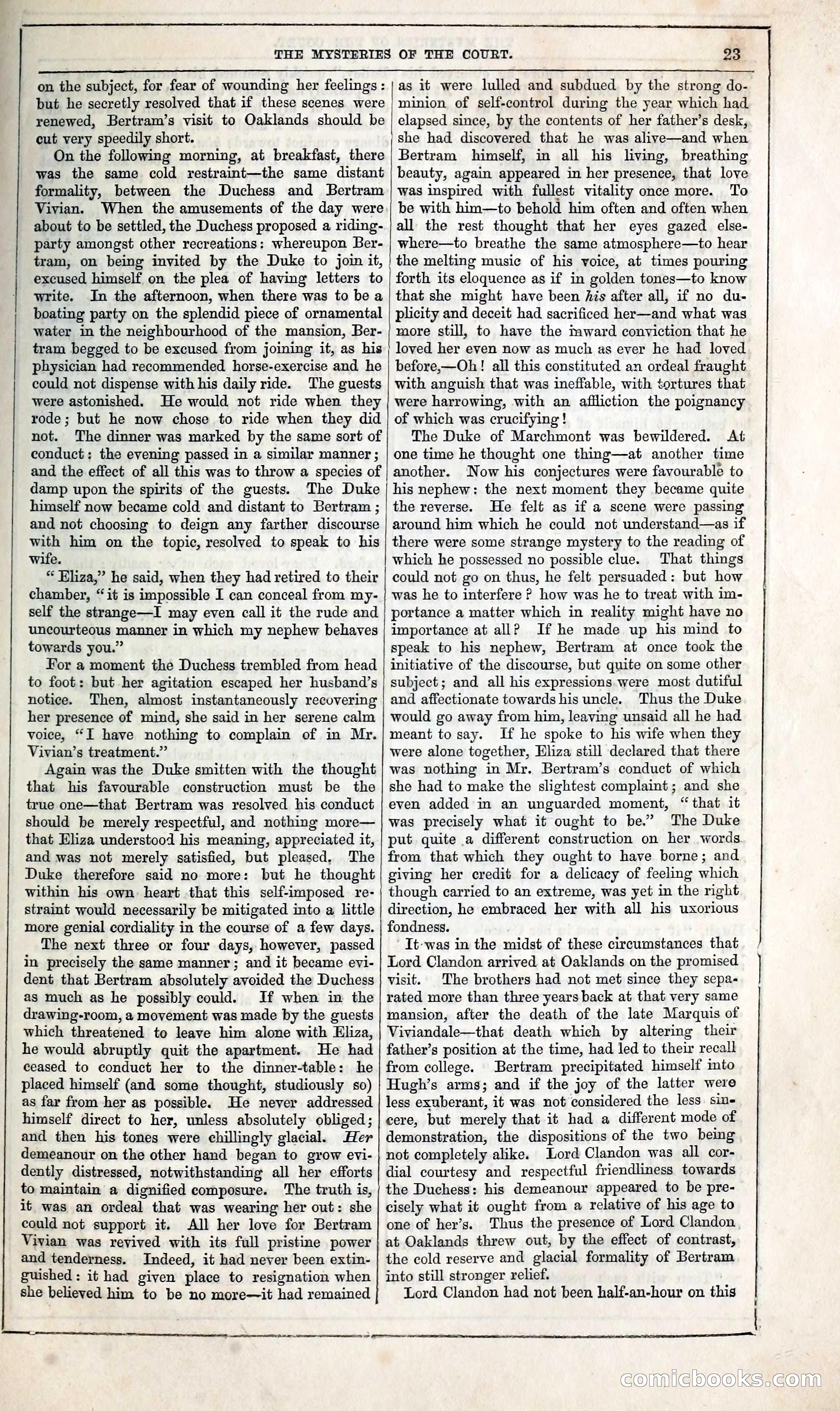
A restored page from Penny Dreadfuls, 1849. Page through the whole issue in the reader above.
📄 Transcribed text from this page (OCR, searchable)
Machine-transcribed from the original scan — historical spelling and the odd misread are preserved.
THE MYSTERIES OF THE COURT. on the subject, for fear of wounding her feelings : but he secretly resolved that if these scenes were renewed, Bertram’s visit to Oaklands should be cut very speedily short. On the following morning, at breakfast, there was the same cold restraint—the same distant formality, between the Duchess and Bertram Vivian. When the amusements of the day were about to be settled, the Duchess proposed a riding- party amongst other recreations: whereupon Ber- tram, on being invited by the Duke to join it, excused himself on the plea of having letters to write. In the afternoon, when there was to be a boating party on the splendid piece of ornamental water in the neighbourhood of the mansion, Ber- tram begged to be excused from joining it, as his physician had recommended horse-exercise and he could not dispense with his daily ride. The guests were astonished. He would not ride when they rode; but he now chose to ride when they did not. The dinner was marked by the same sort of conduct: the evening passed in a similar manner ; and the effect of all this was to throw a species of damp upon the spirits of the guests. The Duke himself now became cold and distant to Bertram ; and not choosing to deign any farther discourse with him on the topic, resolved to speak to his wife. “ Eliza,” he said, when they had retired to their chamber, “it is impossible I can conceal from my- self the strange—I may even call it the rude and uncourteous manner in which my nephew behaves towards you.” For a moment the Duchess trembled from head to foot: but her agitation escaped her husband’s notice. Then, almost instantaneously recovering her presence of mind, she said in her serene calm voice, “I have nothing to complain of in Mr. Vivian’s treatment.” Again was the Duke smitten with the thought that his favourable construction must be the true one—that Bertram was resolved his conduct should be merely respectful, and nothing more— that Eliza understood his meaning, appreciated it, and was not merely satisfied, but pleased. The Duke therefore said no more: but he thought within his own heart that this self-imposed re- straint would necessarily be mitigated into a little more genial cordiality in the course of a few days. The next three or four days, however, passed in precisely the same manner; and it became evi- dent that Bertram absolutely avoided the Duchess as much as he possibly could. If when in the drawing-room, a movement was made by the guests which threatened to leave him alone with Eliza, he would abruptly quit the apartment. He had ceased to conduct her to the dinner-table: he placed himself (and some thought, studiously so) as far from her as possible. He never addressed himself direct to her, unless absolutely obliged; and then his tones were chillingly glacial. Her demeanour on the other hand began to grow evi- dently distressed, notwithstanding all her efforts to maintain a dignified composure. The truth is, it was an ordeal that was wearing her out: she could not support it. All her love for Bertram Vivian was revived with its full pristine power and tenderness. Indeed, it had never been extin- guished : it had given place to resignation when she believed him to be no more—it had remained LL cere SS 23 as it were lulled and subdued by the strong do- minion of self-control during the year which had elapsed since, by the contents of her father’s desk, she had discovered that he was alive—and when Bertram himself, in all his living, breathing beauty, again appeared in her presence, that love was inspired with fullest vitality once more. To be with him—to behold him often and often when all the rest thought that her eyes gazed else- where—to breathe the same atmosphere—to hear the melting music of his voice, at times pouring forth its eloquence as if in golden tones—to know that she might have been his after all, if no du- plicity and deceit had sacrificed her—and what was more still, to have the mward conviction that he loved her even now as much as ever he had loved before,—Oh! all this constituted an ordeal fraught with anguish that was ineffable, with tortures that were harrowing, with an affliction the poignancy of which was crucifying ! The Duke of Marchmont was bewildered. Ati one time he thought one thing—at another time another. Now his conjectures were favourable to his nephew: the next moment they became quite the reverse. He felt as if a scene were passing around him which he could not understand—as if there were some strange mystery to the reading of which he possessed no possible clue. That things could not go on thus, he felt persuaded: but how was he to interfere P how was he to treat with im- portance a matter which in reality might have no importance at allP If he made up his mind to speak to his nephew, Bertram at once took the initiative of the discourse, but quite on some other subject; and all his expressions.were most dutiful and affectionate towards his uncle. Thus the Duke would go away from him, leaving unsaid all he had meant to say. If he spoke to his wife when they were alone together, Eliza still declared that there was nothing in Mr. Bertram’s conduct of which she had to make the slightest complaint; and she even added in an unguarded moment, “that it was precisely what it ought to be.” The Duke put quite a different construction on her words from that which they ought to have borne; and giving her credit for a delicacy of feeling which though carried to an extreme, was yet in the right direction, he embraced her with all his uxorious fondness. It-was in the midst of these circumstances that Lord Clandon arrived at Oaklands on the promised visit. The brothers had not met since they sepa- rated more than three years back at that very same mansion, after the death of the late Marquis of Viviandale—that death which by altering their father’s position at the time, had led to their recall from college. Bertram precipitated himself mto Hugh’s arms; and if the joy of the latter were less exuberant, it was not considered the less sine cere, but merely that it had a different mode of demonstration, the dispositions of the two being not completely alike. Lord Clandon was all cor- dial courtesy and respectful friendliness towards the Duchess: his demeanour appeared to be pre- cisely what it ought from a relative of his age to one of her’s. Thus the presence of Lord Clandon at Oaklands threw out, by the effect of contrast, the cold reserve and glacial formality of Bertram into still stronger relief. Lord Clandon had not been half-an-hour on this 6)(0)(0) (C(O) <S (6)