
Penny Dreadfuls, 1849 · page 300 of 394
The Mysteries of the Court of London — page 300: what you’re looking at
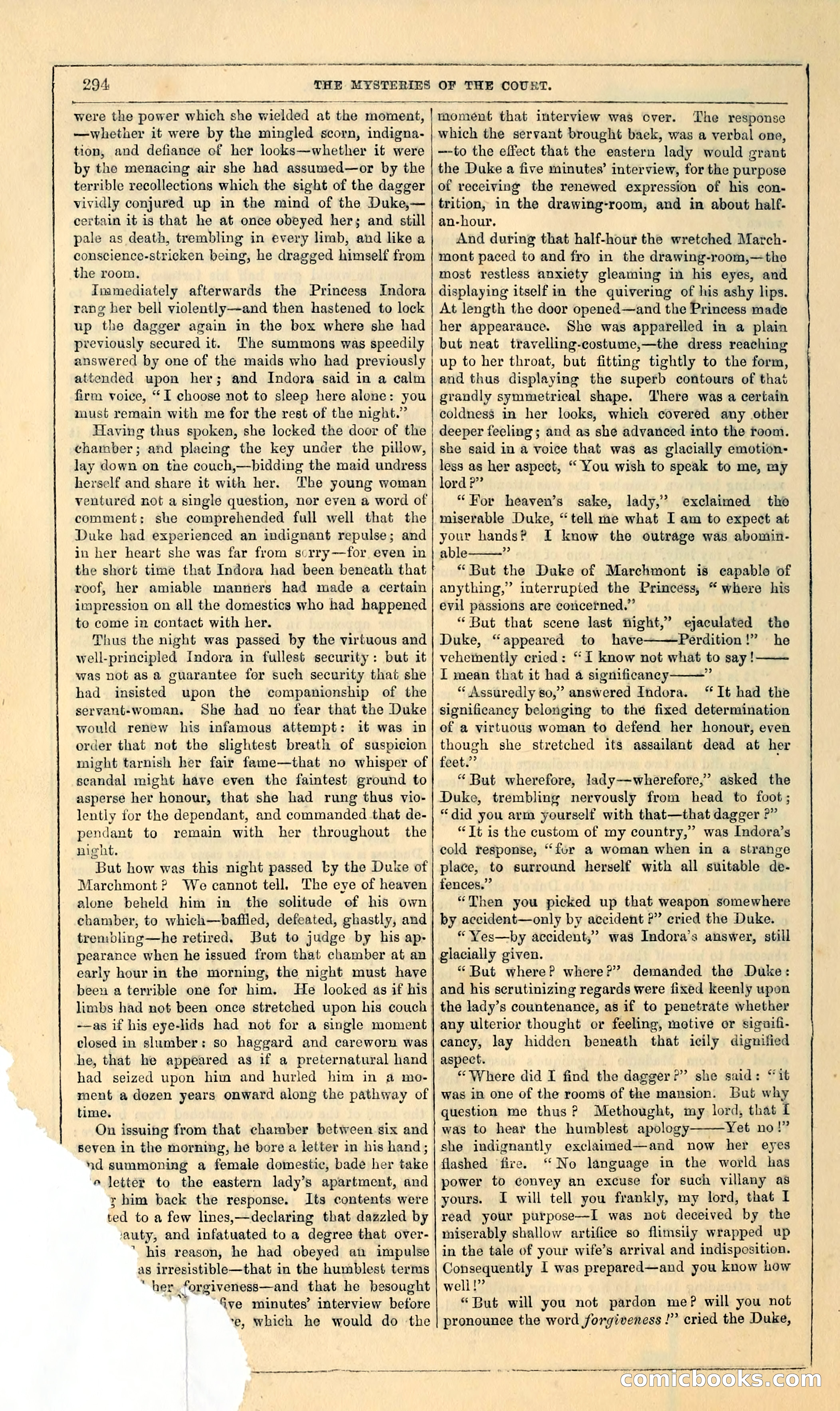
A restored page from Penny Dreadfuls, 1849. Page through the whole issue in the reader above.
📄 Transcribed text from this page (OCR, searchable)
Machine-transcribed from the original scan — historical spelling and the odd misread are preserved.
aS OAS 6 8 es Pe Oe Se mr em THE MYSTERIES To 294, were the power which she wielded at the moment, —whether it were by the mingled scorn, indigna- tion, and defiance of her looks~—whether it were by tho menacing air she had assumed—or by the terrible recollections which the sight of the dagger vividly conjured up in the mind of the Duke,— certain it is that he at once obeyed her; and still pale as death, trembling in every limb, and like a conscience-stricken being, he dragged himself from the room. Immediately afterwards the Princess Indora rang her bell violently—and then hastened to lock up the dagger again in the box where she had previously secured it. The summons was speedily answered by one of the maids who had previously attended upon her; and Indora said in a calm firm voice, “I choose not to sleep here alone: you must remain with me for the rest of the night.” Having thus spoken, she locked the door of the chamber; and placing the key under the pillow, lay down on the couch,—bidding the maid undress herself and share it with her. The young woman ventured not a single question, nor even a word of comment; she comprehended full well that the Duke had experienced an indignant repulse; and in her heart she was far from scrry——for even in the short time that Indora had been beneath that roof, her amiable manners had made a certain impression on all the domestics who had happened to come in contact with her. Thus the night was passed by the virtuous and well-principled Indora in fullest security: but it was not asa guarantee for such security that she had insisted upon the companionship of the servant-woman. She had uo fear that the Duke would renew his infamous attempt: it was in order that not the slightest breath of suspicion might tarnish her fair fame—that no whisper of scandal might have even the faintest ground to asperse her honour, that she had rung thus vio- lently for the dependant, and commanded that de- pendant to remain with her throughout the night. But how was this night passed by the Duke of Marchmont? We cannot tell. The eye of heaven alone beheld him in the solitude of his own chamber, to which—baffled, defeated, ghastly, and trenibling—he retired. But to judge by his ap- pearance when he issued from that chamber at an early hour in the morning, the night must have been a terrible one for him. He looked as if his limbs had not been once stretched upon his couch -—as if his eye-lids had not for a single moment closed in slumber: so haggard and careworn was he, that he appeared as if a preternatural hand had seized upon him and hurled him in a mo- ment a dezen years onward along the pathway of time. On issuing from that chamber between six and seven in the morning, he bore a letter in his hand; nd summoning a female domestic, bade her take e letter to the eastern lady’s apartment, and xr him back the response. Its contents were ted to a few lines,—declaring that dazzled by ‘auty, and infatuated to a degree that over- * his reason, he had obeyed an impulse as irresistible—that in the humblest terms “her. forgiveness—and that he besought y {ve minutes’ interview before *e, which he would do the OF THE COURT. momeént that interview was over. The response which the servant brought back, was a verbal one, --to the effect that the eastern lady would grant the Duke a five minutes’ interview, for the purpose of receiving the renewed expression of his con- trition, in the drawing-room, and in about half- an-hour. And during that half-hour the wretched March- mont paced to and fro in the drawing-room,—the most restless anxiety gleaming in his eyes, and displaying itself in the quivering of his ashy lips. At length the door opened—and the Princess made her appearance. She was apparelled in a plain but neat travelling-costume,—the dress reaching up to her throat, but fitting tightly to the form, and thus displaying the superb contours of that grandly symmetrical shape. ‘There was a certain coldness in her looks, which covered any other deeper feeling ; and as she advanced into the room. she said in a voice that was as glacially emotion- less as her aspect, “ You wish to speak to me, my lord ?” “For heaven’s sake, lady,’ exclaimed tho miserable Duke, “tell me what I am to expect at your hands? I know the outrage was abomin- able ? * But the Duke of Marchmont is eapable of anything,” interrupted the Princess, “ where his evil passions are concerned.” “ But that scene last flight,” ejaculated the Duke, “appeared to have Perdition!” he vehemently cried: “I know not what to say! I mean that it had a significancy " “ Assuredly so,’ answered Indora. “It had the significaney belonging to the fixed determination of a virtuous woman to defend her honour, even though she stretched its assailant dead at her feet.” “ But wherefore, lady—wherefore,” asked the Duke, trembling nervously from head to foot; “did you arm yourself with that—that dagger P” “Tt is the custom of my country,” was Indora’s cold response, “for a woman when in a strange place, to surround herself with all suitable de- fences,” “Then you picked up that weapon somewhere by aceident—only by accident ?” cried the Duke. “ Yes—by accident,’ was Indora’s answer, still glacially given. “ But where? where?’ demanded the Duke: and his scrutinizing regards were fixed keenly upon the lady’s countenance, as if to penetrate whether | any ulterior thought or feeling, motive or sigaifi- cancy, lay hidden beneath that icily dignified aspect. “Where did I find the dagger?” she said: ‘it was in one of the rooms of the mansion. But why question me thus? Methought, my lord, that f was to hear the humblest apology Yet no!” she indignantly exclaimed—and now her eyes flashed fire. ‘No language in the world has power to convey an excuse for such villany as yours. I will tell you frankly, my lord, that I read your purpose—I was not deceived by the miserably shallow artifice so flimsily wrapped up in the tale of your wife’s arrival and indisposition. Consequently I was prepared—and you know how well!” “But will you not pardon me? will you not pronounce the word forgiveness !” cried the Duke, MN CoOmiIcbooksicom