
Penny Dreadfuls, 1849 · page 304 of 394
The Mysteries of the Court of London — page 304: what you’re looking at
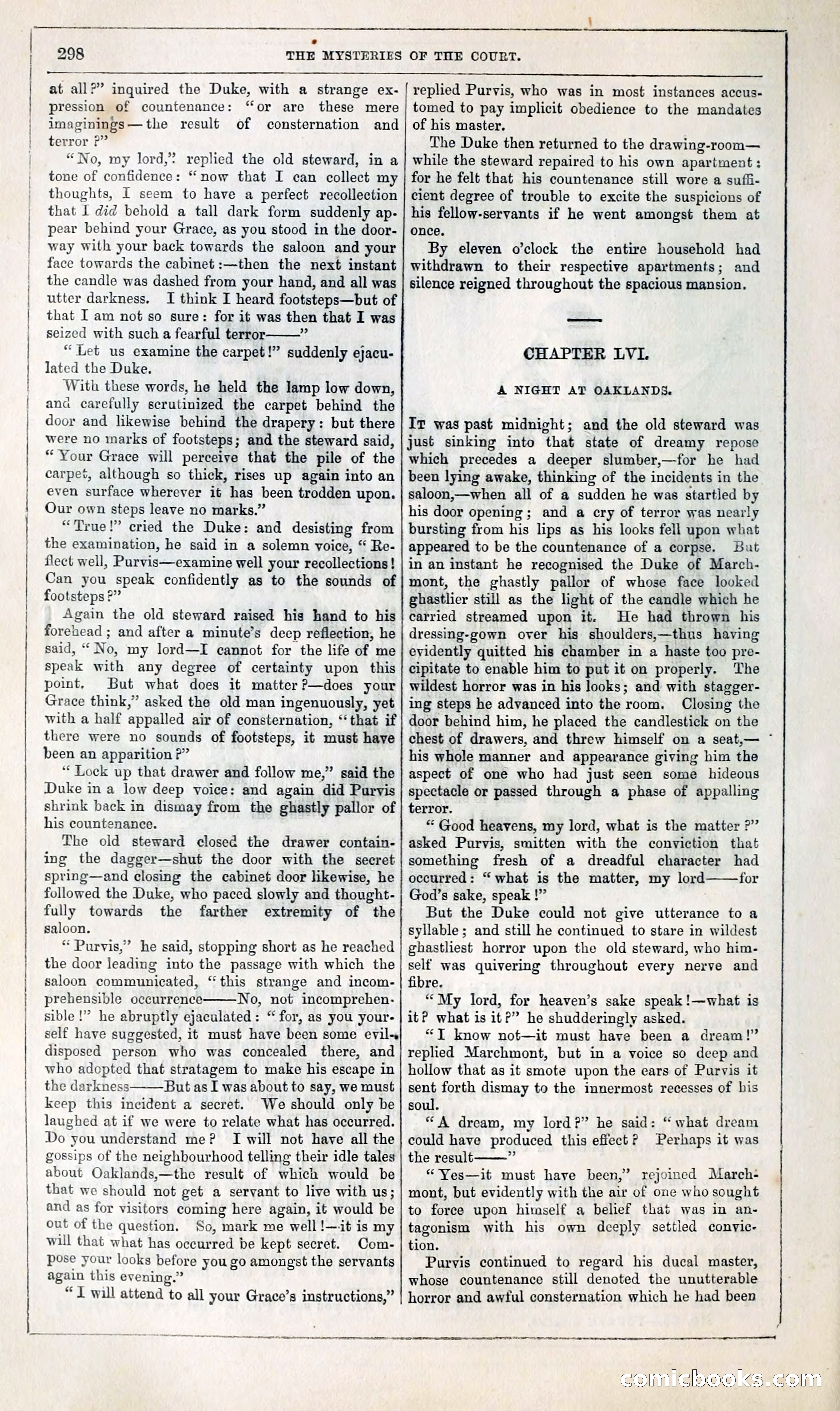
A restored page from Penny Dreadfuls, 1849. Page through the whole issue in the reader above.
📄 Transcribed text from this page (OCR, searchable)
Machine-transcribed from the original scan — historical spelling and the odd misread are preserved.
— ere oe eee LE LALLA LL LAA TT i TC Ct tte itt ttt, itt ee a a ee See eees 298 THE MYSTERIES OF THE COURT. at all?” inquired the Duke, with a strange ex- pression of countenance: “or are these mere imaginings—the result of consternation and terror ?” “No, my lord,’ replied the old steward, in a tone of confidence: “now that I can collect my thoughts, I seem to have a perfect recollection that I did behold a tall dark form suddenly ap- pear behind your Grace, as you stood in the door- way with your back towards the saloon and your face towards the cabinet :—then the next instant the candle was dashed from your hand, and all was utter darkness. I think I heard footsteps—but of that [ am not so sure: for it was then that I was seized with such a fearful terror a “Let us examine the carpet!” suddenly ejacu- lated the Duke. With these words, he held the lamp low down, ana carefully serutinized the carpet behind the door and likewise behind the drapery: but there were no marks of footsteps; and the steward said, “Your Grace will perceive that the pile of the carpet, although so thick, rises up again into an even surface wherever it has been trodden upon. Our own steps leave no marks.” “True!” cried the Duke: and desisting from the examination, he said in a solemn yoice, “ Re- flect well, Purvis—examine well your recollections! Can you speak confidently as to the sounds of footsteps ?” Again the old steward raised his hand to his forehead ; and after a minute’s deep reflection, he said, “No, my lord—I cannot for the life of me speak with any degree of certainty upon this point, But what does it matter ?—does your Grace think,” asked the old man ingenuously, yet with a half appalled air of consternation, “that if there were no sounds of footsteps, it must haye been an apparition P” ‘Lock up that drawer and follow me,” said the Duke in a low deep voice: and again did Purvis shrink back in dismay from the ghastly pallor of his countenance. The old steward closed the drawer contain- ing the dagger—shut the door with the secret spring—and closing the cabinet door likewise, he followed the Duke, who paced slowly and thought- fully towards the farther extremity of the saloon. “ Purvis,’ he said, stopping short as he reached the door leading into the passage with which the saloon communicated, “this strange and incom- prehensible occurrence No, not incomprehen- sible !” he abruptly ejaculated: “for, as you your- self have suggested, it must have been some evile-s disposed person who was concealed there, and who adopted that stratagem to make his escape in the darkness But as I was about to say, we must keep this incident a secret. We should only be laughed at if we were to relate what has occurred. Do you understand me? I will not have all the gossips of the neighbourhood telling their idle tales about Oaklands,—the result of which would be that we should not get a servant to live with us; and as for visitors coming here again, it would be out of the question. So, mark me well !—it is my will that what has occurred be kept secret. Com- pose your looks before you go amongst the servants again this evening.” * 1 will attend to all your Grace’s instructions,” A iy enn th i ti eee replied Purvis, who was in most instances accus- tomed to pay implicit obedience to the mandates of his master, The Duke then returned to the drawing-room— while the steward repaired to his own apartment: for he felt that his countenance still wore a sufli- cient degree of trouble to excite the suspicions of his fellow-servants if he went amongst them at once. By eleven o’clock the entire household had withdrawn to their respective apartments; and silence reigned throughout the spacious mansion. CHAPTER LVI. A NIGHT AT OAKLANDS. It was past midnight; and the old steward was just sinking into that state of dreamy repose which precedes a deeper slumber,—for he had been lying awake, thinking of the incidents in the saloon,—when all of a sudden he was startled by his door opening; and a cry of terror was nearly bursting from his lips as his looks fell upon what appeared to be the countenance of a corpse. But in an instant he recognised the Duke of March- mont, the ghastly pallor of whose face looked ghastlier still as the light of the candle which he carried streamed upon it. He had thrown his dressing-gown over his shoulders,—thus having evidently quitted his chamber in a haste too pre- cipitate to enable him to put it on properly. The wildest horror was in his looks; and with stagger- ing steps he advanced into the room. Closing the door behind him, he placed the candlestick on the chest of drawers, and threw himself on a seat,— ~ his whole manner and appearance giving him the aspect of one who had just seen some hideous spectacle or passed through a phase of appalling terror. “Good heavens, my lord, what is the matter ?”’ asked Purvis, smitten with the conviction that something fresh of a dreadful character had occurred: “what is the matter, my lord for God’s sake, speak !” But the Duke could not give utterance to a syllable; and still he continued to stare in wildest ghastliest horror upon the old steward, who him- self was quivering throughout every nerve and fibre. “My lord, for heaven’s sake speak!—what is it? what is it?” he shudderingly asked. “T know not—it must have been a dream!” replied Marchmont, but in a voice so deep and hollow that as it smote upon the ears of Purvis it sent forth dismay to the innermost recesses of bis soul. “A dream, my lord?” he said: “ what dream could have produced this effect? Perhaps it was the result fs “Yes—it must have been,” rejoined March- mont, but evidently with the air of one who sought to force upon himself a belief that was in an- tagonism with his own deeply settled convic- tion. Purvis continued to regard his ducal master, whose countenance still denoted the unutterable horror and awful consternation which he had been (€) NOOLKS (EO)