
Penny Dreadfuls, 1849 · page 306 of 394
The Mysteries of the Court of London — page 306: what you’re looking at
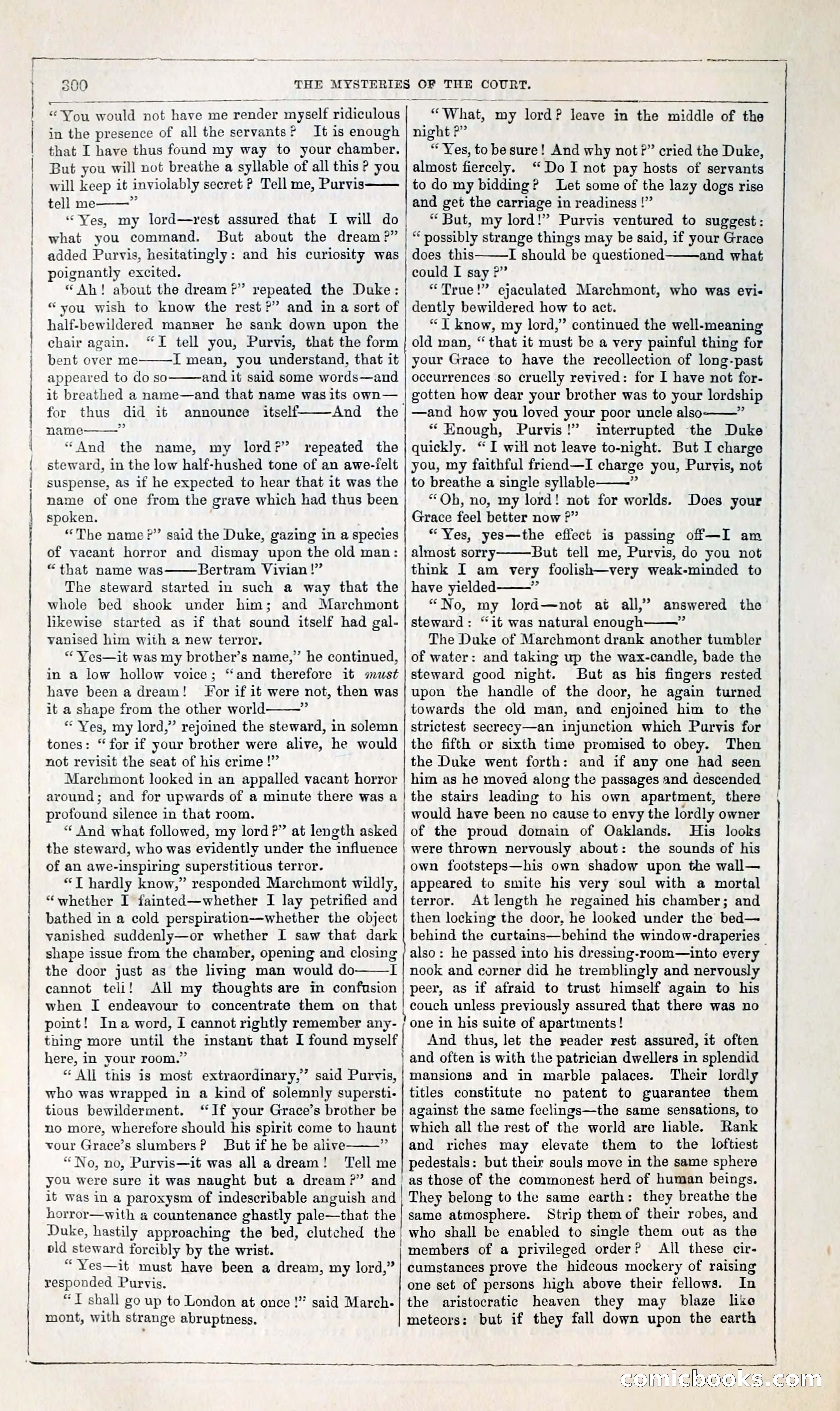
A restored page from Penny Dreadfuls, 1849. Page through the whole issue in the reader above.
📄 Transcribed text from this page (OCR, searchable)
Machine-transcribed from the original scan — historical spelling and the odd misread are preserved.
_—_— ee Ne oe — — 500 > THE MYSTERIES OF THE COURT. “You would not have me render myself ridiculous in the presence of all the servants? It is enough that I have thus found my way to your chamber. But you will not breathe a syllable of all this P you will keep it inviolably secret ? Tell me, Purvis tell me——” “Yes, my lord—rest assured that I will do what you command. But about the dream?” added Purvis, hesitatingly: and his curiosity was poignantly excited. “Ah! about the dream?” repeated the Duke: “you wish to know the rest?” and in a sort of half-bewildered manner he sank down upon the chair again. “I tell you, Purvis, that the form bent over me I mean, you understand, that it appeared to do so and it said some words—and it breathed a name—and that name was its own— for thus did it announce itself name ‘: “And the name, my lord?” repeated the steward, in the low half-hushed tone of an awe-ielt suspense, as if he expected to hear that it was the name of one from the grave which had thus been spoken. “The name?” said the Duke, gazing in a species of vacant horror and dismay upon the old man: “that name was Bertram Vivian!” The steward started in such a way that the whole bed shook under him; and Marchmont likewise started as if that sound itself had gal- vanised him with a new terror. “ Yes—it was my brother’s name,” he continued, in a low hollow voice; “‘and therefore it must have been a dream! For if it were not, then was it a shape from the other world 4 “ Yes, my lord,” rejoined the steward, in solemn tones: “for if your brother were alive, he would not revisit the seat of his crime!’ Marchmont looked in an appalled vacant horror And the —_- ee “What, my lord? leave in the middle of the night P” “Yes, to be sure! And why not P” cried the Duke, almost fiercely. ‘Do TI not pay hosts of servants to do my bidding? Let some of the lazy dogs rise and get the carriage in readiness !” * But, my lord!” Purvis ventured to suggest: * possibly strange things may be said, if your Grace does this I should be questioned and what could I say ?” “True!” ejaculated Marchmont, who was evi- dently bewildered how to act. “T know, my lord,’ continued the well-meaning old man, “ that it must be a very painful thing for your Grace to have the recollection of long-past occurrences so cruelly reyived: for I have not for- gotten how dear your brother was to your lordship —and how you loved your poor uncle also +4 * Enough, Purvis!” interrupted the Duke quickly. “I will not leave to-night. But I charge you, my faithful friend—I charge you, Purvis, not to breathe a single syllable as “Oh, no, my lord! not for worlds. Grace feel better now ?” “Yes, yes—the effect is passing off—I am almost sorry But tell me, Purvis, do you not think I am very foolish—very weak-minded to have yielded 4 “No, my lord—not at all,’ answered the steward: “it was natural enough 4 The Duke of Marchmont drank another tumbler of water: and taking up the wax-candle, bade the steward good night. But as his fingers rested upon the handle of the door, he again turned towards the old man, and enjoined him to the strictest secrecy—an injunction which Purvis for the fifth or sixth time promised to obey. Then the Duke went forth: and if any one had seen him as he moved along the passages and descended Does your around; and for upwards of a minute there was a! the stairs leading to his own apartment, there profound silence in that room. ** And what followed, my lord?” at length asked | of the proud domain of Oaklands. the steward, who was evidently under the influence of an awe-inspiring superstitious terror. “T hardly know,” responded Marchmont wildly, “whether I fainted—whether I lay petrified and bathed in a cold perspiration—whether the object vanished suddenly—or whether I saw that dark shape issue from the chamber, opening and closing the door just as the living man would do I cannot teli! All my thoughts are in confusion when I endeavour to concentrate them on that point! Ina word, I cannot rightly remember any- thing more until the instant that I found myself here, in your room.” “ All this is most extraordinary,” said Purvis, who was wrapped in a kind of solemnly supersti- tious bewilderment. “If your Grace’s brother be no more, wherefore should his spirit come to haunt vour Grace’s slumbersP But if he be alive 4 “No, no, Purvis—it was all adream! Tell me you were sure it was naught but a dream?” and it was in a paroxysm of indescribable anguish and horror—with a countenance ghastly pale—that the Duke, hastily approaching the bed, clutched the old steward forcibly by the wrist. “Yes—it must have been a dream, my lord,” responded Purvis. “{ shall go up to London at once!” said March- mont, with strange abruptness. 3 LO LLL LC tt would have been no cause to envy the lordly owner His looks were thrown nervously about: the sounds of his own footsteps—his own shadow upon the wall— appeared to smite his very soul with a mortal terror. At length he regained his chamber; and then locking the door, he looked under the bed— behind the curtains—behind the window-draperies also: he passed into his dressing-room—into every nook and corner did he tremblingly and nervously peer, as if afraid to trust himself again to his couch unless previously assured that there was no one in his suite of apartments! And thus, let the reader rest assured, it often and often is with the patrician dwellers in splendid mansions and in marble palaces. Their lordly titles constitute no patent to guarantee them against the same feelings—the same sensations, to which all the rest of the world are liable. Rank and riches may elevate them to the loftiest pedestals: but their souls move in the same sphere as those of the commonest herd of human beings. They belong to the same earth: they breathe the same atmosphere. Strip them of their robes, and who shall be enabled to single them out as the members of a privileged order? All these cir- cumstances prove the hideous mockery of raising one set of persons high above their fellows. In the aristocratic heaven they may blaze like meteors: but if they fall down upon the earth CONNICLOOOKS —__———— + ee —— CO