
Penny Dreadfuls, 1849 · page 321 of 394
The Mysteries of the Court of London — page 321: what you’re looking at
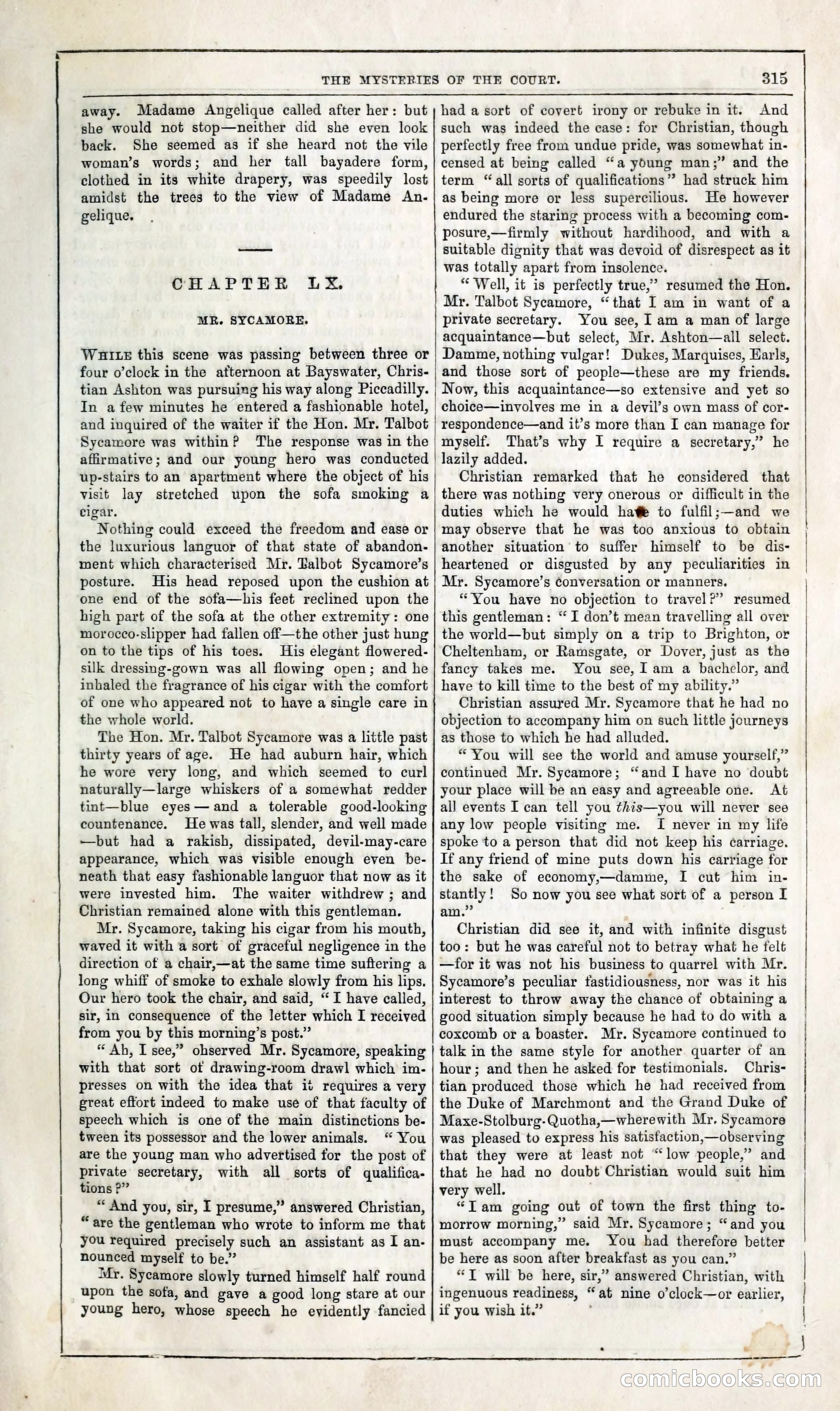
A restored page from Penny Dreadfuls, 1849. Page through the whole issue in the reader above.
📄 Transcribed text from this page (OCR, searchable)
Machine-transcribed from the original scan — historical spelling and the odd misread are preserved.
THE MYSTERIES OF THE COURT. 315 away. Madame Angelique called after her: but she would not stop—neither did she even look back. She seemed as if she heard not the vile woman’s words; and her tall bayadere form, clothed in its white drapery, was speedily lost amidst the trees to the view of Madame An. gelique. CHAPTER UX. MR. SYCAMORE. WHILE this scene was passing between three or four o’clock in the afternoon at Bayswater, Chris- tian Ashton was pursuing his way along Piccadilly. In a few minutes he entered a fashionable hotel, and inquired of the waiter if the Hon. Mr. Talbot Sycamore was within? The response was in the affirmative; and our young hero was conducted up-stairs to an apartment where the object of his visit lay stretched upon the sofa smoking a cigar. Nothing could exceed the freedom and ease or the luxurious languor of that state of abandon- ment which characterised Mr. Talbot Sycamore’s posture. His head reposed upon the cushion at one end of the sofa—his feet reclined upon the high part of the sofa at the other extremity: one morocco-slipper had fallen off—the other just hung on to the tips of his toes. His elegant flowered- silk dressing-gown was all flowing open; and he inhaled the fragrance of his cigar with the comfort of one who appeared not to have a single care in the whole world. The Hon. Mr. Talbot Sycamore was a little past thirty years of age. He had auburn hair, which he wore very long, and which seemed to curl naturally—large whiskers of a somewhat redder tint—blue eyes—and a tolerable good-looking countenance. He was tall, slender, and well made —but had a rakish, dissipated, devil-may-care appearance, which was visible enough even be- neath that easy fashionable languor that now as it were invested him. The waiter withdrew ; and Christian remained alone with this gentleman. Mr. Sycamore, taking his cigar from his mouth, waved it with a sort of graceful negligence in the direction of a chair,—at the same time suftering a long whiff of smoke to exhale slowly from his lips. Our hero took the chair, and said, “I have called, sir, in consequence of the letter which I received from you by this morning’s post.” “ Ah, I see,” ohserved Mr. Sycamore, speaking with that sort ot drawing-room drawl which im- presses on with the idea that it requires a very great effort indeed to make use of that faculty of speech which is one of the main distinctions be- tween its possessor and the lower animals. “ You are the young man who advertised for the post of private secretary, with all sorts of qualifica- tions P” “And you, sir, I presume,” answered Christian, “are the gentleman who wrote to inform me that you required precisely such an assistant as I an- nounced myself to be.” Mr. Sycamore slowly turned himself half round upon the sofa, and gave a good long stare at our young hero, whose speech he evidently fancied had a sort of covert irony or rebuke in it. And such was indeed the case: for Christian, though perfectly free from undue pride, was somewhat in- censed at being called “a young man;” and the term “all sorts of qualifications” had struck him as being more or less supercilious. He however endured the staring process with a becoming com- posure,—firmly without hardihood, and with a suitable dignity that was devoid of disrespect as it was totally apart from insolence. “Well, it is perfectly true,” resumed the Hon. Mr. Talbot Sycamore, “that I am in want of a private secretary. You see, I am a man of large acquaintance—but select, Mr. Ashton—all select. Damme, nothing vulgar! Dukes, Marquises, Earls, and those sort of people—these are my friends. Now, this acquaintance—so extensive and yet so choice—involves me in a devil’s own mass of cor- respondence—and it’s more than I can manage for myself. That’s why I require a secretary,” he lazily added. Christian remarked that he considered that there was nothing very onerous or difficult in the duties which he would hae to fulfil;—and we may observe that he was too anxious to obtain another situation to suffer himself to be dis- heartened or disgusted by any peculiarities in Mr. Sycamore’s conversation or manners. “You have no objection to travel?” resumed this gentleman: “ I don’t mean travelling all over the world—but simply on a trip to Brighton, or Cheltenham, or Ramsgate, or Dover, just as the fancy takes me. You see, I am a bachelor, and have to kill time to the best of my ability.” Christian assured Mr. Sycamore that he had no objection to accompany him on such little journeys as those to which he had alluded. “You will see the world and amuse yourself,” continued Mr. Sycamore; “and I have no doubt your place will be an easy and agreeable one. At all events I can tell you ¢his—you will never see any low people visiting me. I never in my life spoke to a person that did not keep his carriage. If any friend of mine puts down his carriage for the sake of economy,—damme, I cut him in- stantly! So now you see what sort of a person I am.” Christian did see it, and with infinite disgust too: but he was careful not to betray what he felt —for it was not his business to quarrel with Mr. Sycamore’s peculiar fastidiousness, nor was it his interest to throw away the chance of obtaining a good situation simply because he had to do with a coxcomb or a boaster. Mr. Sycamore continued to talk in the same style for another quarter of an hour; and then he asked for testimonials. Chris- tian produced those which he had received from the Duke of Marchmont and the Grand Duke of Maxe-Stolburg-Quotha,—wherewith Mr. Sycamore was pleased to express his satistaction,—observing that they were at least not “low people,” and that he had no doubt Christian would suit him very well. “Tam going out of town the first thing to- morrow morning,” said Mr. Sycamore; “and you must accompany me. You had therefore better be here as soon after breakfast as you can.” “I will be here, sir,” answered Christian, with ingenuous readiness, “at nine o’clock—or earlier, if you wish it.” (C(O) E 6)(0)(0) CO)