
Penny Dreadfuls, 1849 · page 331 of 394
The Mysteries of the Court of London — page 331: what you’re looking at
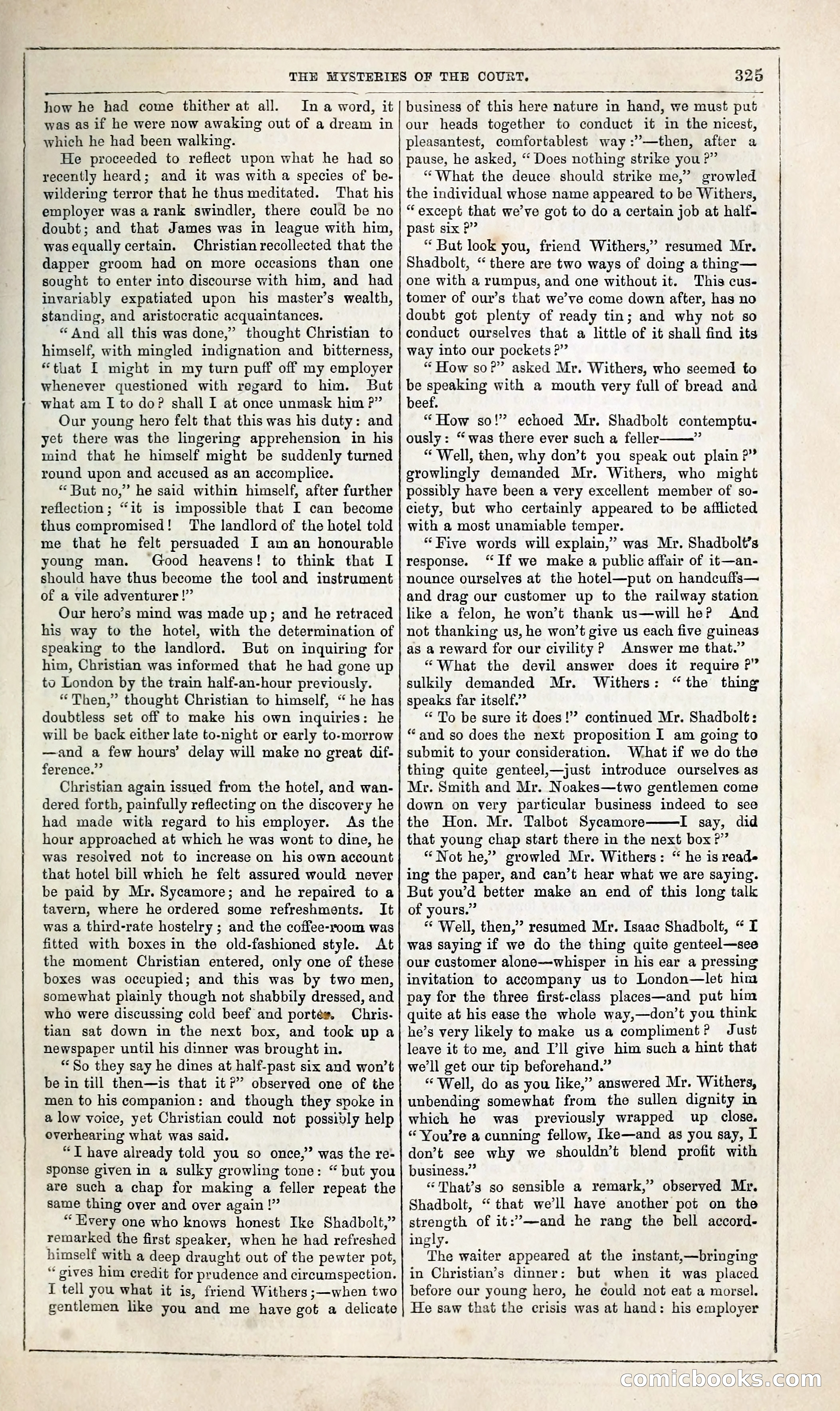
A restored page from Penny Dreadfuls, 1849. Page through the whole issue in the reader above.
📄 Transcribed text from this page (OCR, searchable)
Machine-transcribed from the original scan — historical spelling and the odd misread are preserved.
THE MYSTERIES OF THE COURT. how he had come thither at all. Ina word, it was as if he were now awaking out of a dream in which he had been walking. He proceeded to reflect upon what he had so recently heard; and it was with a species of be- wildering terror that he thus meditated. That his employer was arank swindler, there could be no doubt; and that James was in league with him, was equally certain. Christian recollected that the dapper groom had on more occasions than one sought to enter into discourse with him, and had invariably expatiated upon his master’s wealth, standing, and aristocratic acquaintances. “And all this was done,” thought Christian to himself, with mingled indignation and bitterness, “that [ might in my turn puff off my employer whenever questioned with regard to him. But what am I to do? shall I at once unmask him P” Our young hero felt that this was his duty: and yet there was the lingering apprehension in his mind that he himself might be suddenly turned round upon and accused as an accomplice. “ But no,” he said within himself, after further reflection ; “it is impossible that I can become thus compromised! The landlord of the hotel told me that he felt persuaded I am an honourable young man. Good heavens! to think that I should have thus become the tool and instrument of a vile adventurer !” Our hero’s mind was made up; and he retraced his way to the hotel, with the determination of speaking to the landlord. But on inquiring for him, Christian was informed that he had gone up to London by the train half-an-hour previously. “Then,” thought Christian to himself, “ he has doubtless set off to make his own inquiries: he will be back either late to-night or early to-morrow —and a few hours’ delay will make no great dif- ference.” Christian again issued from the hotel, and wan- dered forth, painfully reflecting on the discovery he had made with regard to his employer. As the hour approached at which he was wont to dine, he was resoived not to increase on his own account that hotel bill which he felt assured would never be paid by Mr. Sycamore; and he repaired to a tavern, where he ordered some refreshments. It was a third-rate hostelry ; and the coffee-room was fitted with boxes in the old-fashioned style. At the moment Christian entered, only one of these boxes was occupied; and this was by two men, somewhat plainly though not shabbily dressed, and who were discussing cold beef and portés. Chris- tian sat down in the next box, and took up a newspaper until his dinner was brought in. *“So they say he dines at half-past six and won’t be in till then—is that it?’ observed one of the men to his companion: and though they spoke in a low voice, yet Christian could not possibly help overhearing what was said. “TI have already told you so once,’ was the re- sponse given in a sulky growling tone: “but you are such a chap for making a feller repeat the same thing over and over again !” “Every one who knows honest Ike Shadbolt,” remarked the first speaker, when he had refreshed himself with a deep draught out of the pewter pot, ‘gives him credit for prudence and cireumspection. I tell you what it is, friend Withers ;—when two gentlemen like you and me have got a delicate YG 2 MRE A Gee ee EEE ——E————SE———E— Eee —— business of this here nature in hand, we must put our heads together to conduct it in the nicest, pleasantest, comfortablest way :’—then, after a pause, he asked, “ Does nothing strike you ?” “What the deuce should strike me,” growled the individual whose name appeared to be Withers, “except that we’ve got to do a certain job at half- past six P” “ But look you, friend Withers,’ resumed Mr. Shadbolt, “ there are two ways of doing a thing— one with a rumpus, and one without it. This cus- tomer of our’s that we’ve come down after, has no doubt got plenty of ready tin; and why not so conduct ourselves that a little of it shall find its way into our pockets ?”” “ How so?” asked Mr. Withers, who seemed to be speaking with a mouth very full of bread and beef. “How so!” echoed Mr. Shadbolt contemptu- ously: “was there ever such a feller 2 “ Well, then, why don’t you speak out plain?” erowlingly demanded Mr. Withers, who might possibly have been a very excellent member of so- ciety, but who certainly appeared to be afflicted with a most unamiable temper. “Five words will explain,” was Mr. Shadbolt’s response. “If we make a public affair of it—an- nounce ourselves at the hotel—put on handcuffs— and drag our customer up to the railway station like a felon, he won’t thank us—will he? And not thanking us, he won’t give us each five guineas as a reward for our civility? Answer me that.” “What the devil answer does it require ?” sulkily demanded Mr. Withers: “the thing speaks far itself.” “ To be sure it does!” continued Mr. Shadbolt: “and so does the next proposition I am going to submit to your consideration. What if we do the thing quite genteel,—just introduce ourselves as Mr. Smith and Mr. Noakes—two gentlemen come down on very particular business indeed to see the Hon. Mr. Talbot Sycamore I say, did that young chap start there in the next box ?”’ “Not he,” growled Mr. Withers: “ he is read ing the paper, and can’t hear what we are saying. But you’d better make an end of this long talk of yours.” ** Well, then,” resumed Mr. Isaac Shadbolt, “ I was saying if we do the thing quite genteel—see our customer alone—whisper in his ear a pressing invitation to accompany us to London—let him pay for the three first-class places—and put him quite at his ease the whole way,—don’t you think he’s very likely to make usa compliment? Just leave it to me, and I'll give him such a hint that we'll get our tip beforehand.” “Well, do as you like,” answered Mr. Withers, unbending somewhat from the sullen dignity in which he was previously wrapped up close. “You’re a cunning fellow, Ike—and as you say, L don’t see why we shouldn’t blend profit with business.” “That’s so sensible a remark,” observed Mr. Shadbolt, “ that we’ll have another pot on the strength of it:’—and he rang the bell accord- ingly. The waiter appeared at the instant,—bringine in Christian’s dinner: but when it was placed before our young hero, he could not eat a morsel. He saw that the crisis was at hand: his employer 325 MICLOOC) (C <S) (C©) 26)