
Penny Dreadfuls, 1849 · page 337 of 394
The Mysteries of the Court of London — page 337: what you’re looking at
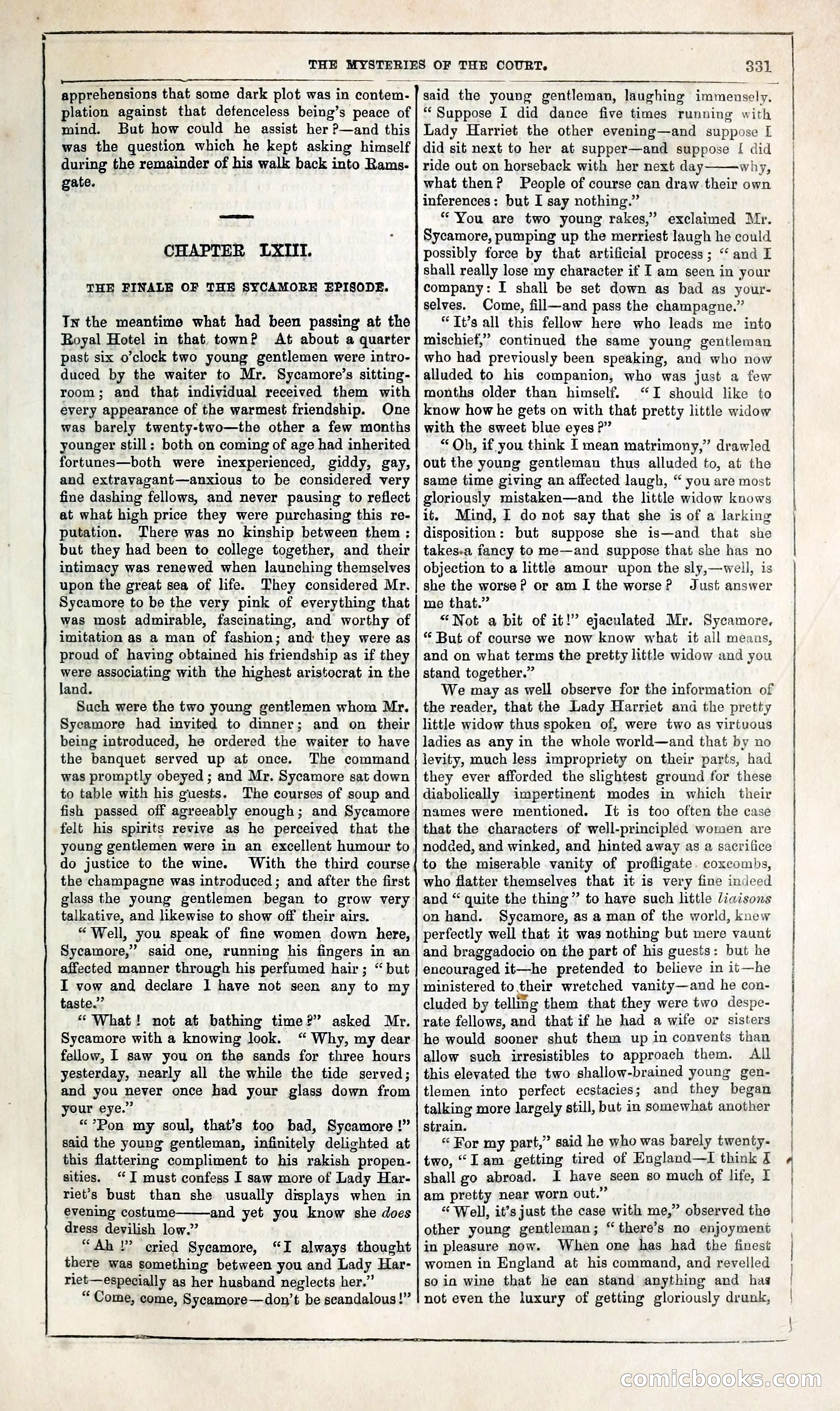
A restored page from Penny Dreadfuls, 1849. Page through the whole issue in the reader above.
📄 Transcribed text from this page (OCR, searchable)
Machine-transcribed from the original scan — historical spelling and the odd misread are preserved.
THE MYSTERIES OF THE COURT, SOL a a el cd apprehensions that some dark plot was in contem- plation against that defenceless being’s peace of mind. But how could he assist her P—and this was the question which he kept asking himself during the remainder of his walk back into Rams. gate. CHAPTER LXIII. THE FINALE OF THE SYCAMORE EPISODE. Tx the meantime what had been passing at the Royal Hotel in that, town? At about a quarter past six o'clock two young gentlemen were intro- duced by the waiter to Mr. Sycamore’s sitting- room; and that individual received them with every appearance of the warmest friendship. One was barely twenty-two—the other a few months younger still: both on coming of age had inherited fortunes—both were inexperienced, giddy, gay, and extravagant—anxious to be considered very fine dashing fellows, and never pausing to reflect at what high price they were purchasing this re- putation. There was no kinship between them ; but they had been to college together, and their intimacy was renewed when launching themselves upon the great sea of life. They considered Mr. Sycamore to be the very pink of everything that was most admirable, fascinating, and worthy of imitation as a man of fashion; and they were as proud of having obtained his friendship as if they were associating with the highest aristocrat in the land. Such were the two young gentlemen whom Mr. Sycamore had invited to dinner; and on their being introduced, he ordered the waiter to have the banquet served up at once. The command was promptly obeyed ; and Mr. Sycamore sat down to table with his guests. The courses of soup and fish passed off agreeably enough; and Sycamore felt his spirits revive as he perceived that the young gentlemen were in an excellent humour to, do justice to the wine. With the third course the champagne was introduced; and after the first glass the young gentlemen began to grow very talkative, and likewise to show off their airs. “Well, you speak of fine women down here, Sycamore,” said one, running his fingers in an affected manner through his perfumed hair; “ but I vow and declare I have not seen any to my taste.” “What! not at bathing time?” asked Mr. Sycamore with a knowing look. “ Why, my dear fellow, I saw you on the sands for three hours yesterday, nearly all the while the tide served; and you never once had your glass down from your eye.” “?*Pon my soul, that’s too bad, Sycamore !” said the young gentleman, infinitely delighted at this flattering compliment to his rakish propen- sities. “I must confess I saw more of Lady Har- riet’s bust than she usually displays when in evening costume———and yet you know she does dress devilish low.” “Ah !’ cried Sycamore, “I always thought there was something between you and Lady Har- riet—especially as her husband neglects her.” “Come, come, Sycamore—don’t be scandalous!” — said the young gentleman, laughing immensely, ‘Suppose I did dance five times running with Lady Harriet the other evening—and suppose [ did sit next to her at supper—and suppose ! did ride out on horseback with her next day why, what then? People of course can draw their own inferences: but I say nothing.” “You are two young rakes,” exclaimed Mr. Sycamore, pumping up the merriest laugh he could possibly force by that artificial process; ‘“‘ and I shall really lose my character if I am seen in your company: I shall be set down as bad as your- selves. Come, fill—and pass the champagne.” “Tt’s all this fellow here who leads me into mischief,’ continued the same young gentleman who had previously been speaking, and who now alluded to his companion, who was just a few months older than himself. ‘I should like to know how he gets on with that pretty little widow with the sweet blue eyes ?” “ Oh, if you think I mean matrimony,” drawled out the young gentleman thus alluded to, at the same time giving an affected laugh, “ you are most gloriously mistaken—and the little widow knows it. Mind, I do not say that she is of a larkine disposition: but suppose she is—and that she takes-a fancy fo me—and suppose that she has no objection to a little amour upon the sly,—well, is she the worseP or am I the worse? Just answer me that.” “Not a bit of it!” ejaculated Mr. Sycamore, * But of course we now know what it all means, and on what terms the pretty little widow and you stand together.” We may as well observe for the information of the reader, that the Lady Harriet and the pretty little widow thus spoken of, were two as virtuous ladies as any in the whole world—and that by no levity, much less impropriety on their parts, had they ever afforded the slightest ground for these diabolically impertinent modes in which their names were mentioned. It is too often the case that the characters of well-principled women are nodded, and winked, and hinted away as a sacrifice to the miserable vanity of profligate. coxcombs, who flatier themselves that it is very fine indeed and “ quite the thing”’ to have such little liaisons on hand. Sycamore, as a man of the world, knew perfectly well that it was nothing but mere vaunt and braggadocio on the part of his guests: but he encouraged it—he pretended to believe in it—he ministered to their wretched vanity—and he con- cluded by telling them that they were two despe- rate fellows, and that if he had a wife or sisters he would sooner shut them up in convents than allow such irresistibles to approach them. All this elevated the two shallow-brained young gen- tlemen into perfect ecstacies; and they began talking more largely still, but in somewhat another strain. « For my part,” said he who was barely twenty- two, “Lam getting tired of England—I think J shall go abroad. I have seen so much of life, I am pretty near worn out.” “Well, it’s just the case with me,” observed the other young gentleman; “there’s no enjoyment in pleasure now. When one has had the finest women in England at his command, and revelled so in wine that he can stand anything and hag not even the luxury of getting gloriously drunk, ———— am ac aaa —— So Lew ao eee eo Se a oe MICLOOOKS (C(O)