
Penny Dreadfuls, 1849 · page 340 of 394
The Mysteries of the Court of London — page 340: what you’re looking at
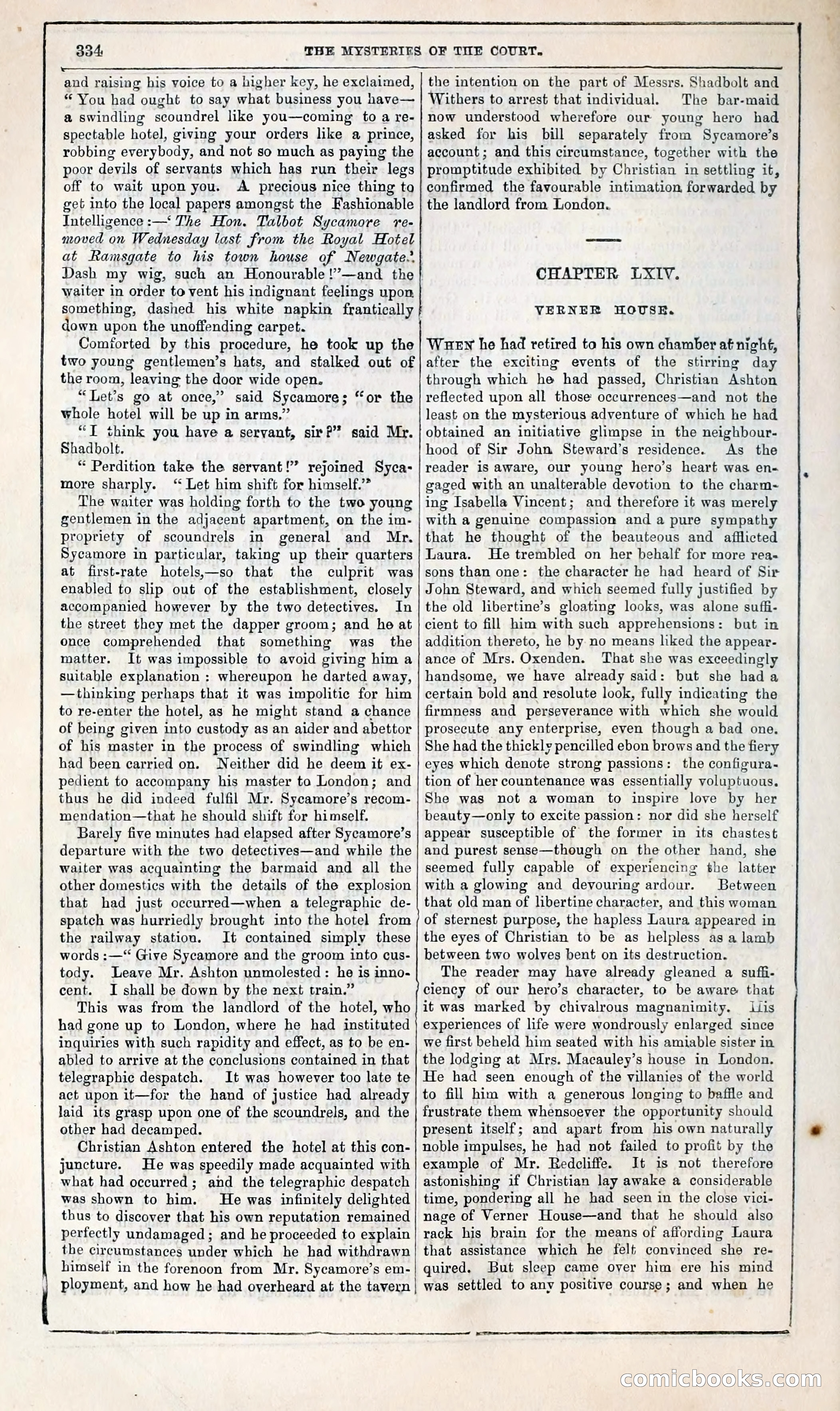
A restored page from Penny Dreadfuls, 1849. Page through the whole issue in the reader above.
📄 Transcribed text from this page (OCR, searchable)
Machine-transcribed from the original scan — historical spelling and the odd misread are preserved.
B04 and raising his voice to a higher key, he exclaimed, * You had ought to say what business you have— a swindling scoundrel like you—coming to a re- spectable hotel, giving your orders like a prince, robbing everybody, and not so much as paying the poor devils of servants which has run their legs off to wait upon you. A precious nice thing to get into the local papers amongst the Fashionable Intelligence :—‘ The Hon. Talbot Sycamore re- moved on Wednesday last from the Royal Hotel at Ramsgate to his town house of Newgate.’ Dash my wig, such an Honourable !’—and the waiter in order to vent his indignant feelings upon something, dashed his white napkin frantically | down upon the unoffending carpet. Comforted by this procedure, he took up the two young gentlemen’s hats, and stalked out of the room, leaving the door wide open. “Let’s go at once,’ said Sycamore; “or the whole hotel will be up in arms,” “TI think you have a servant, sir?” said Mr. Shadbolt. “ Perdition take the servant!” rejoined Syca- more sharply. ‘ Let him shift for himself.” The waiter was holding forth to the two young gentlemen in the adjacent apartment, on the im- propriety of scoundrels in general and Mr. Sycamore in particular, taking up their quarters at first-rate hotels,—so that the culprit was enabled to slip out of the establishment, closely accompanied however by the two detectives. In the street they met the dapper groom; and he at once comprehended that something was the matter. It was impossible to avoid giving him a suitable explanation : whereupon he darted away, —thinking perhaps that it was impolitic for him to re-enter the hotel, as he might stand a chance of being given into custody as an aider and abettor of his master in the process of swindling which had been carried on. Neither did he deem it ex- pedient to accompany his master to London; and thus he did indeed fulfil Mr. Sycamore’s recom- mendation—that he should shift for himself. Barely five minutes had elapsed after Sycamore’s departure with the two detectives—and while the waiter was acquainting the barmaid and all the other domestics with the details of the explosion that had just occurred—when a telegraphic de- spatch was hurriedly brought into the hotel from the railway station. It contained simply these words :—“ Give Sycamore and the groom into cus- tody. Leave Mr. Ashton unmolested : he is inno- cent. I shall be down by the next train.” This was from the landlord of the hotel, who had gone up to London, where he had instituted inquiries with such rapidity and effect, as to be en- abled to arrive at the conclusions contained in that telegraphic despatch. It was however too late te act upon it—for the hand of justice had already laid its grasp upon one of the scoundrels, and the other had decamped. Christian Ashton entered the hotel at this con- juncture. He was speedily made acquainted with what had occurred; and the telegraphic despatch was shown to him. He was infinitely delighted thus to discover that his own reputation remained perfectly undamaged ; and he proceeded to explain the circumstances under which he had withdrawn himself in the forenoon from Mr. Sycamore’s em- THE MYSTERIES OF THE COURT. the intention on the part of Messrs. Shadbolt and Withers to arrest that individual. The bar-maid now understood wherefore our young hero had asked for his bill separately from Sycamore’s account; and this circumstance, together with the promptitude exhibited by Christian in settling it, confirmed the favourable intimation forwarded by the landlord from London. CHAPTER LXIV. VERNER HOUSE. Wuen he had retired to his own chamber af nighé, after the exciting events of the stirring day through which he had passed, Christian Ashton reflected upon all those occurrences—and not the least on the mysterious adventure of which he had obtained an initiative glimpse in the neighbour- hood of Sir John Steward’s residence. As the reader is aware, our young hero’s heart was en- gaged with an unalterable devotion to the charm- ing Isabella Vincent; and therefore it was merely with a genuine compassion and a pure sympathy that he thought of the beauteous and afflicted Laura. He trembled on her behalf for more rea- sons than one: the character he had heard of Sir John Steward, and which seemed fully justified by the old libertine’s gloating looks, was alone suffi- cient to fill him with such apprehensions: but in addition thereto, he by no means liked the appear- ance of Mrs. Oxenden. That she was exceedingly handsome, we have already said: but she had a certain bold and resolute look, fully indicating the firmness and perseverance with which she would prosecute any enterprise, even though a bad one, She had the thickly pencilled ebon brows and the fiery eyes which denote strong passions: the configura- tion of her countenance was essentially voluptuous. She was not a woman to inspire love by her beauty—only to excite passion: nor did she herself appear susceptible of the former in its chastest and purest sense—though on the other hand, she seemed fully capable of experiencing the latter with a glowing and devouring ardour. Between that old man of libertine character, and this woman of sternest purpose, the hapless Laura appeared in the eyes of Christian to be as helpless as a lamb between two wolves bent on its destruction. The reader may have already gleaned a suffi- ciency of our hero’s character, to be aware that it was marked by chivalrous magnanimity. Lis experiences of life were wondrously enlarged since we first beheld him seated with his amiable sister in the lodging at Mrs. Macauley’s house in London. He had seen enough of the villanies of the world to fill him with a generous longing to baffle and frustrate them whensoever the opportunity should present itself; and apart from his own naturally noble impulses, he had not failed to profit by the example of Mr. Redcliffe. It is not therefore astonishing if Christian lay awake a considerable time, pondering all he had seen in the close vici- nage of Verner House—and that he should also rack his brain for the means of affording Laura that assistance which he felf convinced she re- quired. But sleep came over him ere his mind ployment, and how he had overheard at the tavern| was settled to any positive course; and when he (C©) CORNICLOOKS