
Penny Dreadfuls, 1849 · page 40 of 394
The Mysteries of the Court of London — page 40: what you’re looking at
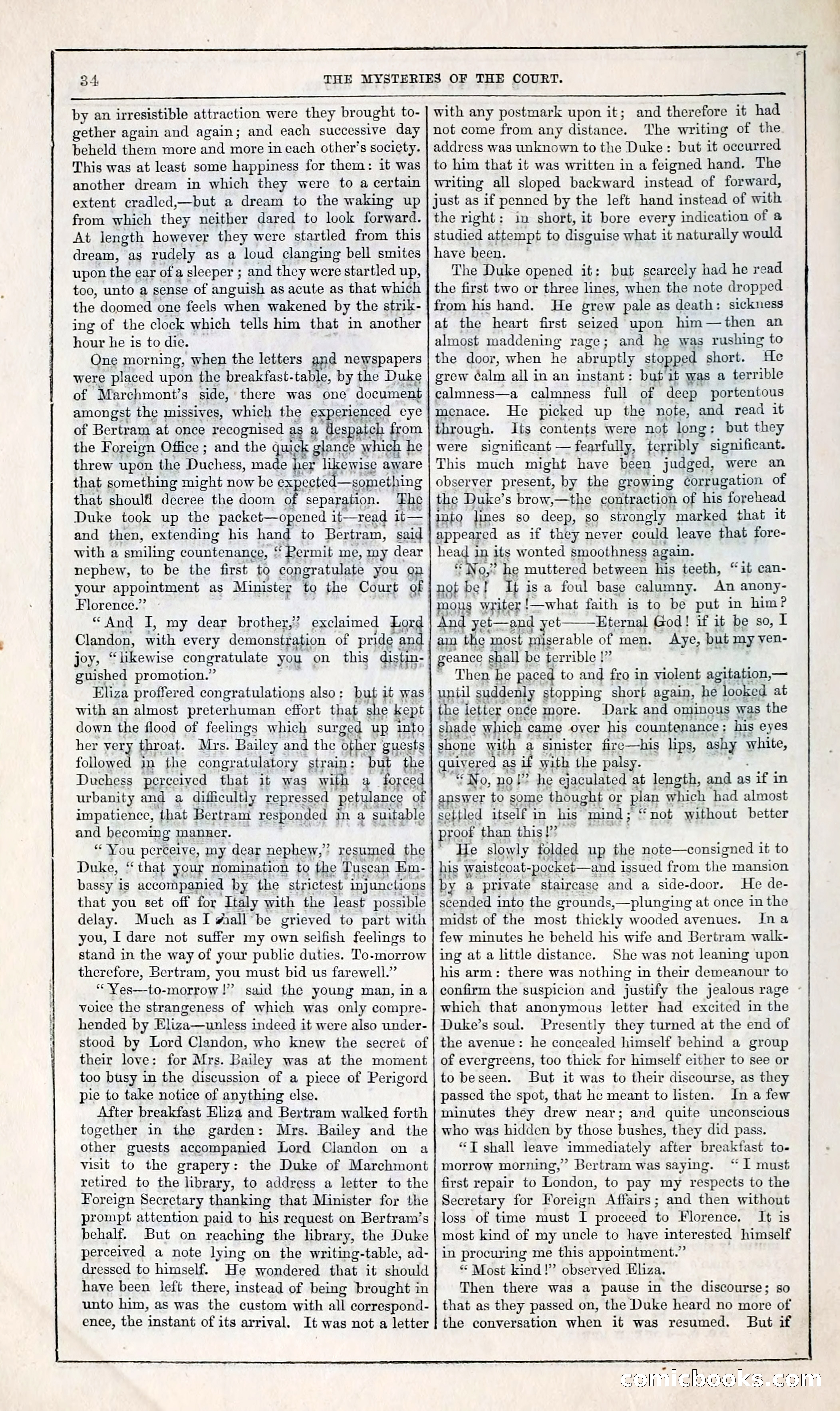
A restored page from Penny Dreadfuls, 1849. Page through the whole issue in the reader above.
📄 Transcribed text from this page (OCR, searchable)
Machine-transcribed from the original scan — historical spelling and the odd misread are preserved.
al 34 THE MYSTERIES OF THE COURT. le ————_——________ O_O by an irresistible attraction were they brought to- gether again and again; and each successive day beheld them more and more in each other's society. This was at least some happiness for them: it was another dream in which they were to a certain extent cradled—but a dream to the waking up from which they neither dared to look forward. At length however they were startled from this dream, as rudely as a loud clanging bell smites upon the ear of a sleeper ; and they were startled up, too, unto a sense of anguish as acute as that which the doomed one feels when wakened by the strik- ing of the clock which tells him that in another hour he is to die. One morning, when the letters and newspapers were placed upon the breakfast-table, by the Duke of Marchmont’s side, there was one document amongst the missives, which the experienced eye of Bertram at once recognised as a despatch from the Foreign Office ; and the quick glance which he threw upon the Duchess, made her likewise aware that something might now be ext ected—something that shoulfl decree the doom of separation. The Duke took up the packet—opened it—read it— and then, extending his hand to Bertram, said with a smiling countenance, * Rermit me, my dear nephew, to be the first to congratulate you op your appointment as Minister to the Court of Florence.’ Bet phy “And I, my dear brother,” exclaimed band And Clandon, with every demonstration of pride an joy, “likewise congratulate you on this distin- guished promotion.” | : Eliza proffered congratulations also: but it was with an almost preterhuman effort tha she kept down the flood of feelings which Rs up into her yery throat. Mrs. Bailey and the other guests followed in the congratulatory strain: but the Duchess perceiyed that it was with a forced urbanity and a difficultly repressed petulance of impatience, that Bertram responded in a suitable and becoming manner. ~~ binge “You percelye, my dear nephew,” resumed the Duke, “that your nomination to the Tuscan Em- bassy is accompanied by the strictest injunctions that you set off for Italy with the least possible delay. Much asI #aallbe grieved to part with you, I dare not suffer my own selfish feelings to stand in the way of your public duties. To-morrow therefore, Bertram, you must bid us farewell.” ““'Yes—to-morrow !” said the young man, ina voice the strangeness of which was only compre- hended by Eliza—uniless indeed it were also under- stood by Lord Clandon, who knew the secret of their love: for Mrs. Bailey was at the moment too busy in the discussion of a piece of Perigord pie to take notice of anything else. After breakfast Eliza and Bertram walked forth together in the garden: Mrs. Bailey and the other guests accompanied Lord Clandon on a visit to the grapery: the Duke of Marchmont retired to the library, to address a letter to the Foreign Secretary thanking that Minister for the prompt attention paid to his request on Bertram’s behalf. But on reaching the library, the Duke perceived a note lying on the writing-table, ad- dressed to himself. He wondered that it should have been left there, instead of being brought in unto him, as was the custom with all correspond- ence, the instant of its arrival. It was not a letter with any postmark upon it; and therefore it had not come from any distance. The writing of the address was unknown to the Duke: but it occurred to him that it was written in a feigned hand. The writing all sloped backward instead of forward, just as if penned by the left hand instead of with the right: in short, it bore every indication of a studied attempt to disguise what it naturally would have been. The Duke opened it: but scarcely had he read the first two or three lines, when the note dropped from his hand. He grew pale as death: sickness at the heart first seized upon him—then an almost maddening rage; and he was rushing to the door, when he abruptly stopped short. He grew éalm all in an instant: but it was a terrible calmness—a calmness full of deep portentous menace. He picked up the note, and read it through. Its contents were not long: but they were significant — fearfully, terribly significant. This much might have been judged, were an observer present, by the growing corrugation of the Duke’s brow,—the contraction of his forehead Into lines so deep, so strongly marked that it appeared as if they never could leave that fore- head in its wonted smoothness again. “No, he muttered between his teeth, “it can- not be! If isa foul base calumny. An anony- mous wyiter!—what faith is to be put in him ? And yet—and yet Eternal God! if it be so, I am the most miserable of men. Aye, but my yen- |?? eance shall be terrible ~ Then he paced to and fro in violent agitation,— until suddenly stopping short again, he looked at the letter on¢e more. Dark and ominous was the shade which came oyer his countenance; his eyes shone with a sinister fire—his lips, ashy white, quiyered as if with the palsy. er: “No, no!” he ejaculated at length, and as if in answer to some thought or plan which had almost settled itself in his mind ; “not without better proof than this}? | He slowly folded up the note—consigned it to his waistcoat-pocket—and issued from the mansion by a private staircase and a side-door. He de- scended into the grounds,—plunging at once in the midst of the most thickly wooded avenues. Ina few minutes he beheld his wife and Bertram walk- ing at a little distance. She was not leaning upon his arm: there was nothing in their demeanour to confirm the suspicion and justify the jealous rage © which that anonymous letter had excited in the Duke’s soul. Presently they turned at the end of the avenue: he concealed himself behind a group of evergreens, too thick for himself either to see or to beseen. But it was to their discourse, as they passed the spot, that he meant to listen. In a few minutes they drew near; and quite unconscious who was hidden by those bushes, they did pass. “T shall leave immediately after breakfast to- morrow morning,” Bertram was saying. “I must first repair to London, to pay my respects to the Secretary for Foreign Affairs; and then without loss of time must I proceed to Florence. It is most kind of my uncle to have interested himself in procuring me this appointment.” “ Most kind!” observed Eliza. Then there was a pause in the discourse; so that as they passed on, the Duke heard no more of the conversation when it was resumed. But if Goma o(OVOKS4(O) S|