
Penny Dreadfuls, 1849 · page 46 of 394
The Mysteries of the Court of London — page 46: what you’re looking at
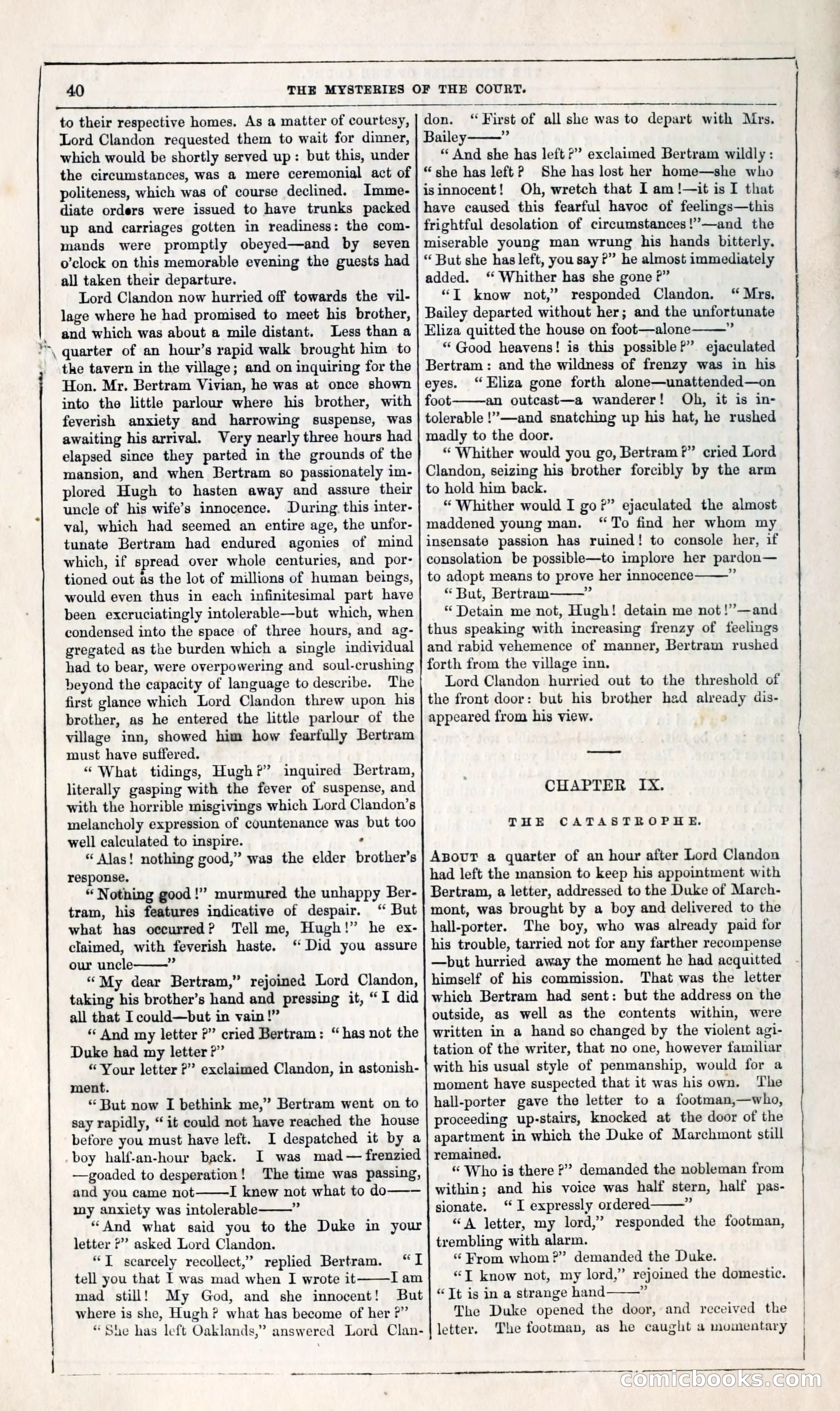
A restored page from Penny Dreadfuls, 1849. Page through the whole issue in the reader above.
📄 Transcribed text from this page (OCR, searchable)
Machine-transcribed from the original scan — historical spelling and the odd misread are preserved.
See ee \ \ quarter of an hour’s rapid walk brought him to boy half-an-hour back. 40 to their respective homes. As a matter of courtesy, Lord Clandon requested them to wait for dinner, which would be shortly served up: but this, under the circumstances, was a mere ceremonial act of politeness, which was of course declined. Imme- diate orders were issued to have trunks packed up and carriages gotten in readiness: the com- mands were promptly obeyed—and by seven o’clock on this memorable evening the guests had all taken their departure, Lord Clandon now hurried off towards the vil- lage where he had promised to meet his brother, and which was about a mile distant. Less than a the tavern in the village; and on inquiring for the Hon. Mr. Bertram Vivian, he was at once shown into the little parlour where his brother, with feverish anxiety and harrowing suspense, was awaiting his arrival. Very nearly three hours had elapsed since they parted in the grounds of the mansion, and when Bertram so passionately im- plored Hugh to hasten away and assure their uncle of his wife’s innocence. During this inter- val, which had seemed an entire age, the unfor- tunate Bertram had endured agonies of mind which, if spread over whole centuries, and por- tioned out as the lot of millions of human beings, would even thus in each infinitesimal part have been excruciatingly intolerable—but which, when condensed into the space of three hours, and ag- gregated as the burden which a single individual had to bear, were overpowering and soul-crushing beyond the capacity of language to describe. The first glance which Lord Clandon threw upon his brother, as he entered the little parlour of the village inn, showed him how fearfully Bertram must have suffered. “What tidings, Hugh?” inquired Bertram, literally gasping with the fever of suspense, and with the horrible misgivings which Lord Clandon’s melancholy expression of countenance was but too well calculated to inspire. “ Alas! nothing good,” was the elder brother’s response. “ Nothing good!” murmured the unhappy Ber- tram, his features indicative of despair. ‘“ But what has occurred? Tell me, Hugh!” he ex- claimed, with feverish haste. ‘ Did you assure our uncle if “My dear Bertram,” rejoined Lord Clandon, taking his brother’s hand and pressing it, “I did all that I could—but in vain !” ‘And my letter P” cried Bertram: “has not the Duke had my letter ?” “Your letter ?” exclaimed Clandon, in astonish- ment. * But now I bethink me,” Bertram went on to say rapidly, “it could not have reached the house before you must have left. I despatched it by a I was mad— frenzied —goaded to desperation! The time was passing, and you came not I knew not what to do my anxiety was intolerable ¥ “And what said you to the Duke in your letter ?” asked Lord Clandon. “I scarcely recollect,’ replied Bertram. tell you that I was mad when I wrote it Tam mad still! My God, and she innocent! But where is she, Hugh? what has become of her ?” “She has left Oaklands,” answered Lord Clan- ad a ~—- —- eer ere THE MYSTERIES OF THE COURT. don. ‘First of all she was to depart with Mrs. Bailey 5 “ And she has left?” exclaimed Bertram wildly : “ she has left? She has lost her home—she who isinnocent! Oh, wretch that I am !—it is I that have caused this fearful havoc of feelings—this frightful desolation of circumstances!’—and the miserable young man wrung his hands bitterly. “ But she has left, you say ?” he almost immediately added. ‘ Whither has she gone P” “T know not,’ responded Clandon. “ Mrs. Bailey departed without her; and the unfortunate Eliza quitted the house on foot—alone Hs “ Good heavens! is this possible?’ ejaculated Bertram: and the wildness of frenzy was in his eyes. “Eliza gone forth alone—unattended—on foot an outcast—a wanderer! Oh, it is in- tolerable !”—and snatching up his hat, he rushed madly to the door. “ Whither would you go, Bertram?” cried Lord Clandon, seizing his brother forcibly by the arm to hold him back. “ Whither would I go?” ejaculated the almost maddened young man. “To find her whom my insensate passion has ruined! to console her, if consolation be possible—to implore her pardon— to adopt means to prove her innocence . “ But, Bertram 4 * Detain me not, Hugh! detain me not!’’—and thus speaking with increasing frenzy of feelings and rabid vehemence of manner, Bertram rushed forth from the village inn. Lord Clandon hurried out to the threshold of the front door: but his brother had already dis- appeared from his view. CHAPTER IX. THE CATASTROPHE. ApBourt a quarter of an hour after Lord Clandon had left the mansion to keep his appointment with Bertram, a letter, addressed to the Duke of March- mont, was brought by a boy and delivered to the hall-porter. The boy, who was already paid for his trouble, tarried not for any farther recompense —but hurried away the moment he had acquitted himself of his commission. That was the letter which Bertram had sent: but the address on the outside, as well as the contents within, were written in a hand so changed by the violent agi- tation of the writer, that no one, however familiar with his usual style of penmanship, would for a moment have suspected that it was his own. The hall-porter gave the letter to a footman,—who, proceeding up-stairs, knocked at the door of the apartment in which the Duke of Marchmont still remained. “ Who is there ?” demanded the nobleman from within; and his voice was half stern, half pas- sionate. ‘I expressly ordered 4 “A letter, my lord,” responded the footman, trembling with alarm. “ Fyrom whom?” demanded the Duke. “T know not, my lord,” rejoined the domestic. “Tt is in a strange hand ? The Duke opened the door, and received the letter. The footman, as he caught a momentary ~ (eoypnlnicelanrcvo| KS, (Eo) im