
Penny Dreadfuls, 1849 · page 52 of 394
The Mysteries of the Court of London — page 52: what you’re looking at
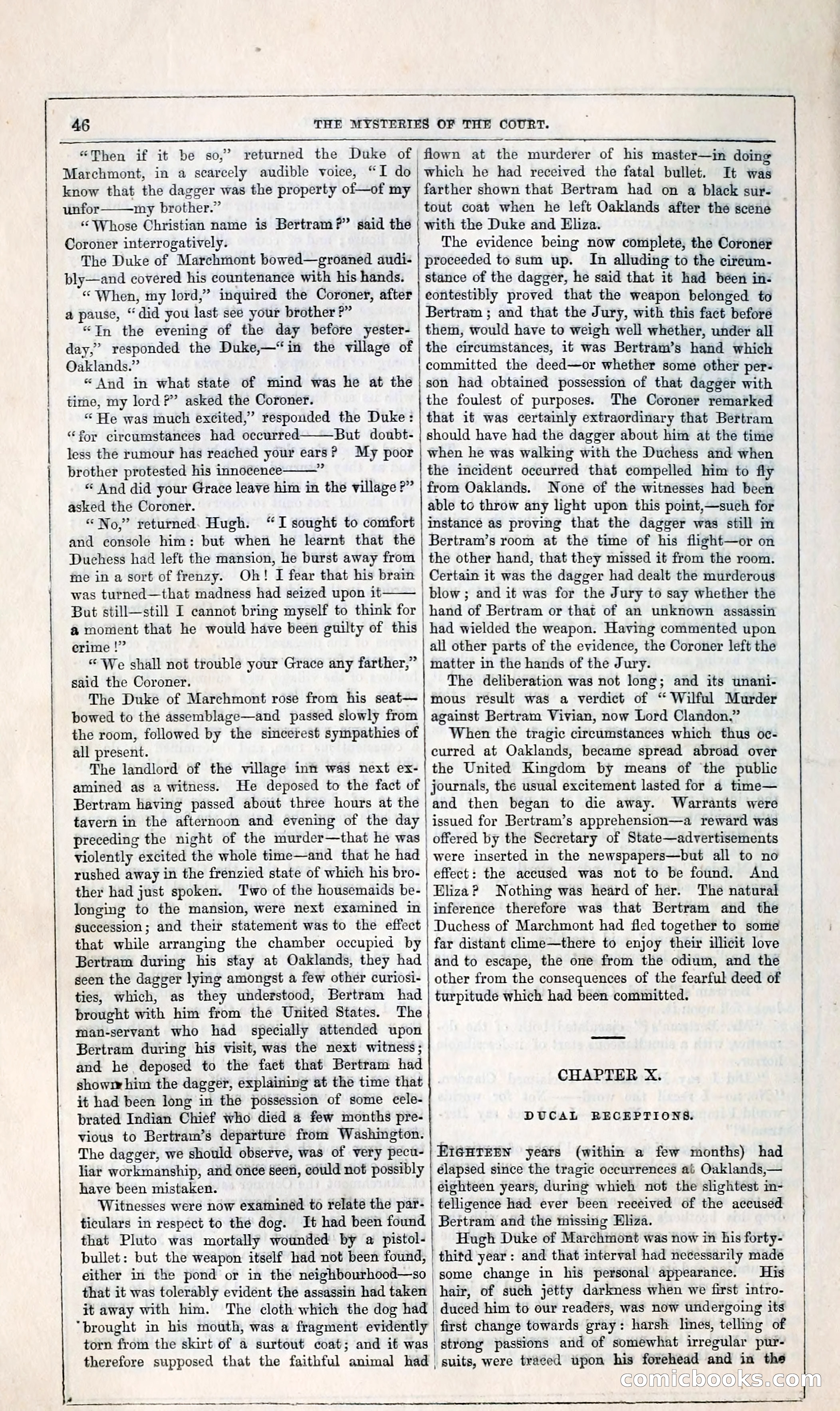
A restored page from Penny Dreadfuls, 1849. Page through the whole issue in the reader above.
📄 Transcribed text from this page (OCR, searchable)
Machine-transcribed from the original scan — historical spelling and the odd misread are preserved.
46 “Then if it be so,’ returned the Duke of Marchmont, in a scarcely audible voice, “I do know that the dagger was the property of—of my unfor my brother.” “Whose Christian name is Bertram?” said the Coroner interrogatively. The Duke of Marchmont bowed—groaned audi- bly—and covered his countenance with his hands. “ When, my lord,” inquired the Coroner, after a pause, “did you last see your brother ?” “In the evening of the day before yester- day,” responded the Duke,—‘in the village of Oaklands.” “And in what state of mind was he at the time, my lord ?”’ asked the Coroner. “ He was much excited,” responded the Duke: asc But doubt- for circumstanees had occurred less the rumour has reached your ears? My poor brother protested his innocence - « And did your Grace leave him in the village P” asked the Coroner. “No,” returned. Hugh. “I sought to comfort and console him: but when he learnt that the Duchess had left the mansion, he burst away from me in a sort of frenzy. Oh! I fear that his brain was turned—that madness had seized upon it But still—still I cannot bring myself to think for a moment that he would have been guilty of this erime !” “We shall not trouble your Grace any farther,” said the Coroner. The Duke of Marchmont rose from his seat— bowed to the assemblage—and passed slowly from the room, followed by the sincerest sympathies of all present. The landlord of the village inn was next ex- amined as a witness. He deposed to the fact of Bertram having passed about three hours at the tavern in the afternoon and evening of the day preceding the night of the murder—that he was | violently excited the whole time—and that he had | rushed away in the frenzied state of which his bro- ther had just spoken. Two of the housemaids be- longing to the mansion, were next examined in succession; and their statement was to the effect that while arranging the chamber occupied by Bertram during his stay at Oaklands, they had seen the dagger lying amongst a few other curiosi- ties, which, as they understood, Bertram had brought with him from the United States. The manp-servant who had specially attended upon Bertram during his visit, was the next witness; and he deposed to the fact that Bertram had show him the dagger, explaining at the time that it had been long in the possession of some cele- brated Indian Chief who died a few months pre- vious to Bertram’s departure from Washington. The dagger, we should observe, was of very pecu- liar workmanship, and once seen, could not possibly have been mistaken. Witnesses were now examined to relate the par- ticulars in respect to the dog. It had been found that Pluto was mortally wounded by a pistol- bullet: but the weapon itself had not been found, | either in the pond or in the neighbourhood—so | that it was tolerably evident the assassin had taken > it away with him. The cloth which the dog had “brought in his mouth, was a fragment evidently torn from the skirt of a surtout coat; and if was therefore supposed that the faithful animal had | THE MYSTERIES OF THE COURT. flown at the murderer of his master—in doing which he had received the fatal bullet. It was farther shown that Bertram had on a black sur- tout coat when he left Oaklands after the scene with the Duke and Eliza. The evidence being now complete, the Coroner proceeded to sum up. In alluding to the cireum- stance of the dagger, he said that it had béen in- eontestibly proved that the weapon belonged to Bertram ; and that the Jury, with this fact beforé them, would have to weigh well whether, under all the circumstances, it was Bertram’s hand which committed the deed—or whether some other per- son had obtained possession of that dagger with the foulest of purposes. The Coroner remarked that it was certainly extraordinary that Bertram should have had the dagger about him at the time when he was walking with the Duchess and when the incident occurred that compelled him to fly from Oaklands. None of the witnesses had been able to throw any light upon this point,—such for instance as proving that the dagger was still in Bertram’s room at the time of his flight—or on the other hand, that they missed it from the room. Certain it was the dagger had dealt the murderous blow ; and it was for the Jury to say whether the hand of Bertram or that of an unknown assassin had wielded the weapon. Having commented upon all other parts of the evidence, the Coroner left the matter in the hands of the Jury. The deliberation was not long; and its unani- mous result was a verdict of “ Wilful Murder against Bertram Vivian, now Lord Clandon.” When the tragic circumstances which thus oc- curred at Oaklands, became spread abroad over the United Kingdom by means of the public _ journals, the usual excitement lasted for a time— and then began to die away. Warrants were issued for Bertram’s apprehension—a reward was offered by the Secretary of State—advertisements were inserted in the newspapers—but all to no effect: the accused was not to be found. And Eliza? Nothing was heard of her. The natural inference therefore was that Bertram and the Duchess of Marchmont had fled together to some far distant clime—there to enjoy their illicit love and to escape, the one from the odium, and the other from the consequences of the fearful deed of turpitude which had been committed. CHAPTER X. DUCAL RECEPTIONS. EIGHTEEN years (within a few months) had élapsed since the tragic occurrences at Oaklands,— eighteen years, during which not the shghtest in- telligence had ever been received of the accused Bertram and the missing Eliza. Hugh Duke of Marchmont was now in his forty- thitd year: and that interval had necessarily made some change in his personal appearance. His hair, of such jetty darkmess when we first intro- duced him to our readers, was now undergoing its first change towards gray: harsh lines, telling of strong passions and of somewhat irregular pur- suits, were traced upon his forehead and in the CONNICOOOLKS GON