
Penny Dreadfuls, 1849 · page 70 of 394
The Mysteries of the Court of London — page 70: what you’re looking at
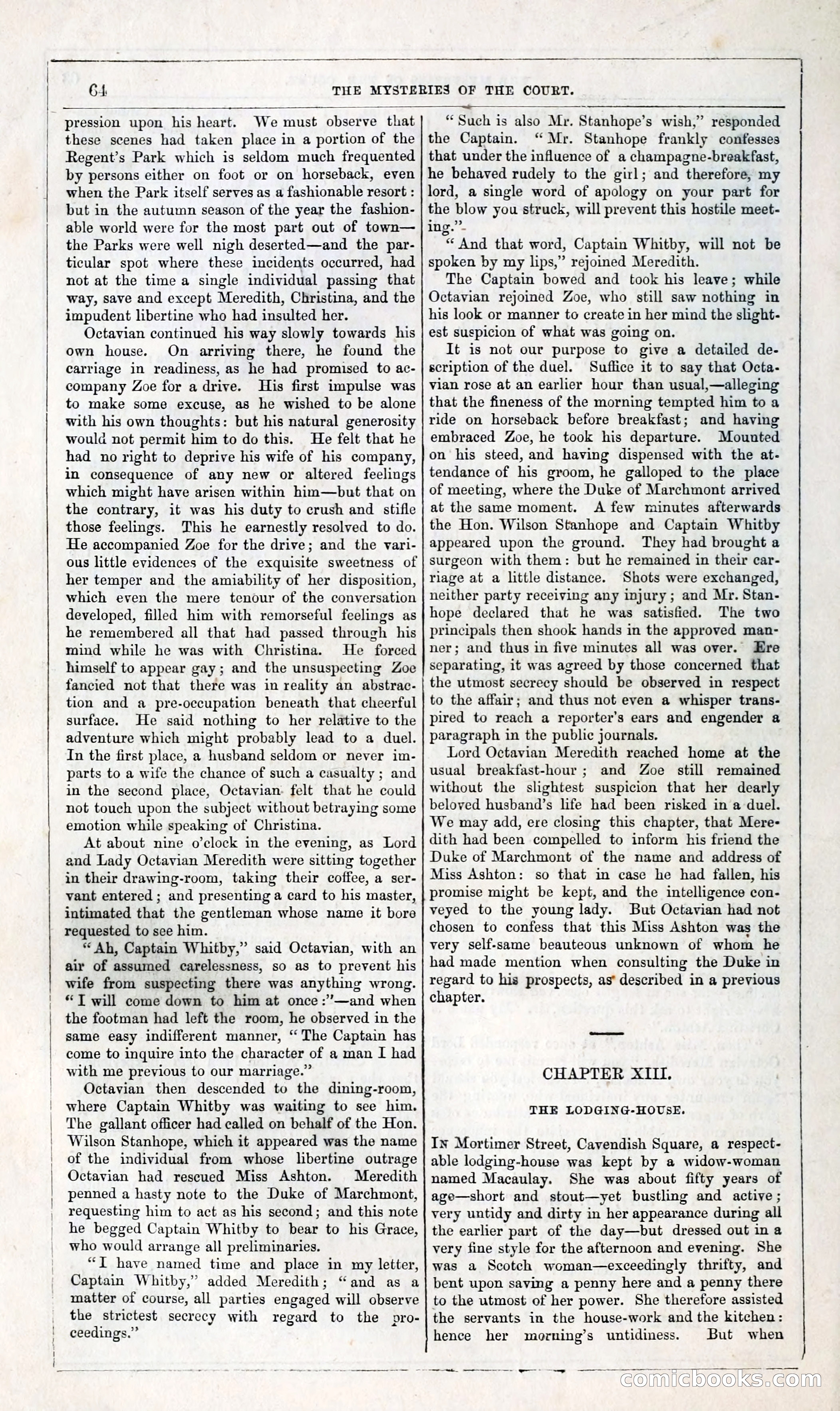
A restored page from Penny Dreadfuls, 1849. Page through the whole issue in the reader above.
📄 Transcribed text from this page (OCR, searchable)
Machine-transcribed from the original scan — historical spelling and the odd misread are preserved.
pression upon his heart. 64. We must observe that these scenes had taken place in a portion of the Regent’s Park which is seldom much frequented by persons either on foot or on horseback, even when the Park itself serves as a fashionable resort : but in the autumn season of the year the fashion- able world were for the most part out of town— the Parks were well nigh deserted—and the par- ticular spot where these incidents occurred, had not at the time a single individual passing that way, save and except Meredith, Christina, and the impudent libertine who had insulted her. Octavian continued his way slowly towards his own house. On arriving there, he found the carriage in readiness, as he had promised to ac- company Zoe for a drive. His first impulse was to make some excuse, as he wished to be alone with his own thoughts: but his natural generosity woula not permit him to do this. He felt that he had no right to deprive his wife of his company, in consequence of any new or altered feelings which might have arisen within him—but that on the contrary, it was his duty to crush and stifle those feelings. This he earnestly resolved to do. He accompanied Zoe for the drive; and the vari- ous little evidences of the exquisite sweetness of her temper and the amiability of her disposition, which even the mere tenour of the conversation developed, filled him with remorseful feelings as he remembered all that had passed through his mind while he was with Christina. He forced himself to appear gay; and the unsuspecting Zoe fancied not that there was in reality an abstrac- tion and a pre-occupation beneath that cheerful surface. He said nothing to her relative to the adventure which might probably lead to a duel. In the first place, a husband seldom or never im- parts to a wife the chance of such a casualty ; and in the second place, Octavian. felt that he could not touch upon the subject without betraying some emotion while speaking of Christina. At about nine o’clock in the evening, as Lord and Lady Octavian Meredith were sitting together in their drawing-room, taking their coffee, a ser- vant entered ; and presenting a card to his master, intimated that the gentleman whose name it bore requested to see him. * Ah, Captain Whitby,” said Octavian, with an air of assumed carelessness, so as to prevent his wife from suspecting there was anything wrong. “T will come down to him at once :’—and when the footman had left the room, he observed in the Same easy indifferent manner, “ The Captain has come to inquire into the character of a man I had with me previous to our marriage.” Octavian then descended to the dining-room, where Captain Whitby was waiting to see him. The gallant officer had called on behalf of the Hon. Wilson Stanhope, which it appeared was the name of the individual from whose libertine outrage Octavian had rescued Miss Ashton. Meredith penned a hasty note to the Duke of Marchmont, requesting him to act as his second; and this note he begged Captain Whitby to bear to his Grace, who would arrange all preliminaries. “JT have named time and place in my letter, Captain Whitby,” added Meredith; “and as a matter of course, all parties engaged will observe the strictest secrecy with regard to the pro- ceedings.” AO EE « = —_—_———-_-—_- eo ee ee THE MYSTERIES OF THE COURT. “Such is also Mr. Stanhope’s wish,” responded the Captain. “Mr. Stanhope frankly confesses that under the influence of a champagne-breakfast, he behaved rudely to the girl; and therefore, my lord, a single word of apology on your part for the blow you struck, will prevent this hostile meet- ing. J “ And that word, Captain Whitby, will not be spoken by my lips,” rejoined Meredith. The Captain bowed and took his leave; while Octavian rejoined Zoe, who still saw nothing in his look or manner to create in her mind the slight- est suspicion of what was going on. It is not our purpose to give a detailed de- scription of the duel. Suflice it to say that Octa- vian rose at an earlier hour than usual,—alleging that the fineness of the morning tempted him to a ride on horseback before breakfast; and having embraced Zoe, he took his departure. Mounted on his steed, and having dispensed with the at- tendance of his groom, he galloped to the place of meeting, where the Duke of Marchmont arrived at the same moment. A few minutes afterwards the Hon. Wilson Stanhope and Captain Whitby appeared upon the ground. They had brought a surgeon with them: but he remained in their ear- riage at a little distance. Shots were exchanged, neither party receiving any injury; and Mr. Stan- hope declared that he was satisfied. The two principals then shook hands in the approved man- ner; and thus in five minutes all was over. Ere separating, it was agreed by those concerned that the utmost secrecy should be observed in respect to the affair; and thus not even a whisper trans- pired to reach a reporter’s ears and engender a paragraph in the public journals. Lord Octavian Meredith reached home at the usual breakfast-hour; and Zoe still remained without the slightest suspicion that her dearly beloved husband’s life had been risked in a duel. We may add, ere closing this chapter, that Mere- dith had been compelled to inform his friend the Duke of Marchmont of the name and address of Miss Ashton: so that in case he had fallen, his promise might be kept, and the intelligence con- veyed to the young lady. But Octavian had not chosen to confess that this Miss Ashton was the very self-same beauteous unknown of whom he had made mention when consulting the Duke in regard to his prospects, as’ described in a previous chapter. CHAPTER XIII. THE LODGING-HOUSE. In Mortimer Street, Cavendish Square, a respect- able lodging-house was kept by a widow-woman named Macaulay. She was about fifty years of age—short and stout—yet bustling and active; very untidy and dirty in her appearance during all the earlier part of the day—but dressed out in a very fine style for the afternoon and evening. She was a Scotch woman—exceedingly thrifty, and bent upon saving a penny here and a penny there to the utmost of her power. She therefore assisted the servants in the house-work and the kitchen : hence her morning’s untidiness. But when Gon S (C(O)