
Penny Dreadfuls, 1849 · page 85 of 394
The Mysteries of the Court of London — page 85: what you’re looking at
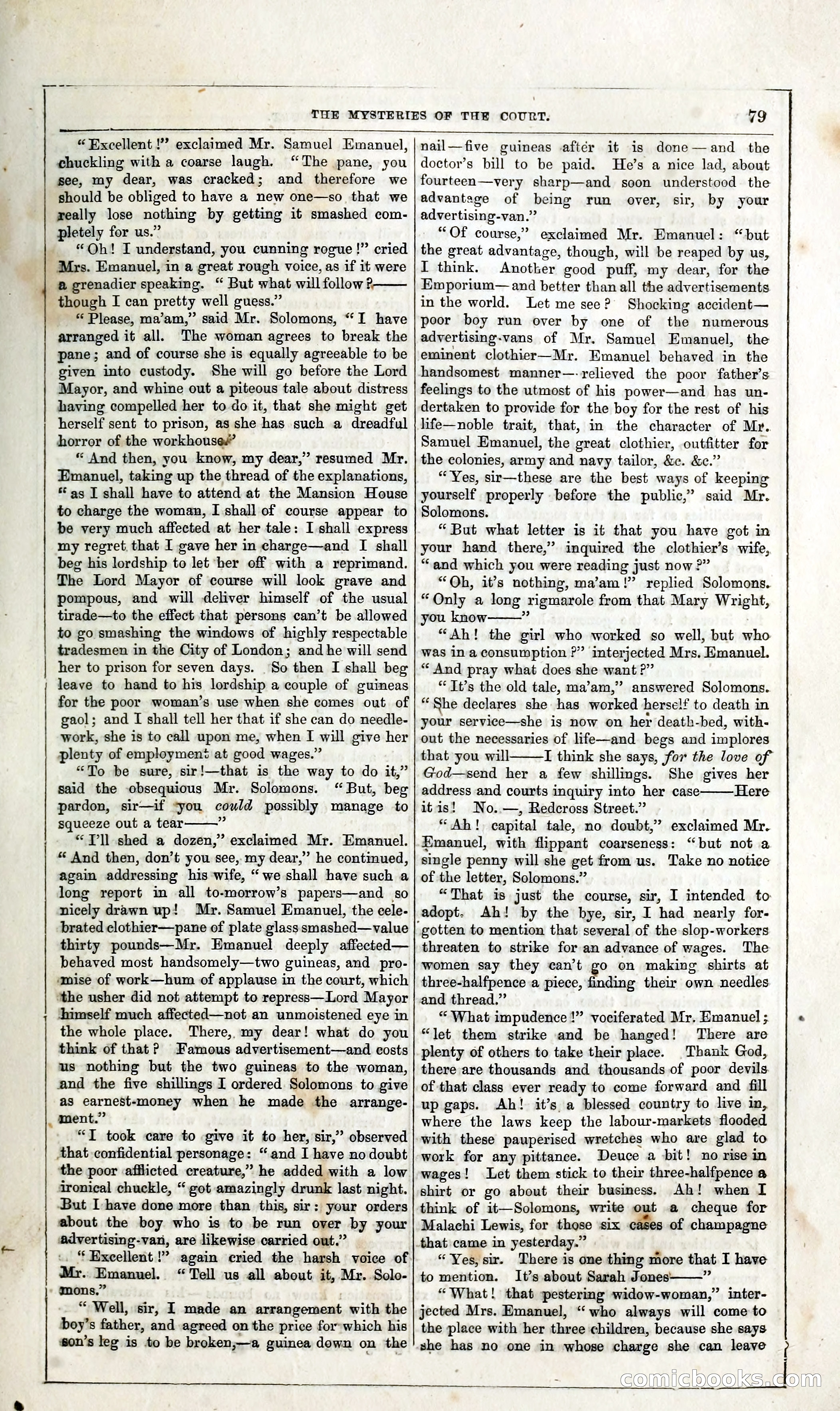
A restored page from Penny Dreadfuls, 1849. Page through the whole issue in the reader above.
📄 Transcribed text from this page (OCR, searchable)
Machine-transcribed from the original scan — historical spelling and the odd misread are preserved.
nn eee ee THE MYSTERIES OF THE cCoURT. 79 “Excellent !”’ exclaimed Mr. Samuel Emanuel, chuckling with a coarse laugh. “The pane, you see, my dear, was cracked; and therefore we should be obliged to have a new one—so that we really lose nothing by getting it smashed com- pletely for us.” “Oh! I understand, you cunning rogue !” cried Mrs. Emanuel, in a great rough voice, as if it were ® grenadier speaking. “ But what will follow ?—— though I can pretty well guess.” “‘ Please, ma’am,” said Mr. Solomons, “‘I have arranged it all. The woman agrees to break the pane; and of course she is equally agreeable to be given into custody. She will go before the Lord Mayor, and whine out a piteous tale about distress having compelled her to do it, that she might get herself sent to prison, as she has such a dreadful horror of the workhouse’ “ And then, you know, my dear,” resumed Mr. Emanuel, taking up the thread of the explanations, “as I shall have to attend at the Mansion House to charge the woman, I shall of course appear to be very much affected at her tale: I shall express my regret, that I gave her in charge—and [I shall beg his lordship to let ‘her off with a reprimand. The Lord Mayor of course will look grave and pompous, and will deliver himself of the usual tirade—to the effect that persons can’t be allowed to go smashing the windows of highly respectable tradesmen in the City of London; and he will send her to prison for seven days. So then I shall beg leave to hand to his lordship a couple of guineas for the poor woman’s use when she comes out of gaol; and I shall tell her that if she can do needle- work, she is to call upon me, when I will give her plenty of employment at good wages.” “To be sure, sir!—that is the way to do it,” said the obsequious Mr. Solomons. “But, beg pardon, sir—if *you could possibly manage to squeeze out a tear *“ T’ll shed a dozen,” exclaimed Mr. Emanuel. “ And then, don’t you see, my dear,” he continued, again addressing his wife, “we shall have such a long report in all to-morrow’s papers—and so nicely drawn up! Mr. Samuel Emanuel, the ecele- brated clothier—pane of plate glass smashed—value thirty pounds—Mr. Emanuel deeply affected— behaved most handsomely—two guineas, and pro- mise of work—hum of applause in the court, which ‘tthe usher did not attempt to repress—Lord Mayor himself much affected—not an unmoistened eye in the whole place. There, my dear! what do you think of that? Famous advertisement—and costs us nothing but the two guineas to the woman, and the five shillings I ordered Solomons to give as earnest-money when he made the arrange- _ ment.” “I took care to give it to her, sir,” observed that confidential personage: “and I have no doubt ‘the poor afflicted creature,” he added with a low ironical chuckle, “ got amazingly drunk last night. But Ihave done more than this, sir: your orders about the boy who is to be run over by your advertising-van, are likewise carried out.” .. * Exeellent!’ again cried the harsh voice of Mr. Emanuel. “Tell us all about it, Mr. Solo- “Well, sir, I made an arrangement with the boy’s father, and agreed on the price forwhich his son’s leg is to be broken;—a guinea down on the ‘gotten to mention that several of the slop-workers that came in yesterday.” nail—five guineas after it is done—and the doctor’s bill to be paid. He’s a nice lad, about fourteen—very sharp—and soon understood the advantege of being run over, sir, by your advertising-van.” “Of course,” exclaimed Mr. Emanuel: “but the great advantage, though, will be reaped by us, I think. Another good puff, my dear, for the Emporium— and better than all the advertisements in the world. Let me see? Shocking accident— poor boy run over by one of the numerous advertising-vans of Mr. Samuel Emanuel, the eminent clothier—Mr. Emanuel behaved in the handsomest manner—-relieved the poor father’s feelings to the utmost of his power—and has un- dertaken to provide for the boy for the rest of his hife—noble trait, that, in the character of Mr. Samuel Emanuel, the great clothier, outfitter for the colonies, army and navy tailor, &c. &c.” “Yes, sir—these are the best ways of keeping yourself properly before the public,” said Mr. Solomons. “ But what letter is it that you have got in your hand there,” inquired the clothier’s wife, “and which you were reading just now ?” “Qh, it’s nothing, ma’am!” replied Solomons. “Only a long rigmarole from that Mary Wright, you know ‘3 “Ah! the girl who worked so well, but who was in a consumption ?” imterjected Mrs. Emanuel. “And pray what does she want ?” “It’s the old tale, ma’am,” answered Solomons. “She declares she has worked herself to death in your service—she is now on her death-bed, with- out the necessaries of life—and begs and implores that you will I think she says, for the love of God—send her a few shillmgs. She gives her address and courts inquiry into her case Here itis! No..—, Redcross Street.” “Ah! capital tale, no doubt,’ exclaimed Mr. Emanuel, with flippant coarseness: “but not a single penny will she get from us. Take no notice of the letter, Solomons.” “That is just the course, sir, I intended to adopt. Ah! by the bye, sir, I had nearly for- threaten to strike for an advance of wages. The women say they can’t go on making shirts at three-halfpence a piece, finding their own needles and thread.” “ What impudence !” vociferated Mr. Emanuel ; “let them strike and be hanged! There are plenty of others to take their place. Thank God, there are thousands and thousands of poor devils of that class ever ready to come forward and fill up gaps. Ah! it’s a blessed country to live in, where the laws keep the labour-markets flooded with these pauperised wretches who are glad to work for any pittance. Deuce a bit! no rise in wages! Let them stick to their three-halfpence a shirt or go about their business. Ah! when I think of it—Solomons, write out a cheque for Malachi Lewis, for those six cases of champagne “Yes, sir. There is one thing more that I have to mention. It’s about Sarah Jones‘ F “What! that pestermg widow-woman,” inter- jected Mrs. Emanuel, “who always will come to the place with her three children, because she says she has no one in whose charge she can leave ?