
Penny Dreadfuls, 1849 · page 94 of 394
The Mysteries of the Court of London — page 94: what you’re looking at
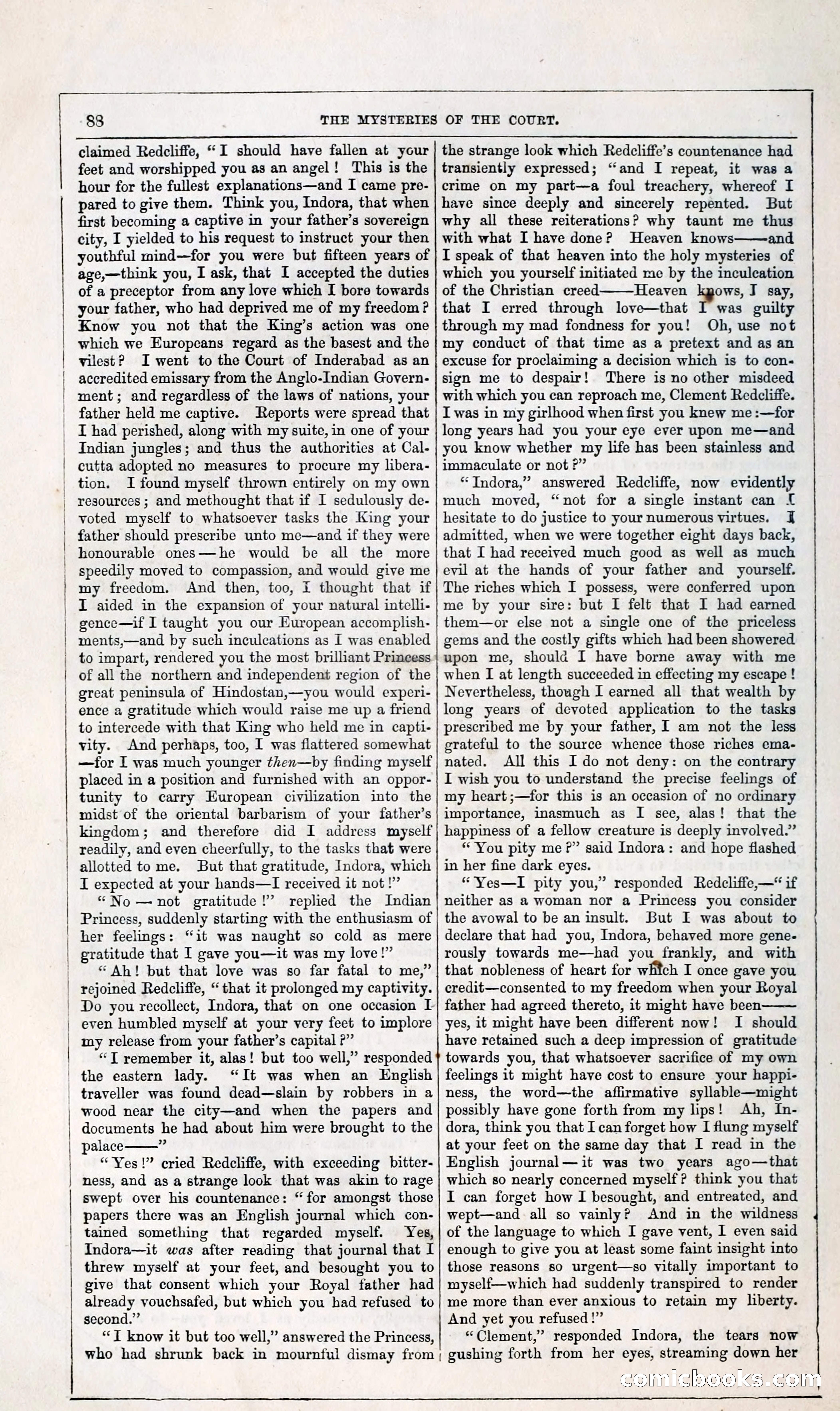
A restored page from Penny Dreadfuls, 1849. Page through the whole issue in the reader above.
📄 Transcribed text from this page (OCR, searchable)
Machine-transcribed from the original scan — historical spelling and the odd misread are preserved.
— . ne - 88 claimed Redcliffe, “I should have fallen at your feet and worshipped you as an angel! This is the hour for the fullest explanations—and I came pre- pared to give them. Think you, Indora, that when first becoming a captive in your father’s sovereign city, I yielded to his request to instruct your then youthful mind—for you were but fifteen years of age,—think you, I ask, that I accepted the duties of a preceptor from any love which I bore towards your father, who had deprived me of my freedom? Know you not that the King’s action was one which we Europeans regard as the basest and the vilest? I went to the Court of Inderabad as an accredited emissary from the Anglo-Indian Govern- ment; and regardless of the laws of nations, your father held me captive. Reports were spread that I had perished, along with my suite, in one of your Indian jungles; and thus the authorities at Cal- cutta adopted no measures to procure my libera- tion. I found myself thrown entirely on my own resources ; and methought that if I sedulously de- voted myself to whatsoever tasks the King your father should prescribe unto me—and if they were honourable ones—he would be all the more speedily moved to compassion, and would give me my freedom. And then, too, i thought that if I aided in the expansion of your natural intelli- gence—if I taught you our European accomplish- ments,—and by such inculcations as I was enabled to impart, rendered you the most brilliant Princess of all the northern and independent region of the great peninsula of Hindostan,—you would experi- ence a gratitude which would raise me up a friend to intercede with that King who held me in capti- vity. And perhaps, too, I was flattered somewhat —for I was much younger then—by finding myself placed in a position and furnished with an oppor- tunity to carry European civilization into the midst of the oriental barbarism of your father’s kingdom; and therefore did I address myself readily, and even cheerfully, to the tasks that were allotted tome. But that gratitude, Indora, which I expected at your hands—I received it not!” “No —not gratitude!” replied the Indian Princess, suddenly starting with the enthusiasm of her feelings: “it was naught so cold as mere gratitude that I gave you—it was my love!” “ Ah! but that love was so far fatal to me,” rejoined Redcliffe, “that it prolonged my captivity. Do you recollect, Indora, that on one occasion I even humbled myself at your very feet to implore my release from your father’s capital P”’ “T remember it, alas! but too well,’ responded the eastern lady. “It was when an English traveller was found dead—slain by robbers in a wood near the city—and when the papers and documents he had about him were brought to the palace " “Yes!” cried Redcliffe, with exceeding bitter- ness, and as a strange look that was akin to rage swept over his countenance: “for amongst those papers there was an English journal which con- tained something that regarded myself. Yes, Indora—it was after reading that journal that I threw myself at your feet, and besought you to give that consent which your Royal father had already vouchsafed, but which you had refused to second.” ““T know it but too well,” answered the Princess, THE MYSTERIES OF THE COURT. the strange look which Redcliffe’s countenance had transiently expressed; “and I repeat, it was a crime on my part—a foul treachery, whereof I have since deeply and sincerely repented. But why all these reiterations? why taunt me thus with what I have done? Heaven knows and I speak of that heaven into the holy mysteries of which you yourself initiated me by the inculcation of the Christian creed Heaven kpows, I say, that I erred through love—that I was guilty through my mad fondness for you! Oh, use not my conduct of that time as a pretext and as an excuse for proclaiming a decision which is to con- sign me to despair! There is no other misdeed with which you can reproach me, Clement Redcliffe. I was in my girlhood when first you knew me:—for long years had you your eye ever upon me—and you know whether my life has been stainless and immaculate or not P” “Indora,” answered Redcliffe, now evidently much moved, “not for a single instant can hesitate to do justice to your numerous virtues. J admitted, when we were together eight days back, that I had received much good as well as much evil at the hands of your father and yourself. The riches which I possess, were conferred upon me by your sire: but I felt that I had earned them—or else not a single one of the priceless gems and the costly gifts which had been showered upon me, shoula I have borne away with me when I at length succeeded in effecting my escape! Nevertheless, though I earned all that wealth by long years of devoted application to the tasks prescribed me by your father, I am not the less grateful to the source whence those riches ema- nated. All this Ido not deny: on the contrary I wish you to understand the precise feelings of my heart ;—for this is an occasion of no ordinary importance, inasmuch as I see, alas! that the happiness of a fellow creature is deeply involved.” “You pity me?” said Indora: and hope flashed in her fine dark eyes. “Yes—I pity you,’ responded Redcliffe,—“ if neither as a woman nor a Princess you consider the avowal to be an insult. But I was about to declare that had you, Indora, behaved more gene- rously towards me—had you frankly, and with that nobleness of heart for whtch I once gave you eredit—consented to my freedom when your Royal father had agreed thereto, it might have been yes, it might have been different now! I should have retained such a deep impression of gratitude towards you, that whatsoever sacrifice of my own feelings it might have cost to ensure your happi- ness, the word—the affirmative syllable—might possibly have gone forth from my lips! Ah, In- dora, think you that I can forget how I flung myself at your feet on the same day that I read in the English journal—it was two years ago—that which so nearly concerned myself? think you that I can forget how I besought, and entreated, and wept—and all so vainly? And in the wildness of the language to which I gave vent, I even said enough to give you at least some faint insight into those reasons so urgent—so vitally important to myself—which had suddenly transpired to render me more than ever anxious to retain my liberty. And yet you refused !” Clement,’ responded Indora, the tears now who had shrunk back in mournful dismay from; gushing forth from her eyes, streaming down her COMME MOO (C <SEiGO