
Penny Dreadfuls, 1850 · page 11 of 394
The Mysteries of London; or, Lights and Shadows of London Life — page 11: what you’re looking at
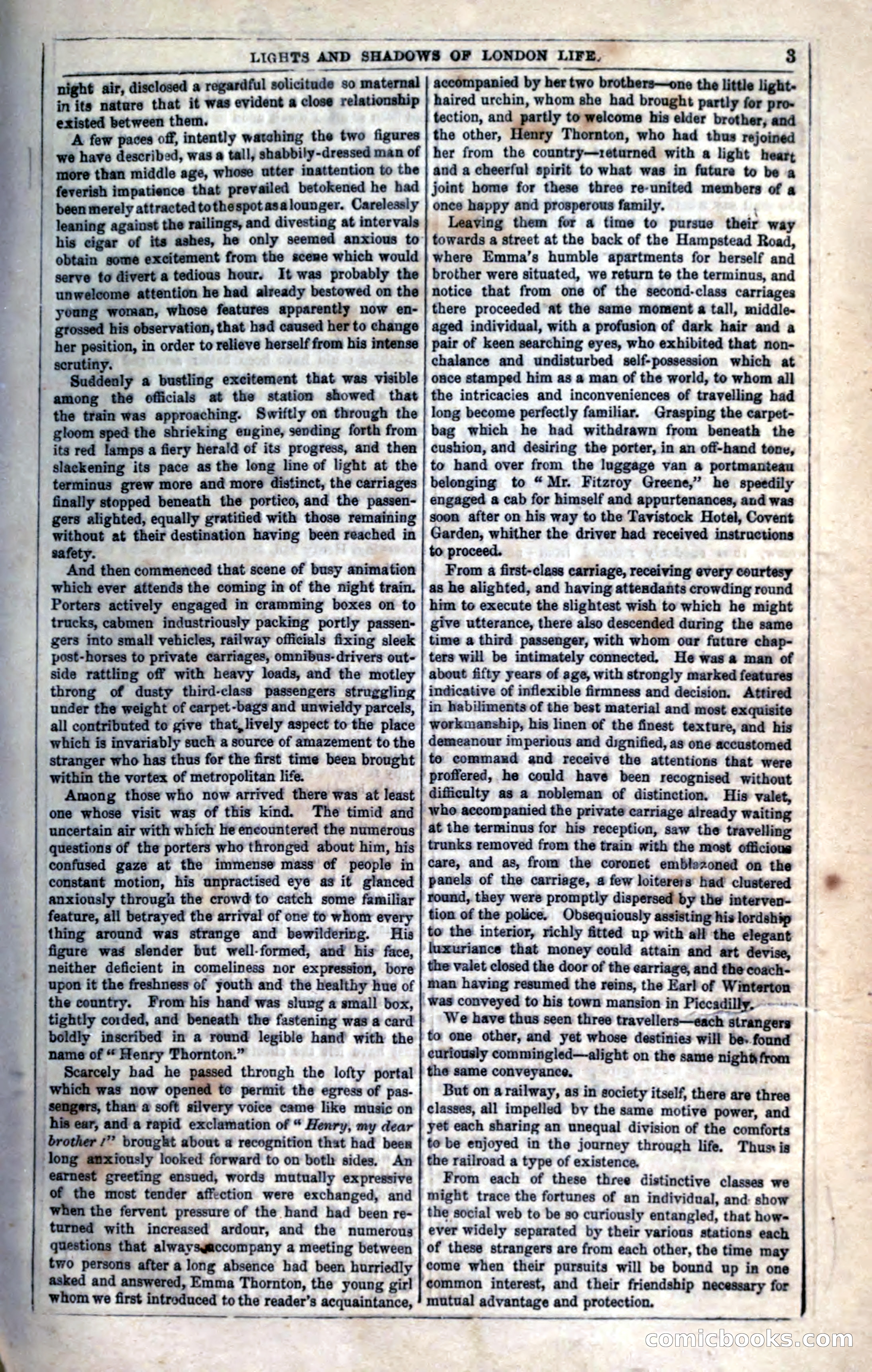
A restored page from Penny Dreadfuls, 1850. Page through the whole issue in the reader above.
📄 Transcribed text from this page (OCR, searchable)
Machine-transcribed from the original scan — historical spelling and the odd misread are preserved.
ee a € air, disclosed a regardful solicitude so maternal i natare that it was evident a close relationship existed between them. A few paces off, intently watching the two figures we have described, was a tall, shabbily-dressed ~~ ws more than middle age, whose utter inattention to the feverish impatience that prevailed betokened he had been merely attracted tothespot asa lounger. Carelessly leaning against the railings, and divesting at intervals his cigar of its ashes, he only seemed anxious to obtain some excitement from the scere which would serve to divert a tedious hour. It was probably the unwelcome attention he had already bestowed on the young woman, whose features apparently now en- grossed his observation, that had caused | to change her position, in order to relieve herself from his intense Suddenly a bustling excitement that was visible among the officials at the station showed that the train was approaching. Swiftly on through the gloom sped the shrieking engine, sending forth from its red lamps a fiery herald of its progress, and then slackening its pace as the long line of light at the terminus grew more and more distinct, the carriages finally stopped beneath the portico, and the passen- gers alighted, equally gratitied with those remaining without at their destination having been reached in And then commenced that scene of busy animation which ever attends the coming in of the night train. Porters actively engaged in cramming boxes on to trucks, cabmen industriously packing portly passen- gers into small! vehicles, railway officials fixing sleek post-horses to private carriages, omnibus-drivers out- side rattling off with heavy loads, and the motley throng of dusty third-class passengers struggling under the weight of carpet-bags and unwieldy parcels, all contributed to give that, lively aspect to the place which is invariably such a source of amazement to the stranger who has thus for the first time been brought within the vortex of metropolitan life. Among those who now arrived there was at least one whose visit was of this kind. The timid and uncertain air with which he encountered the numerous questions of the porters who thronged about him, his confused gaze at the immense mass of people in constant motion, his unpractised eye as it glanced anxiously through the crowd to catch some familiar feature, all betrayed the arrival of one to whom every thing around was strange and bewildering. His figure was slender but well-formed, and his face, neither deficient in comeliness nor expression, bore upon it the freshness of youth and the healthy hue of the country. From his hand was slung a small box, tightly corded, and beneath the fastening was a card boldly inscribed in a rownd legible hand with the name of “ Henry Thornton.” he passed throngh the lofty portal oodles permit the egress of pas- se than a soft silvery voice came like music on | ear, and a rapid exclamation of “ Henry, my dear brother 7” brought about a recognition that had beer am y looked forward to on both sides. An earnest greeting ensued, words mutually expressive ich was now A ee ee LIGHTS AND SHADOWS OF LONDON LIFE, | -— + —— oS —— TE ee —_ 3 accompanied by her two brothers—one the little light- haired urchin, whom she had brought partly for pro- tection, and partly to welcome his elder brother, and the other, Henty Thornton, who had thus rejoined her from the country—returned with a light heart and a cheerful spirit to what was in future to be a joint home for these three re-united members of a onee happy and prosperous family. aving them for a time to pursue their way towards a street at the back of the Hampstead Road, where Emma’s humble apartments for herself and brother were situated, we return te the terminus, and notice that from one of the second-class carriages there proceeded at the same moment a tall, middle- aged individual, with a profusion of dark hair and a pair of keen searching eyes, who exhibited that non- chalance and undisturbed self-possession which at once stamped him as a man of the world, to whom all the intricacies and inconveniences of travelling had long become perfectly familiar. Grasping the carpet- bag which he had withdrawn from beneath the cushion, and desiring the porter, in an off-hand tone, to hand over from the luggage van a portmanteau belonging to “ Mr. Fitzroy Greene,” he speedily engaged a cab for himself and appurtenances, and was soon after on his way to the Tavistock Hotel, Covent Garden, whither the driver had received instructions to proceed. From a first-class carriage, receiving every courtesy as he alighted, and having attendants crowding round him to execute the slightest wish to which he might give utterance, there also descended during the same time a third passenger, with whom our future chap- ters will be intimately connected. He was a man of about fifty years of age, with strongly marked features indicative of inflexible firmness and decision. Attired in habiliments of the best material and most exquisite workmanship, his linen of the finest texture, and his demeanour imperious and dignified, as one accustomed te command and receive the attentions that were proffered, he could have been recognised without difficulty as a nobleman of distinction. His valet, who accompanied the private carriage already waiting at the terminus for his reception, saw the travelling trunks removed from the train with the most officious care, and as, from the coronet emblezoned on the panels of the carriage, a few loitere?s’ had clustered round, they were promptly dispersed by the interven- tion of the police. Obsequiously assisting his lordship to the interior, richly fitted up with all the elegant luxuriance that money could attain and art devise, the valet closed the door of the earriage, and the coach- man having resumed the reins, the Earl of Winterton was conveyed to his town mansion in Piccadilly, ~~ We have thus seen three travellers—each to one other, and yet whose destinies will bes found curiously commingled—alight on the same night from the same conveyance. But on a railway, as in society itself, there are three classes, all impelled by the same motive power, and yet each sharing an unequal division of the comforts to be enjoyed in the journey through life. Thus: is the railroad a type of existence. From each of these three distinctive classes we of the most tender affection were exchanged, and | might trace the fortunes of an individual, and show when the fervent pressure of the hand had been re- turned with increased ardour, and the numerous questions that alwaysyaccumpany a meeting between two persons after along absence had been hurriedly asked and answered, Emma Thornton, the young girl whom we first introduced to the reader’s acquaintance, ———— —— i the social web to be so curiously entangled, that how- ever widely separated by their various stations each of these strangers are from each other, the time may come when their pursuits will be bound up in one common interest, and their friendship necessary for mutual advantage and protection. —— — a - im Ss CORNICLOO (E()