
Penny Dreadfuls, 1850 · page 110 of 394
The Mysteries of London; or, Lights and Shadows of London Life — page 110: what you’re looking at
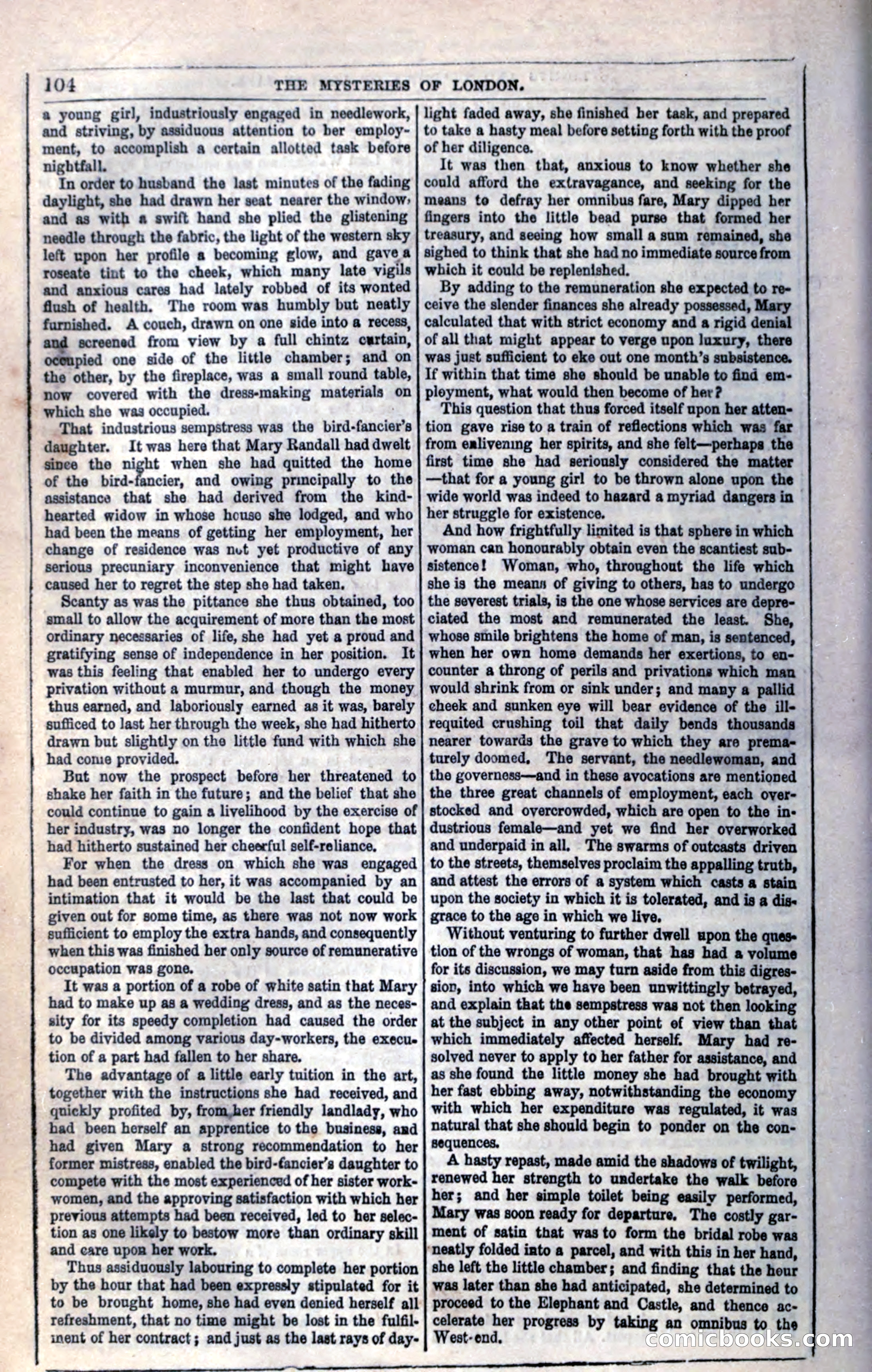
A restored page from Penny Dreadfuls, 1850. Page through the whole issue in the reader above.
📄 Transcribed text from this page (OCR, searchable)
Machine-transcribed from the original scan — historical spelling and the odd misread are preserved.
—- @a- = —_e-- -— - —_ — 104 a young girl, industriously engaged in needlework, and striving, by assiduous attention to ber employ- ment, to accomplish a certain allotted task before nightfall. In order to husband the last minutes of the fading daylight, she had drawn her seat nearer the window, and as with a swift hand she plied the glistening needle through the fabric, the light of the western sky left upon her profile a becoming glow, and gave a roseate tint to the cheek, which many late vigils and anxious cares had lately robbed of its wonted flush of health. The room was humbly but neatly furnished. A couch, drawn on one side into a recess, screened from view by a full chintz curtain, ocenpied one side of the little chamber; and on the other, by the fireplace, was a small round table, now covered with the dressemaking materials on which she was occupied. ! That industrious sempstress was the bird-fancier’s daughter. It was here that Mary Randall had dwelt sinee the night when she had quitted the home of the bird-fancier, and owing principally to the assistance that she had derived from the kind- hearted widow in whose house she lodged, and who had been the means of getting her employment, her change of residence was net yet productive of any serious precuniary inconvenience that might have caused her to regret the step she had taken. Scanty as was the pittance she thus obtained, too small to allow the acquirement of more than the most ordinary necessaries of life,she had yet a proud and gratifying sense of independence in her position. It was this feeling that enabled her to undergo every privation without a murmur, and though the money thus earned, and laboriously earned as it was, barely sufficed to last her through the week, she had hitherto drawn but slightly on the little fund with which she had come provided. But now the prospect before her threatened to shake her faith in the future; and the belief that she could continue to gain a livelihood by the exercise of her industry, was no longer the confident hope that had hitherto sustained her cheerful self-reliance, For when the dress on which she was engaged had been entrusted to her, it was accompanied by an intimation that it would be the last that could be given out for some time, as there was not now work sufficient to employ the extra hands, and consequently when this was finished her only source of remunerative occupation was gone. It was a portion of a robe of white satin that Mary had to make up as a wedding dress, and as the neces- sity for its speedy completion had caused the order to be divided among various day-workers, the execu tion of a part had fallen to her share. The advantage of a little early tuition in the art, together with the instructions she had received, and quickly profited by, fromher friendly landlady, who had been herself an apprentice to the business, and had given Mary a strong recommendation to her former mistress, enabled the bird-fancier’s daughter to compete with the most experienced of her sister work- women, and the approving satisfaction with which her previous attempts had been received, led to her selec- tion as one likely to bestow more than ordinary skill and care upon her work. Thus assiduously labouring to complete her portion by the hour that had been expressly stipulated for it to be brought home, she had even denied herself all refreshment, that no time might be lost in the fulfil- inent of her contract; and just as the last rays of day- eS ee eee ee ee THE MYSTERIES OF LONDON, A A cit ttt. tt tia em tt LO Ae 2 -_ -—-- -=- light faded away, she finished her task, and prepared to take a hasty meal before setting forth with the proof of her diligence. It was then that, anxious to know whether she could afford the extravagance, and seeking for the means to defray her omnibus fare, Mary dipped her fingers into the little bead purse that formed her treasury, and seeing how small a sum remained, she sighed to think that she had no immediate source from which it could be replenished. By adding to the remuneration she expected to re- ceive the slender finances she already possessed, Mary calculated that with strict economy and a rigid denial of all that might appear to verge upon luxury, there was just sufficient to eke out one month’s subsistence. If within that time she should be unable to find em- ployment, what would then become of her? This question that thus forced itself upon her atten- tion gave rise to a train of reflections which was far from enlivening her spirits, and she felt—perhaps the first time she had seriously considered the matter —that for a young girl to be thrown alone the wide world was indeed to hazard a myriad dangers in her struggle for existence. And how frightfully limited is that sphere in which woman can honourably obtain even the scantiest sub- sistence! Woman, who, throughout the life which she is the means of giving to others, has to undergo the severest trials, is the one whose services are depre- ciated the most ard remunerated the least. She, whose sthile brightens the home of man, is sentenced, when her own home demands her exertions, to en- counter a throng of perils and privations which man would shrink from or sink under; and many a pallid eheek and sunken eye will bear evidence of the ill- requited crushing toil thet daily bends thousands nearer towards the grave to which they are prema- turely doomed, The servant, the needlewoman, and the governess—and in these ayocations are mentioned the three great channels of employment, each over- stocked and overcrowded, which are open to the in- dustrious female—and yet we find her overworked and underpaid in all, The swarms of outcasts driven to the streets, themselves proclaim the appalling truth, and attest the errors of a system which casts a stain upon the society in which it is tolerated, and is a dis. grace to the age in which we live, Without venturing to further dwell upon the ques tion of the wrongs of woman, that has had a volume for its discussion, we may turn aside from this digres- sior, into which we have been unwittingly betrayed, and explain that the sempstress was not then at the subject in any other point ef view than that which immediately affected herself. Mary had re- solved never to apply to her father for assistance, and as she found the little money she had brought with her fast ebbing away, notwithstanding the economy with which her expenditure was regulated, it was natural that she should begin to ponder on the con- sequences, A hasty repast, made amid the shadows of twilight, renewed her strength to undertake the walk before her; and her simple toilet being easily performed, Mary was soon ready for departure. The costly gar- ment of satin that was to form the bridal robe was ‘neatly folded into a parcel, and with this in her hand, she left the little chamber; and finding that the hour was later than she had anticipated, she determined to proceed to the Elephant and Castle, and thence ac- celerate her progress by taking an omnibus to the West-end, Gomicbooks