
Penny Dreadfuls, 1850 · page 125 of 394
The Mysteries of London; or, Lights and Shadows of London Life — page 125: what you’re looking at
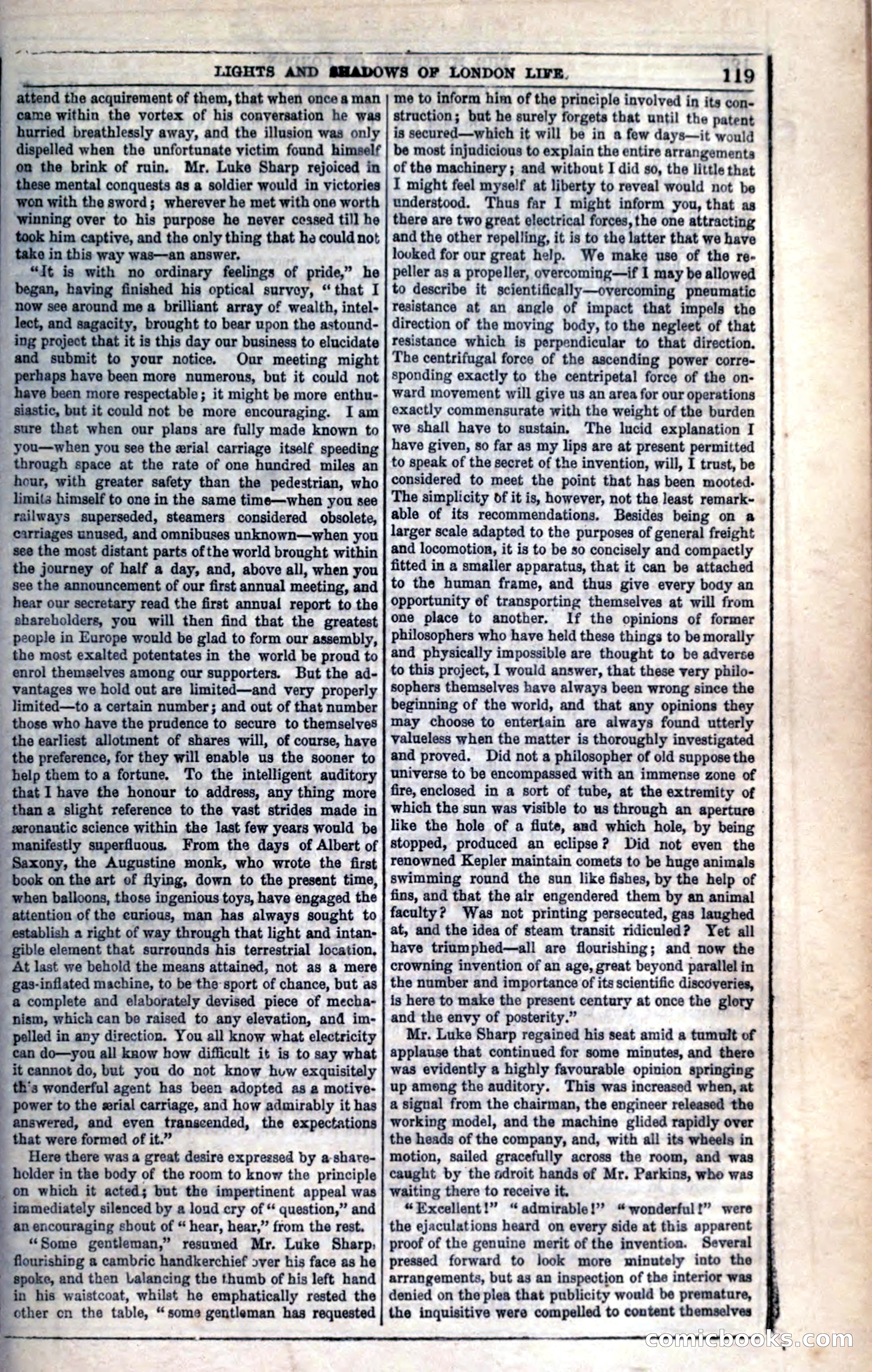
A restored page from Penny Dreadfuls, 1850. Page through the whole issue in the reader above.
📄 Transcribed text from this page (OCR, searchable)
Machine-transcribed from the original scan — historical spelling and the odd misread are preserved.
Pp attend end the acquirement of them, that when once a man _ came within the vortex of his conversation he was _ hurried breathlessly away, and the illusion was only _ dispelled when the unfortunate victim found himself on the brink of ruin. Mr. Luke Sharp rejoiced in these mental conquests as a soldier would in victories _ won with the sword; wherever he met with one worth _ winning over to his purpose he never cessed til] he _ took him captive, and the only thing that he could not take in this way was—an answer. “dt is with no ordinary feelings of pride,” he began, having finished his optical survey, “that I now see around me a brilliant array of wealth, intel- lect, and sagacity, brought to bear upon the astound- ing project that it is this day our business to elucidate and submit to your notice. Our meeting might perhaps have been more numerons, but it could not _ have been more respectable; it might be more enthu- _ siastic, but it could not be more encouraging. I am _ sure that when our plans are fully made known to _ you—when you see the erial carriage itself speeding through space at the rate of one hundred miles an hour, with greater safety than the pedestrian, who limits himself to one in the same time—when you see railways superseded, steamers considered obsolete, _ carriages unused, and omnibuses unknown—when you _ see the most distant parts of the world brought within the journey of half a day, and, above all, when you see the announcement of our first annual meeting, and _ hear our secretary read the first annual report to the shareholders, you will then find that the greatest people in Europe would be glad to form our assembly, the most exalted potentates in the world be proud to enrol themselves among our supporters. But the ad- vantages we hold out are limited—and very properly limited—to a certain number; and out of that number _ those who have the prudence to secure to themselves _ the earliest allotment of shares will, of course, have _ the preference, for they will enable us the sooner to help them toa fortune. To the intelligent auditory _ that I have the honour to address, any thing more : than a slight reference to the vast strides made in = science within the last few years would be manifestly superfluous. From the days of Albert of ‘Saxony, the Augustine monk, who wrote the first _ book on the art of flying, down to the present time, when balloons, those ingenious toys, have engaged the attention of the curious, man has always sought to establish a right of way through that light and intan- gible element that surrounds his terrestrial location, _ At last we behold the means attained, not as a mere gas-inflated machine, to be the sport of chance, but as _a complete and elaborately devised piece of mecha- nism, which can be raised to any elevation, and im- polled in any direction. You all know what electricity can do—you all know how difficult it is to say what it cannot do, but you do not know huw exquisitely th’s wonderful agent has been adopted as a motive- _ power to the srial carriage, and how admirably it has answered, and eyen transcended, the expectations that were formed of it.” Here there was a great desire expressed by a-share- holder in the body of the room to know the principle on which it acted; but the impertinent appeal was immediately silenced by a loud cry of “ question,” and an encouraging shout of “ hear, hear,” from the rest. “Some gentleman,” resumed Mr. Luke Sharp, flourishing a cambric handkerchief >ver his face as he and then Lalancing the thumb of his left hand in his waistcoat, whilst he emphatically rested the other cn the table, “some gentleman has requested LIGHTS AND aHADOWS OF LONDON LIFE. 119 me to inform him of the principle involved in its con- struction; but he surely forgets that until the patent is secured—which it will be in a few days—it would be most injudicions to explain the entire arrangements of the machinery; and without I did so, the little thet I might feel myself at liberty to reveal would not be understood. Thus far I might inform you, that as there are two great electrical forces, the one attracting and the other repelling, it is to the latter that we have looked for our great help. We make use of the re- peller as a propeller, overcoming—if I may be allowed to describe it scientifically—overcoming pneumatic resistance at an angle of impact that impels the direction of the moving body, to the negleet of that resistance which is perpendicular to that direction. The centrifugal force of the ascending power corre- sponding exactly to the centripetal force of the on- ward movement will give us an area for our operations exactly commensurate with the weight of the burden we shall have to sustain. The lucid explanation I have given, so far as my lips are at present permitted to speak of the secret of the invention, will, I trust, be considered to meet the point that has been mooted. The simplicity of it is, however, not the least remark~ able of its recommendations. Besides being on a larger scale adapted to the purposes of general freight and locomotion, it is to be so concisely and compactly fitted in a smaller apparatus, that it can be attached to the human frame, and thus give every body an opportunity of transporting themselves at will from one place to another. If the opinions of former philosophers who have held these things to be morally and physically impossible are thought to be adverse to this project, 1 would answer, that these very philo- sophers themselves have always been wrong since the beginning of the world, and that any opinions they may choose to entertain are always found utterly valueless when the matter is thoroughly investigated and proved. Did not a philosopher of old suppose the universe to be encompassed with an immense zone of fire, enclosed in a sort of tube, at the extremity of which the sun was visible to us through an aperture like the hole of a flute, and which hole, by being stopped, produced an eclipse? Did not even the renowned Kepler maintain comets to be huge animals swimming round the sun like fishes, by the help of fins, and that the air engendered them by an animal faculty? ‘Was not printing persecuted, gas laughed at, and the idea of steam transit ridiculed? Yet all have triumphed—all are flourishing; and now the crowning invention of an age, great beyond parallel in the number and importance of its scientific discdyeries, is here to make the present century at once the glory and the envy of posterity.” Mr. Luke Sharp regained his seat amid a tumult of applause that continued for some minutes, and there was evidently a highly favourable opinion springing up among the auditory. This was increased when, at a signal from the chairman, the engineer released the working model, and the machine glided rapidly over the heads of the company, and, with all its wheels in motion, sailed gracefully across the room, and was caught by the adroit hands of Mr. Parkins, who was waiting there to receive it, “Excellent!” “admirable!’’ “wonderful!” were the ejaculations heard on every side at this apparent proof of the genuine merit of the invention. Several pressed forward to look more minutely into the arrangements, but as an inspection of the interior was denied on the plea that publicity would be premature, the inquisitive were compelled to content themselves OLA ANKA TOONS EO m CE EO Eo