
Penny Dreadfuls, 1850 · page 129 of 394
The Mysteries of London; or, Lights and Shadows of London Life — page 129: what you’re looking at
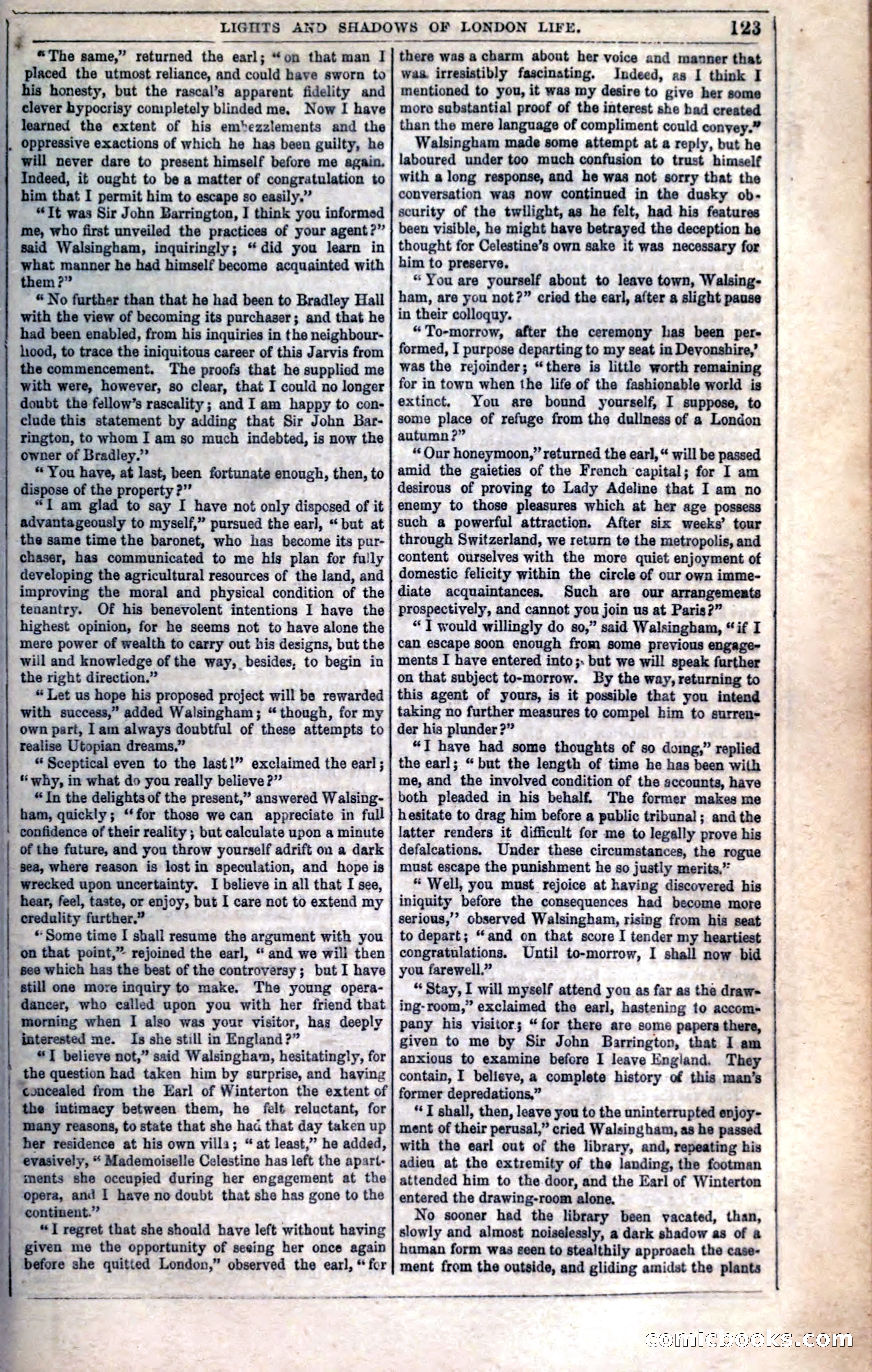
A restored page from Penny Dreadfuls, 1850. Page through the whole issue in the reader above.
📄 Transcribed text from this page (OCR, searchable)
Machine-transcribed from the original scan — historical spelling and the odd misread are preserved.
eli a ae ee De ee SE etme sa a: : ! 4 j 4 : LIGHTS AND SHADOWS OF LONDON LIFE, “The same,” returned the earl; “on that man I the utmost reliance, and could have sworn to s honesty, but the rascal’s apparent fidelity and clever hypocrisy completely blinded me, Now I have Hi } learned the extent of his embezzlements and the ene exactions of which he has been guilty, he never dare to present himself before me again. Books tc he o meatier of conamiabtne 1 ee oe oan “Tt was Sir John Barrington, I think you informed 0 first unveiled the practices of your agent?” alsingham, inquiringly; “did you learn in manner he had himself become acquainted with further than that he had been to Bradley Hall the view of becoming its purchaser; and that he had been enabled, from his inquiries in the neighbour- d, to trace the iniquitous career of this Jarvis from commencement. The proofs that he supplied me with were, however, so clear, that I could no longer eR the fellow’s rascality ; and I am happy to con- clude this statement by adding that Sir John Bar- rington, to whom I am so much indebted, is now the owner of Bradley.’ * You have, at last, been fortunate enough, then, to of the property ?”’ I am glad to say I have not only disposed of it to myself,” pursued the earl, “but at +o vena advantageously the same time the baronet, who has become its pur- chaser, has communicated to me his plan for fu'ly developing the agricultural resources of the land, and improving the moral and physical condition of the tenantry. Of his benevolent intentions I have the highest opinion, for he seems not to have alone the mere power of wealth to carry out his designs, but the will and knowledge of the way, besides, to begin in the right direction.” * Let us hope his proposed project will be rewarded with success,” added Walsingham; “though, for my own part, Iam always doubtful of these attempts to realise Utopian dreams,” “ Sceptical even to the last!” exclaimed the earl; “why, in what do you really believe?” “In the delights of the present,” answered Walsing- ham, quickly; “for those we can appreciate in full confidence of their reality ; but calculate upon a minute of the future, and you throw yourself adrift on a dark pea, where reason is lost in speculation, and hope is wrecked upon uncertainty. I believe in all that I see, hear, feel, taste, or enjoy, but I care not to extend my credulity further,” “Some time I shall resume the argument with you on that point,” rejoined the earl, “ and we will then see which has the best of the controversy; but I have still one more inquiry to make. The young opera- dancer, who called upon you with her friend that morning when I also was your visitor, has deeply interested me. Is she still in England?” “TI believe not,” said Walsingham, hesitatingly, for _the question had taken him by surprise, and haying from the Earl of Winterton the extent of the intimacy between them, he felt reluctant, for Many reasons, to state that she hac that day taken up her residence at his own villa; “at least,” he added, evasively, * Mademoiselle Celestine has left the apart- ments she occupied during her engagement at the opera, and I have no doubt that she has gone to the continent.” “I regret that she should have left without having given me the opportunity of seeing her once again before she quitted London,” observed the earl, “ for me ee - a - — os oe ee -—- ———s ee WSOP LORDON Lirx, = 123 there was a charm about her voice and manner that was. irresistibly fascinating. Indeed, as I think I mentioned to you, it was my desire to give her some more substantial proof of the interest she had created than the mere language of compliment could convey.” Walsingham made some attempt at a reply, but he laboured under too much confusion to trust himself with a long response, and he was not sorry that the conversation was now continued in the dusky ob- scurity of the twilight, as he felt, had his features been visible, he might have betrayed the deception he thought for Celestine’s own sake it was necessary for him to preserve. “ You are yourself about to leave town, Walsing- ham, are you not?” cried the earl, after a slight pause in their colloquy. “To-morrow, after the ceremony has been per- formed, I purpose departing to my seat in Devonshire,’ was the rejoinder; “there is little worth remaining for in town when the life of the fashionable world is extinct, You are bound yourself, I suppose, to some place of refuge from the dullness of a London autumn ?” “Our honeymoon,” returned the earl, “ will be passed amid the gaieties of the French capital; for I am desirous of proving to Lady Adeline that I am no enemy to those pleasures which at her age possess such a powerful attraction. After six weeks’ tour through Switzerland, we return te the metropolis, and content ourselves with the more quiet en joyment of domestic felicity within the circle of our own imme- diate acquaintances. Such are our arrangements prospectively, and cannot you join us at Paris?” “] would willingly do so,” said Walsingham, a al can escape soon enough from some previous engage~- ments I have entered into;. but we will speak further on that subject to-morrow. By the way, returning to this agent of yours, is it possible that you intend taking no further measures to compel him to surren= der his plunder ?” “J have had some thoughts of so doimg,” replied the earl; “ but the length of time he has been with me, and the involved condition of the accounts, have both pleaded in his behalf. The former makes me hesitate to drag him before a public tribunal; and the latter renders it difficult for me to legally prove his defalcations. Under these circumstances, the rogue must escape the punishment he so justly merits,” * Well, you must rejoice at having discovered his iniquity before the consequences had become more serious,’’ observed Walsingham, rising from his seat to depart; “and on that score I tender my heartiest congratulations. Until to-morrow, I shall now bid you farewell.” “ Stay, I will myself attend you as far as the draw- ing-room,” exclaimed the earl, hastening to accom- pany his visitor; “for there are some papers there, given to me by Sir John Barrington, that I am anxious to examine before I leave England. They contain, I believe, a complete history of this man’s former depredations,” I shall, then, leave you to the uninterrupted enjoy- ment of their perusal,” cried Walsingham, as he passed with the earl out of the library, and, repeating his adieu at the extremity of the landing, the footman attended him to the door, and the Earl of Winterton entered the drawing-room alone. No sooner had the library been vacated, than, slowly and almost noiselessly, a dark shadow as of a human form was seen to stealthily approach the case- ment from the outside, and gliding amidst the i ——— CORNICLOO (E(@)