
Penny Dreadfuls, 1850 · page 134 of 394
The Mysteries of London; or, Lights and Shadows of London Life — page 134: what you’re looking at
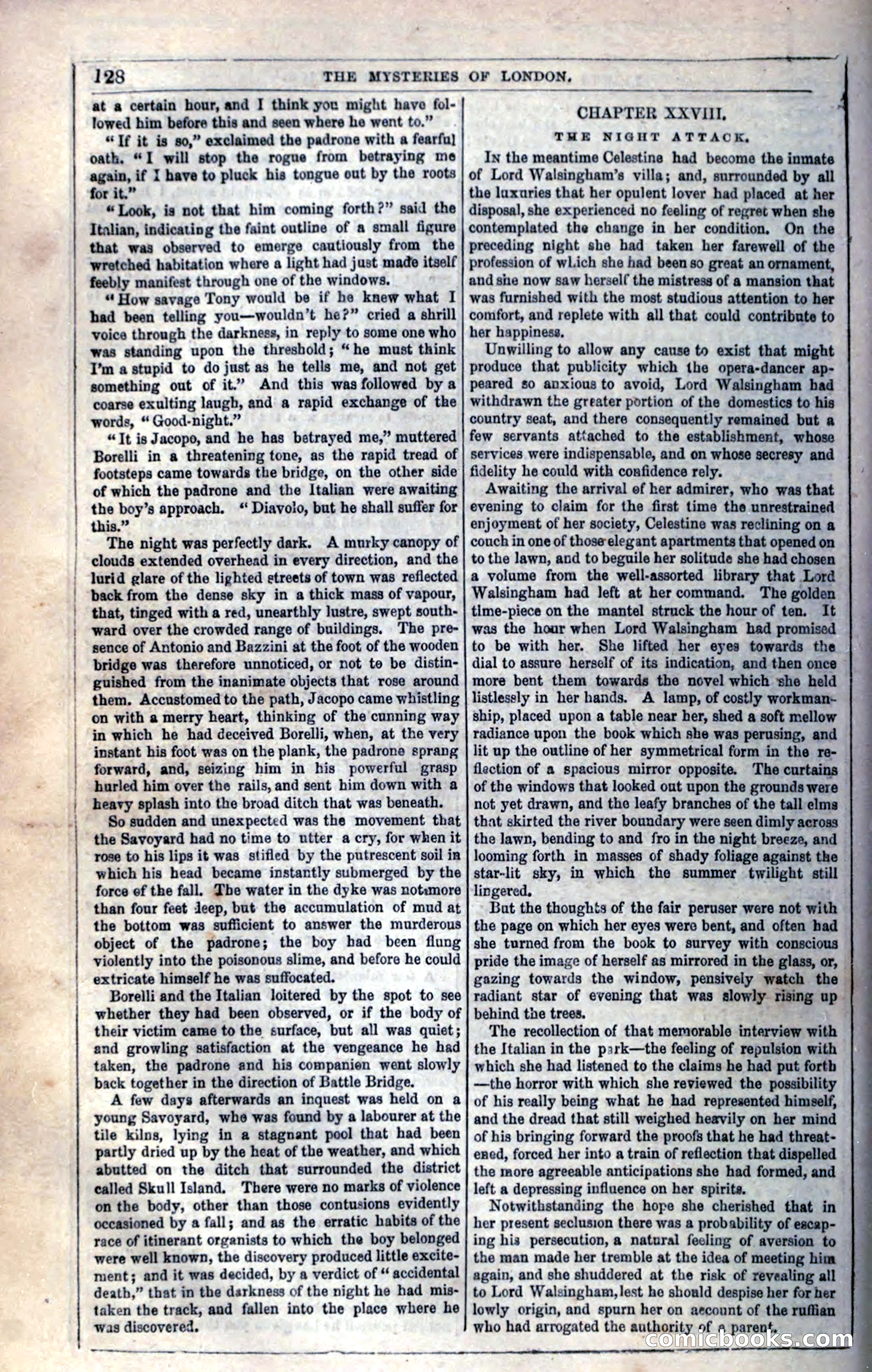
A restored page from Penny Dreadfuls, 1850. Page through the whole issue in the reader above.
📄 Transcribed text from this page (OCR, searchable)
Machine-transcribed from the original scan — historical spelling and the odd misread are preserved.
ewe — ee . — we ee ee 128 : THE MYSTERIES at 2 4 certain hour, and I think you might have fol- lowed him before this and seen where he went to.” “Tf it is so,” exclaimed the padrone with a fearfu) oath, “I will stop the rogue from betraying me again, if I have to pluck his tongue out by the roots for it.” “Look, is not that him coming forth?” said the Italian, indicating the faint outline of a small figure that was observed to emerge cautiously from the wretched habitation where a light had just made itself feebly manifest through one of the windows. “ How savage Tony would be if he knew what I had been telling you—wouldn’t he?” cried a shrill voice through the darkness, in reply to some one who was standing upon the threshold; “he must think I’m a stupid to do just as he tells me, and not get something out of it.” And this was followed by a coarse exulting laugh, and a rapid exchange of the words, “ Good-night.” “It is Jacopo, and he has betrayed me,” muttered Borelli in a threatening tone, as the rapid tread of footsteps came towards the bridge, on the other side of which the padrone and the Italian were awaiting the boy’s approach. “ Diavolo, but he shall suffer for this.” The night was perfectly dark. A murky canopy of clouds extended overhead in every direction, and the lurid glare of the lighted etreets of town was reflected back from the dense sky in a thick mass of vapour, that, tinged with a red, unearthly lustre, swept south- ward over the crowded range of buildings. The pre- sence of Antonio and Bazzini at the foot of the wooden bridge was therefore unnoticed, or not te be distin- guished from the inanimate objects that rose around them. Accnstomed to the path, Jacopo came whistling on with a merry heart, thinking of the cunning way in which he had deceived Borelli, when, at the very instant his foot was on the plank, the padrone sprang forward, and, seizing him in his powerful grasp hurled him over the rails, and sent him down with a heavy splash into the broad ditch that was beneath. So sudden and unexpected was the movement that the Savoyard had no time to utter a cry, for when it rose to his lips it was stifled by the putrescent soil in which his head became instantly submerged by the force ef the fall. The water in the dyke was notsmore than four feet Jeep, but the accumulation of mud at the bottom was sufficient to answer the murderous object of the padrone ; the boy had been flung violently into the poisonous slime, and before he could extricate himself he was suffocated. Borelli and the Italian loitered by the spot to see whether they had been observed, or if the body of their victim came to the surface, but all was quiet; and growling satisfaction at the vengeance he had taken, the padrone and his companien went slowly back together in the direction of Battle Bridge. A few days afterwards an inquest was held on a young Savoyard, whe was found by a labourer at the tile kilns, lying in a stagnant pool that had been partly dried up by the heat of the weather, and which abutted on the ditch that surrounded the district called Skull Island. There were no marks of violence on the body, other than those contusions evidently occasioned by a fall; and as the erratic habits of the race of itinerant orgenists to which the boy belonged were well known, the discovery produced little excite- ment; and it was decided, by a verdict of “ accidental death, ? that in the darkness of the night he had mis- taken the track, and fallen into the place where he was discovered, eee ——<— ee a cei ——_ - —_< me OF LONDON ‘ — — - CHAPTER XXVIII, THE NIGHT ATTACK, In the meantime Celestine had become the inmate of Lord Walsingham’s villa; and, surrounded by all the luxuries that her opulent lover had placed at her disposal, she experienced no feeling of regret when she contemplated the change in her condition, On the preceding night she had taken her farewell of the profession of wLich she had been so great an ornament, and she now saw herself the mistress of a mansion that was furnished with the most studious attention to her comfort, and replete with all that could contribute to her happiness, Unwilling to allow any cause to exist that might produce that publicity which the ap- peared so anxious to avoid, Lord Walsingham had withdrawn the greater portion of the domestics to his country seat, and there consequently remained but a few servants attached to the establishment, whose services were indispensable, and on whose secresy and fidelity he could with confidence rely. Awaiting the arrival ef her admirer, who was that evening to claim for the first time the unrestrained enjoyment of her society, Celestine was reclining on a couch in one of those elegant apartments that opened on to the lawn, and to beguile her solitude she had chosen a volume from the well-assorted library that Lord Walsingham had left at hercommand. The time-piece on the mantel struck the hour of ten. It — was the hour when Lord W to be with her. She lifted her eyes towards the dial to assure herself of its indication, and then once ~ more bent them towards the novel which she held listlessly in her hands. A lamp, of costly workman ship, placed upon a table near her, shed a soft mellow radiance upon the book which she was perusing, and lit up the outline of her symmetrical form in the re- flection of a spacious mirror opposite. The curtains — of the windows that looked out upon the were not yet drawn, and the leafy branches of the tall elms — that skirted the river boundary were seen dimly across the lawn, bending to and fro in the night breeze, and — looming forth in masses of shady foliage against the star-lit sky, in which the summer twilight still lingered, But the thoughts of the fair peruser were not with the page on which her eyes were bent, and often had she turned from the book to survey with conscious | pride the image of herself as mirrored in the glass, or, — gazing towards the window, pensively watch the radiant star of evening that was slowly rising de) behind tie trees. The recollection of that memorable interview with the Italian in the park—the feeling of repulsion with which she had listened to the claims he had put forth —the horror with which she reviewed the possibility of his really being what he had represented himself, | and the dread that still weighed heavily on her mind of his bringing forward the proofs that he had threat- ened, forced her into a train of reflection that dispelled the more agreeable anticipations she had formed, and left a depressing influence on her spirits. Notwithstanding the hope she cherished that in her present seclusion there was a probability of escap- — ing his persecution, a natural feeling of aversion to the man made her tremble at the idea of meeting him — again, and she shuddered at the risk of all to Lord Walsingham, lest he should despise her forher — lowly origin, and spurn her on aecount of the ruffian — who had arrogated the authority of iGomicbooks.cc ' | .