
Penny Dreadfuls, 1850 · page 142 of 394
The Mysteries of London; or, Lights and Shadows of London Life — page 142: what you’re looking at
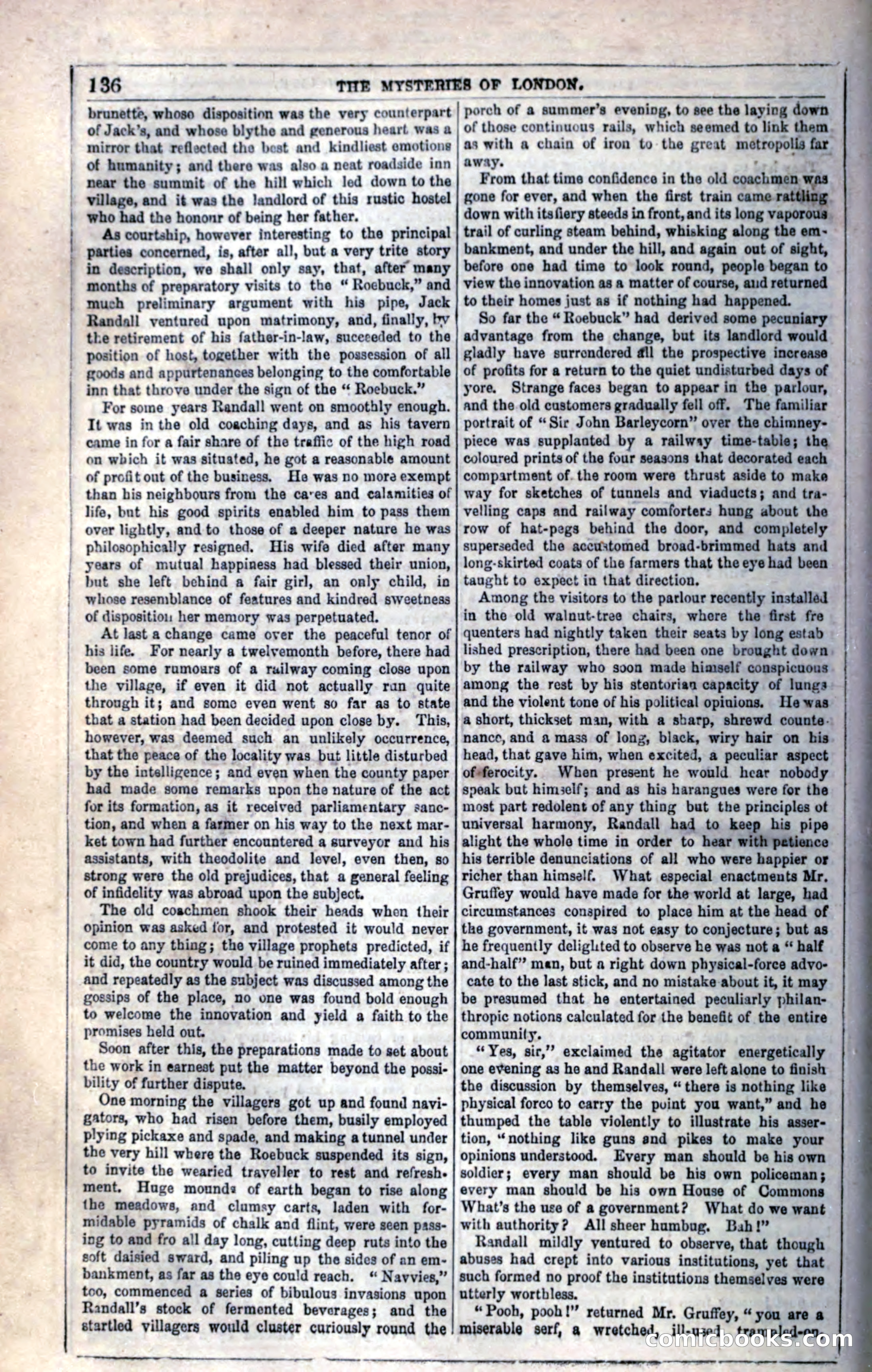
A restored page from Penny Dreadfuls, 1850. Page through the whole issue in the reader above.
📄 Transcribed text from this page (OCR, searchable)
Machine-transcribed from the original scan — historical spelling and the odd misread are preserved.
ee a ee ee eee — owe 136 THE MYSTERIES OF LONDON, ee eer em = —— sti‘ C*” — ET brunette, whoso disposition was the very counterpart of Jack’s, and whose blythe and generous heart was a mirror that reflected the best and kindliest emotions of humanity; and there was also a neat roadside inn near the summit of the hill which led down to the village, and it was the landlord of this rustic hostel who had the hononr of being her father. As courtship, however interesting to the principal parties concerned, is, after all, but a very trite story in description, we shall only say, that, after many months of preparatory visits to the “ Roebuck,” and much preliminary argument with his pipe, Jack Randall ventured upon matrimony, and, finally, bv the retirement of his father-in-law, suceeeded to the position of host, together with the possession of all goods and appurtenances belonging to the comfortable inn that throve under the sign of the “ Roebuck.” For some years Randall went on smoothly enough. It was in the old coaching days, and as his tavern came in for a fair share of the traffic of the high road on which it was situated, he got a reasonable amount of profit out of the business, He was no more exempt than his neighbours from the cares and calamities of | life, but his good spirits enabled him to pass them over lightly, and to those of a deeper nature he was philosophically resigned. His wife died after many years of mutual happiness had blessed their union, but she left behind a fair girl, an only child, in whose resemblance of features and kindred sweetness of disposition her memory was perpetuated. At last a change came over the peaceful tenor of his life. For nearly a twelvemonth before, there had been some rumours of a railway coming close upon the village, if even it did not actually ran quite through it; and some even went so far as to state that a station had been decided upon close by. This, however, was deemed such an unlikely occurrence, that the peace of the locality was but little disturbed by the intelligence; and even when the county paper had made some remarks upon the nature of the act for its formation, as it received parliamentary sanc- tion, and when a farmer on his way to the next mar- ket town had further encountered a surveyor and his assistants, with theodolite and level, even then, so strong were the old prejudices, that a general feeling of infidelity was abroad upon the subject. The old coachmen shook their heads when their Opinion was asked for, and protested it would never come to any thing; the village prophets predicted, if it did, the country would be ruined immediately after ; and repeatedly as the subject was discussed among the gossips of the place, no one was found bold enough to welcome the innovation and yield a faith to the promises held out. Soon after this, the preparations made to set about the work in earnest put the matter beyond the possi- bility of further dispute. One morning the villagers got up and found navi- gators, who had risen before them, busily employed plying pickaxe and spade, and making atunnel under the very hill where the Roebuck suspended its sign, to invite the wearied traveller to rest and refresh- ment, Huge mounds of earth began to rise along the meadows, and clumsy carts, laden with for- midable pyramids of chalk and flint, were seen pass- ing to and fro all day long, cutting deep ruts into the soft daisied sward, and piling up the sides of an em- bankment, as far as the eye could reach. “ Navyvies,” too, commenced a series of bibulous invasions upon Randall’s stock of fermented beverages; and the startled villagers would cluster curiously round the - --— ee porch of a summer’s evening, to see the laying down of those continuous rails, which seemed to link them. as with a chain of iron to the great metropolis far away. >? waa From that time confidence in the old coachmen gone for ever, and when the first train rat down with itsfiery steeds in front, and its long vaporous_ trail of curling steam behind, whisking along the em- bankment, and under the hill, and again out of sight, before one had time to look round, people began to view the innovation as a matter of course, aud returned to their homes just as if nothing had happened. So far the “ Roebuck” had derived some | : advantage from the change, but its landlord would gladly have surrondered @il the prospective increase of profits for a return to the quiet undisturbed days of yore. Strange faces began to appear in the parlour, and the old customers gradually fell off. The familiar portrait of “Sir John Barleycorn” over the chimney- piece was supplanted by a railway time-table; the coloured prints of the four seasons that decorated each compartment of. the room were thrust aside to make way for sketches of tunnels and viaducts; and tra- velling caps and railway comforters hung about the row of hat-pegs behind the door, and completely superseded the accustomed broad-brimmed hats and long-skirted coats of the farmers that the eye had been taught to expect in that direction. Among the visitors to the parlour recently installéd | in the old walnut-tree chairs, where the first fre quenters had nightly taken their seats by long estab lished prescription, there had been one brought down, by the railway who soon made himself conspicuous among the rest by his stentorian capacity of lungs» and the violent tone of his political opinions. He was a short, thickset man, with a sharp, shrewd counte- nance, and a mass of long, black, wiry hair on his. head, that gave him, when excited, a peculiar aspect ofeferocity. When present he would hear nobody speak but himself; and as his harangues were for the most part redolent of any thing but the principles ot universal harmony, Randall had to keep his pipe alight the whole time in order to hear with petience his terrible denunciations of all who were happier or richer than himself. What especial enactments Mr, Gruffey would have made for the world at large, had | circumstances conspired to place him at the head of | the government, it was not easy to conjecture; but as | he frequently delighted to observe he was not a “ half and-half” man, but a right down physical-foree adyo- cate to the last stick, and no mistake about it, it may be presumed that he entertained peculiarly philan- thropic notions calculated for the benefit of the entire community. “Yes, sir,” exclaimed the agitator energetically one evening as he and Randall were left alone to finish the discussion by themselves, “ there is nothing like physical forco to carry the pvint you want,” and he thumped the table violently to illustrate his asser- tion, “nothing like guns and pikes to make your opinions understood. Every man should be his own soldier; every man should be his own policeman; every man should be his own House of Commons What’s the use of a government? What do we want | with authority? All sheer humbug. Bah!” | Randall mildly yentured to observe, that though abuses had crept into various institutions, yet that such formed no proof the institutions themselves were utterly worthless. : “Pooh, pooh!” returned Mr. Gruffey, “you are a | miserable serf, a wretched, miciooksscom —_—_———e