
Penny Dreadfuls, 1850 · page 16 of 394
The Mysteries of London; or, Lights and Shadows of London Life — page 16: what you’re looking at
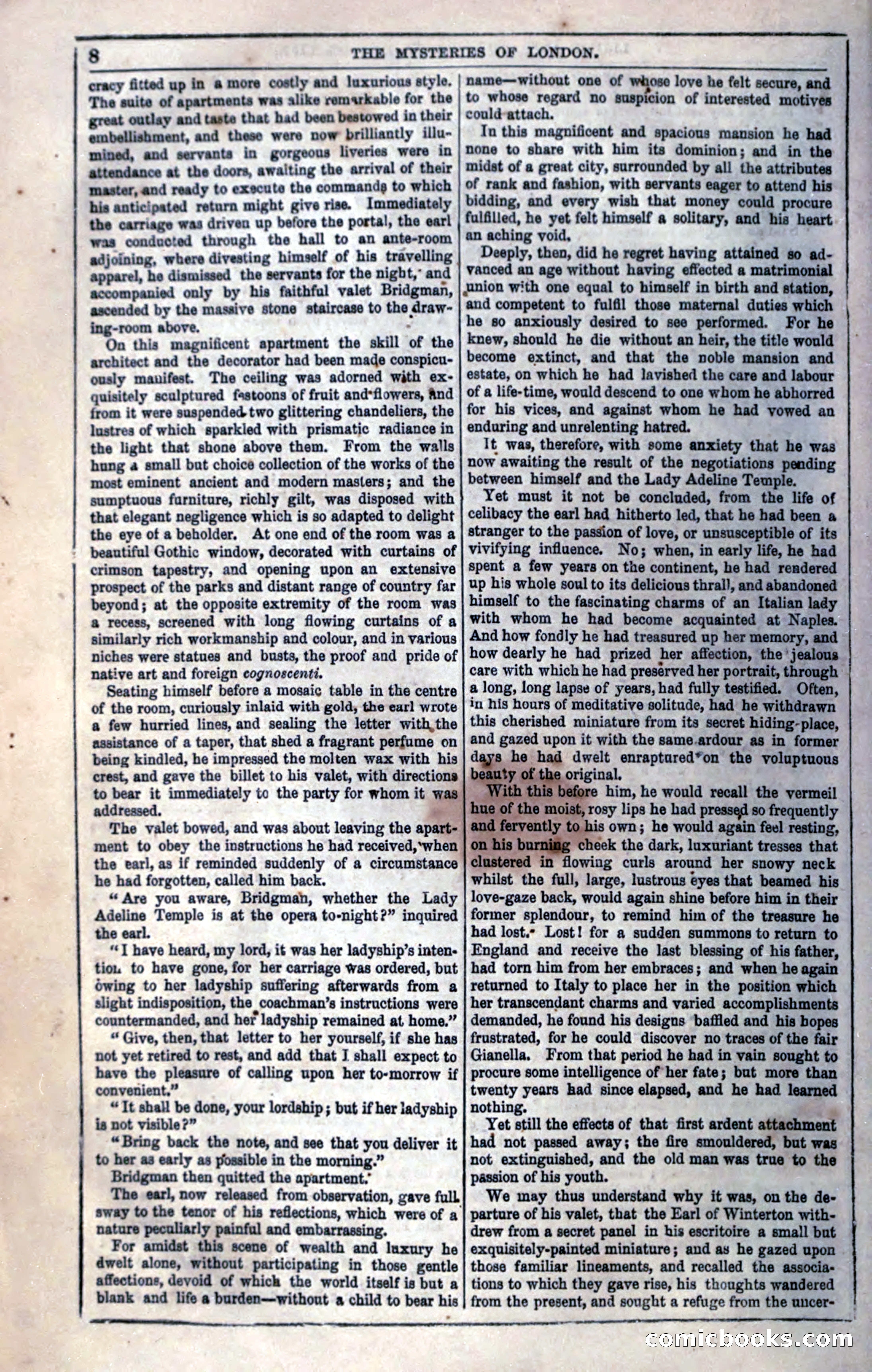
A restored page from Penny Dreadfuls, 1850. Page through the whole issue in the reader above.
📄 Transcribed text from this page (OCR, searchable)
Machine-transcribed from the original scan — historical spelling and the odd misread are preserved.
ee THE MYSTERIES OF LONDON, 7 | a ee EE Berens ae me cracy fitted up in a more costly and luxurious style. The suite of apartments was alike remarkable for the great outlay and taste that had been bestowed in their embellishment, and these were now brilliantly illu- mined, and servants in gorgeous liveries were in attendance at the doors, awalting the arrival of their master, and ready to execute the commands to which his anticipated return might give rise. Immediately the carriage was driven up before the portal, the earl was conducted through the hall to an ante-room adjoining, where divesting himself of his travelling apparel, he dismissed the servants for the night," and accompanied only by his faithful valet Bridgman, ascended by the massive stone staircase to the draw- ing-room above. . On this magnificent apartment the skill of the architect and the decorator had been made conspicu- ously manifest. The ceiling was adorned with ex- quisitely sculptured fastoons of fruit and*flowers, And from it were suspended two glittering chandeliers, the lustres of which sparkled with prismatic radiance in the light that shone above them. From the walls hung a small but choice collection of the works of the most eminent ancient and modern masters; and the sumptuous furniture, richly gilt, was disposed with that elegant negligence which is so adapted to delight the eye of a beholder, At one end of the room was a beautiful Gothic window, decorated with curtains of crimson tapestry, and opening upon an extensive prospect of the parks and distant range of country far beyond; at the opposite extremity of the room was a recess, screened with long flowing curtains of a similarly rich workmanship and colour, and in various niches were statues and busts, the proof and pride of native art and foreign cognoscenti. Seating himself before a mosaic table in the centre of the room, curiously inlaid with gold, the earl wrote a few hurried lines, and sealing the letter with,the assistance of a taper, that shed a fragrant perfume on being kindled, he impressed the molten wax with his crest, and gave the billet to his valet, with directions | beauty to bear it immediately to the party for whom it addressed. The valet bowed, and was about leaving the apart- | aud fervently t ment to obey the instructions he had received, ‘when | On Bis burr the earl, as if reminded suddenly of a circumstance | Ciusterec he had forgotten, called him back. “Are you aware, Bridgman, whether the Lady Adeline Temple is at the opera to-night?” inquired the earl. “‘T have heard, my lord, it was her ladyship’s inten- tio. to have gone, for her carriage was ordered, but owing to her ladyship suffering afterwards from a slight indisposition, the coachman’s instructions were countermanded, and her ladyship remained at home.” “ Give, then, that letter to her yourself, if she has not yet retired to rest, and add that J shall expect to have the pleasure of calling upon her to-morrow if convenient,” “It shall be done, your lordship; but if her ladyship is not visible?” “Bring back the note, and see that you deliver it to her as early as possible in the morning.” Bridgman then quitted the apartment.’ The earl, now released from observation, gave full sway to the tenor of his reflections, which were of a nature peculiarly painful and embarrassing. For amidst this scene of wealth and luxury he dwelt alone, without participating in those gentle affections, devoid of which the world itself is but a blank and life a burden—without a child to bear his i le ef 5 Tt 7 & w ' ~ Gi name—without one of — love he felt secure, and to whose regard no suspicion of interested motives could-attach. In this magnificent and spacious mansion he had none to share with him its dominion; and in the midst of a great city, surrounded by all the attributes of rank and fashion, with servants eager to attend his bidding, and every wish that money could procure fulfilled, he yet felt himself a solitary, and his heart an aching void, \ Deeply, then, did he regret having attained go ad- vanced an age without having effected a matrimonial anion with one equal to himself in birth and station, and competent to fulfil those maternal duties which he so anxiously desired to see performed. For he knew, should he die without an heir, the title would become extinct, and that the noble mansion and estate, on which he had lavished the care and labour of a life-time, would descend to one whom he abhorred for his vices, and against whom he had yowed an enduring and unrelenting hatred. It was, therefore, with some anxiety that he was now awaiting the result of the negotiations pending between himself and the Lady Adeline Temple. Yet must it not be concluded, from the life of celibacy the earl had hitherto led, that he had been a stranger to the passion of love, or unsusceptible of its vivifying influence. No; when, in early life, he had spent a few years on the continent, he had rendered up his whole soul to its delicious thrall, and abandoned himself to the fascinating charms of an Italian lady with whom he had become acquainted at Naples. And how fondly he had treasured up her memory, and how dearly he had prized her affection, the ‘jealou care with which he had preserved her portrait, throug a long, long lapse of years, had fully testified. Ofte in his hours of meditative solitude, had he withdrawn this cherished miniature from its secret hiding-place, and gazed upon it with the same.ardour as in former had net | enraptared*on the voluptuous love-gaze back, would again shine before him in their former splendour, to remind him of the treasure he had lost. Lost! for a sudden summons to return to England and receive the last blessing of his father, had torn him from her embraces; and when he again returned to Italy to place her in the position which her transcendant charms and varied accomplishments demanded, he found his designs baffled and his bopes frustrated, for he could discover no traces of the fair Gianella. From that period he had in vain sought to procure some intelligence of her fate; but more than twenty years had since elapsed, and he had learned nothing. | Yet still the effects of that first ardent atta had not passed away; the fire smouldered, but was not extinguished, and the old man was true to the passion of his youth. We may thus understand why it was, on the de- parture of his valet, that the Earl of Winterton with- drew from a secret panel in his escritoire a small but — exquisitely-painted miniature; and as he gazed upon © those familiar lineaments, and recalled the associa- tions to which they gave rise, his thoughts wandered from the present, and sought a refuge from the uncer- _ <a pe ale os (eo) boo Me ‘(S.com