
Penny Dreadfuls, 1850 · page 168 of 394
The Mysteries of London; or, Lights and Shadows of London Life — page 168: what you’re looking at
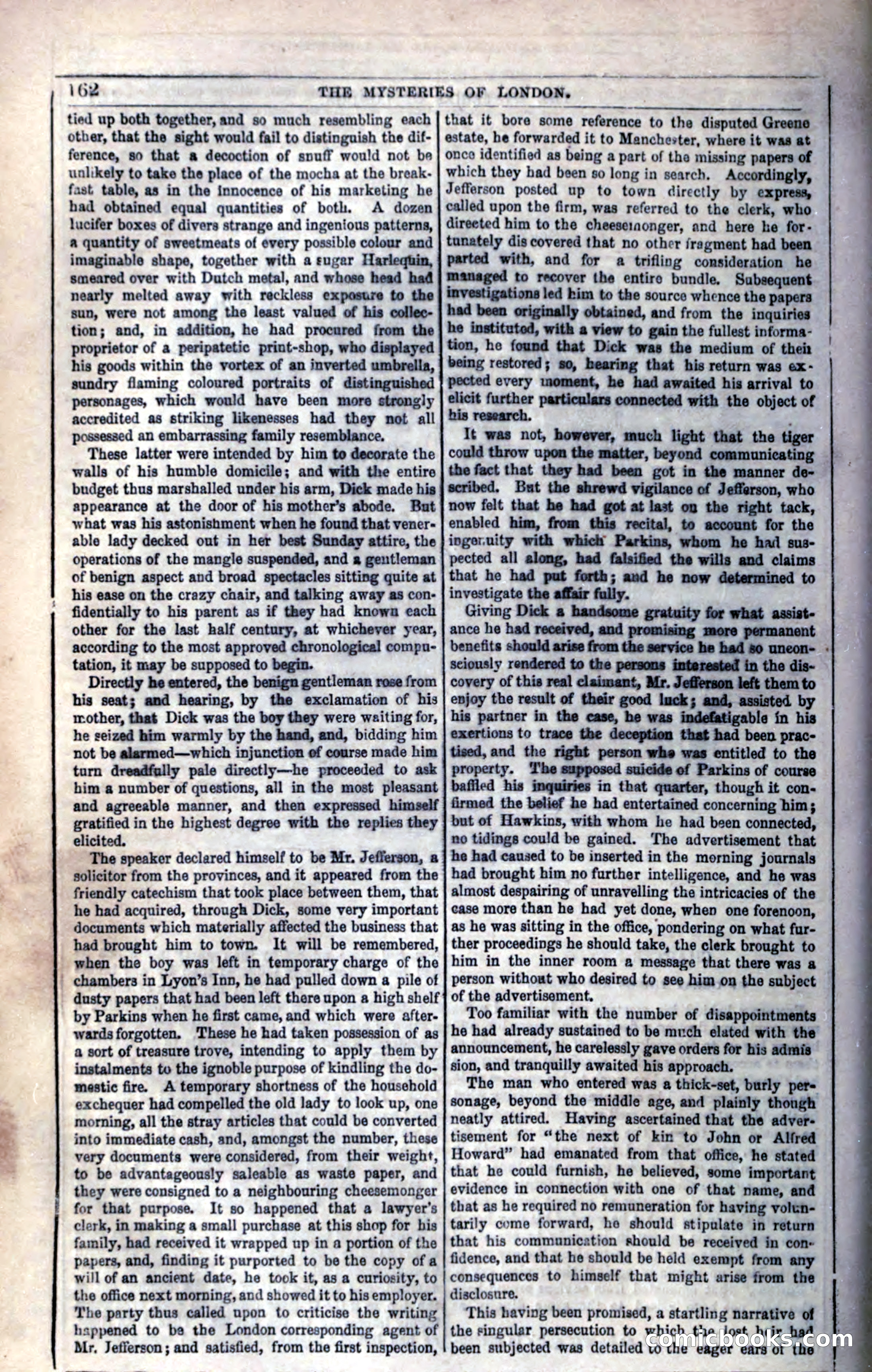
A restored page from Penny Dreadfuls, 1850. Page through the whole issue in the reader above.
📄 Transcribed text from this page (OCR, searchable)
Machine-transcribed from the original scan — historical spelling and the odd misread are preserved.
ve yo aa le 162 tied up both together, and so much resembling each other, that the sight would fail to distinguish the dif- ference, so that a decoction of snuff would not be unlikely to take the place of the mocha at the break- fast table, as in the innocence of his marketing he had obtained equal quantities of both. A dozen lucifer boxes of divers strange and ingenious patterns, a quantity of sweetmeats of every possible colour and imaginable shape, together with a suger Harleqhin, smeared over with Dutch metal, and whose head had nearly melted away with reckless exposure to the sun, were not among the least valued of his collec- tion; and, in addition, he had procured from the proprietor of a peripatetic print-shop, who displayed his goods within the vortex of an inverted umbrella, sundry flaming coloured portraits of distinguished personages, which would have been more strongly accredited as striking likenesses had they not all possessed an embarrassing family resemblance. These latter were intended by him to decorate the walls of his humble domicile; and with the entire budget thus marshalled under his arm, Dick made his appearance at the door of his mother’s abode. But what was his astonishment when he found that vener- able lady decked ont in her best Sunday attire, the operations of the mangle suspended, and a gentleman of benign aspect and broad spectacles sitting quite at his ease on the crazy chair, and talking away as con- fidentially to his parent as if they had known each other for the last half century, at whichever year, according to the most approved chronological compu- tation, it may be supposed to begin. Directly he entered, the benign gentleman rose from his seat; amd hearing, by the exclamation of his mother, that Dick was the boy they were waiting for, he seized him warmly by the hand, and, bidding him not be alarmed—which injunction of course made him turn dreadfully pale directly—he proceeded to ask him a number of questions, all in the most pleasant and agreeable manner, and then expressed himself gratified in the highest degree with the replies they elicited. The speaker declared himself to be Mr. Jefferson, a solicitor from the provinces, and it appeared from the friendly catechism that took place between them, that he had acquired, through Dick, some very important documents which materially affected the business that had brought him to town. It will be remembered, when the boy was left in temporary charge of the chambers in Lyon’s Inn, he had pulled down a pile of dusty papers that had been left there upon a high shelf by Parkins when he first came, and which were after- wards forgotten. These he had taken possession of as a sort of treasure trove, intending to apply them by instalments to the ignoble purpose of kindling the do- mestic fire. A temporary shortness of the household exchequer had compelled the old lady to look up, one morning, all the stray articles that could be converted into immediate cash, and, amongst the number, these very documents were considered, from their weight, to be advantageously saleable as waste paper, and they were consigned to a neighbouring cheesemonger for that purpose. It so happened that a lawyer's clerk, in making a small purchase at this shop for his family, had received it wrapped up in a portion of the papers, and, finding it purported to be the copy ofa will of an ancient date, he took it, as a curiosity, to the office next morning, and showed it to his employer. The party thus called upon to criticise the writing happened to be the London corresponding agent of Mr. Jefferson; and satisfied, from the first inspection, THE MYSTERIES OF LONDON, ee - ee A that it bore some reference to the disputed Greene estate, he forwarded it to Manchester, where it was at once identified as being a part of the missing papers of which they had been so long in search. Accordingly, Jefferson posted up to town directly by express, called upon the firm, was referred to the clerk, who direeted him to the cheesetnonger, and here he for- tunately dis covered that no other fragment had been parted with, and for a trifling consideration he managed to recover the entire bundle. Subsequent investigations led him to the source whence the papers had been originally obtained, and from the inquiries he instituted, with a view to gain the fullest informa- tion, he found that Dick was the medium of theit being restored; so, bearing that his return was ex- pected every moment, he had awaited his arrival to elicit further particulars connected with the object of his research. . It was not, however, much light that the tiger could throw upon the matter, beyond communicating the fact that they had been got in the manner de- | scribed. But the shrewd vigilance of Jefferson, who now felt that he had got at last on enabled him, from this to ingeruity with pected all along, had falsified the wills and claims that he had put forth; and he now determined to investigate the affair fully. Giving Dick a handsome gratuity for what assist- ance he had received, and promising more permanent benefits should arise from the service he had so uneon- seiously rendered to the persons interested in the dis- covery of this real claimant, Mr. Jefferson left them to enjoy the result of their good luck; and, assisted by his partner in the case, he was indefatigable in his exertions to trace the deception that had been prac- tised, and the right person whe was entitled to the property. The suicide of Parkins of course baffled his inquiries in that quarter, though it con- firmed the belief he had entertained concerning him; but of Hawkins, with whom he had been connected, no tidings could be gained. The advertisement that he had caused to be inserted in the morning journals had brought him no further intelligence, and he was almost despairing of unravelling the intricacies of the ease more than he had yet done, when one forenoon, as he was sitting in the office, pondering on what fur- ther proceedings he should take, the clerk brought to him in the inner room a message that there was a person without who desired to see him on the subject of the advertisement. Too familiar with the number of disappointments he had already sustained to be much elated with the announcement, he carelessly gave orders for his admis sion, and tranquilly awaited his approach. The man who entered was a thick-set, burly pet- sonage, beyond the middle age, and plainly thong¢h neatly attired. Having ascertained that the adver- tisement for “the next of kin to John or Alfred Howard” had emanated from that office, he stated that he could furnish, he believed, some important evidence in connection with one of that name, and that as he required no remuneration for having volen- tarily come forward, he should stipulate in return that his communication should be received in con- fidence, and that he should be held exempt from any consequences to himself that might arise from the disclosure. This having been promised, a startling narrative of the singular persecution to wbich ¢* been subjected was detailed com