
Penny Dreadfuls, 1850 · page 170 of 394
The Mysteries of London; or, Lights and Shadows of London Life — page 170: what you’re looking at
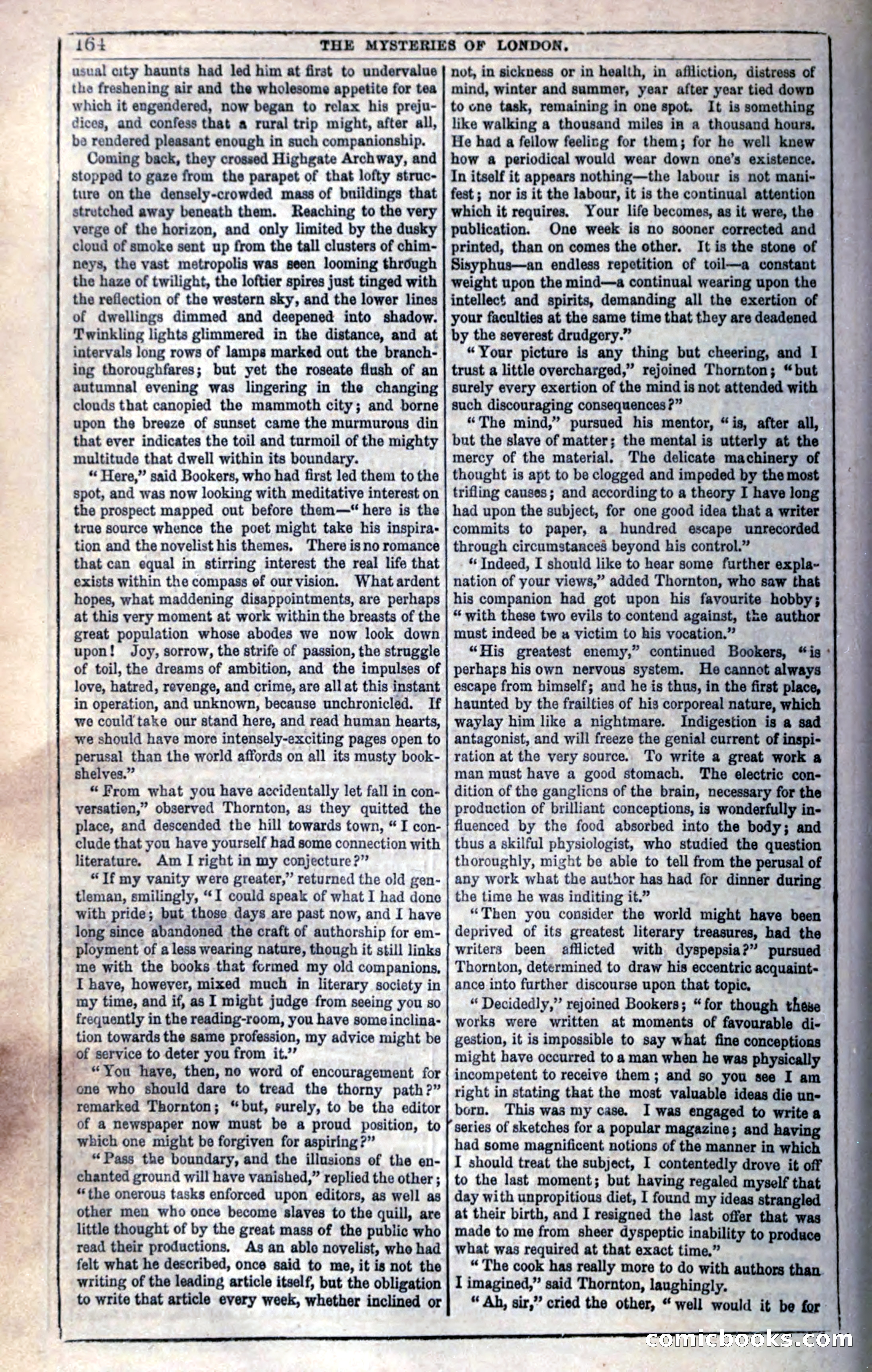
A restored page from Penny Dreadfuls, 1850. Page through the whole issue in the reader above.
📄 Transcribed text from this page (OCR, searchable)
Machine-transcribed from the original scan — historical spelling and the odd misread are preserved.
“164 usual city haunts had led him at first to undervalue the freshening air and the wholesome appetite for tea which it engendered, now began to relax his preju- dices, and confess that a rural trip might, after all, be rendered pleasant enough in such companionship. Coming back, they crossed Highgate Archway, and stopped to gaze from the parapet of that lofty struc- ture on the densely-crowded mass of buildings that stretched away beneath them. Reaching to the very verge of the horizon, and only limited by the dusky cloud of smoke sent up from the tall clusters of chim- neys, the vast metropolis was seen looming through the haze of twilight, the loftier spires just tinged with the reflection of the western sky, and the lower lines of dwellings dimmed and deepened into shadow. Twinkling lights glimmered in the distance, and at intervals long rows of lamps marked out the branch- ing thoroughfares; but yet the roseate flush of an autumnal evening was lingering in the changing clouds that canopied the mammoth city; and borne upon the breeze of sunset came the murmurous din that ever indicates the toil and turmoil of the mighty multitude that dwell within its boundary. “ Here,” said Bookers, who had first led them to the spot, and was now looking with meditative interest on the prospect mapped out before them—“ here is the true source whence the poet might take his inspira- tion and the novelist his themes, There isno romance that can equal in stirring interest the real life that exists within the compass ef ourvision. What ardent hopes, what maddening disappointments, are perhaps at this yery moment at work within the breasts of the great population whose abodes we now look down upon! Joy, sorrow, the strife of passion, the struggle of toil, the dreams of ambition, and the impulses of love, hatred, revenge, and crime, are allat this instant in operation, and unknown, because unchronicled. If we could take our stand here, and read human hearts, we should have more intensely-exciting pages open to perusal than the world affords on all its musty book- shelves.” “From what you have accidentally let fall in con- versation,” observed Thornton, as they quitted the place, and descended the hill towards town, “ I con- clude that you have yourself had some connection with literature. Am I right in my conjecture?” “If my vanity wero greater,” returned the old gen- tleman, smilingly, “I could speak of what I had done with pride; but those days are past now, and I have long since abandoned the craft of authorship for em- ployment of a less wearing nature, though it still links me with the books that formed my old companions, I have, however, mixed much in literary society in my time, and if, as I might judge from seeing you so frequently in the reading-room, you have some inclina- tion towards the same profession, my advice might be of service to deter you from it.’’ _- “You have, then, no word of encouragement for one who should dare to tread the thorny path?” remarked Thornton; “but, eurely, to be the editor of a newspaper now must be a proud position, to which one might be forgiven for aspiring?” “Pass the boundary, and the illusions of the en- chanted ground will have vanished,” replied the other ; “the onerous tasks enforced upon editors, as well as other men who once become slaves to the quill, are little thought of by the great mass of the public who read their productions. As an ablo novelist, who had felt what he described, once said to me, it is not the writing of the leading article itself, but the obligation to write that article every week, whether inclined or omiuicbook om THE MYSTERIES OF LONDON, not, in sickness or in health, in affliction, distress of mind, winter and sammer, year after year tied down to one task, remaining in one spot. It is something like walking a thousand miles in a thousand hours, He had a fellow feeling for them; for he well knew how a periodical would wear down one’s existence. In itself it appears nothing—the labour is not mani- fest; nor is it the labour, it is the continual attention which it requires. Your life becomes, as it were, the publication. One week is no sooner corrected and printed, than on comes the other. It is the stone of Sisyphus—an endless repetition of toil—a constant weight upon the mind—a continual wearing upon the intellect and spirits, demanding all the exertion of your faculties at the same time that they are deadened by the severest drudgery.” “Your picture is any thing but cheering, and I trust a little overcharged,” rejoined Thornton; “but surely every exertion of the mind is not attended with such discouraging consequences ?” | “The mind,” pursued his mentor, “is, after all, but the slave of matter; the mental is utterly at the mercy of the material. The delicate machinery of thought is apt to be clogged and impeded by the most trifling causes; and according to a theory I have long had upon the subject, for one good idea that a writer commits to paper, a hundred escape unrecorded through circumstances beyond his control.” * Indeed, I should like to hear some further expla~ nation of your views,” added Thornton, who saw that his companion had got upon his favourite hobby; “ with these two evils to contend against, the author must indeed be w victim to his vocation.” “His greatest enemy,” continued Bookers, “is * perhars his own nervous system. He cannot always — escape from himself; and he is thus, in the first place, haunted by the frailties of his corporeal nature, which waylay him like a nightmare. Indigestion is a sad antagonist, and will freeze the genial current of inspi- ration at the very source. To write a great work a man must have a good stomach. The electric con- dition of the ganglions of the brain, necessary for the production of brilliant conceptions, is wonderfully in- fluenced by the food absorbed into the body; and thus a skilful physiologist, who studied the question thoroughly, might be able to tell from the of any work what the author has had for dinner during the time he was inditing it.” : “Then you consider the world might have been deprived of its greatest literary treasures, had the writers been afilicted with dyspepsia?” pursued Thornton, determined to draw his eccentric acquaint- ance into further discourse upon that topic, “ Decidedly,” rejoined Bookers; “for though these works were written at moments of favourable di- gestion, it is impossible to say what fine conce might have occurred to a man when he was physically incompetent to receive them; and so see I am right in stating that the most valuable ideas die un- born. This was my case. I was engaged to writea series of sketches for a popular magazine; and having had some magnificent notions of the manner in which I should treat the subject, I contentedly drove it off to the last moment; but having regaled myself that day with unpropitious diet, I found my ideas strangled at their birth, and I resigned the last offer that was made to me from sheer dyspeptic inability to produce what was required at that exact time,” “The cook has really more to do with authors than | I imagined,” said Thornton, laughingly. | “ Ah, sir,” cried the other, “well would it be for