
Penny Dreadfuls, 1850 · page 176 of 394
The Mysteries of London; or, Lights and Shadows of London Life — page 176: what you’re looking at
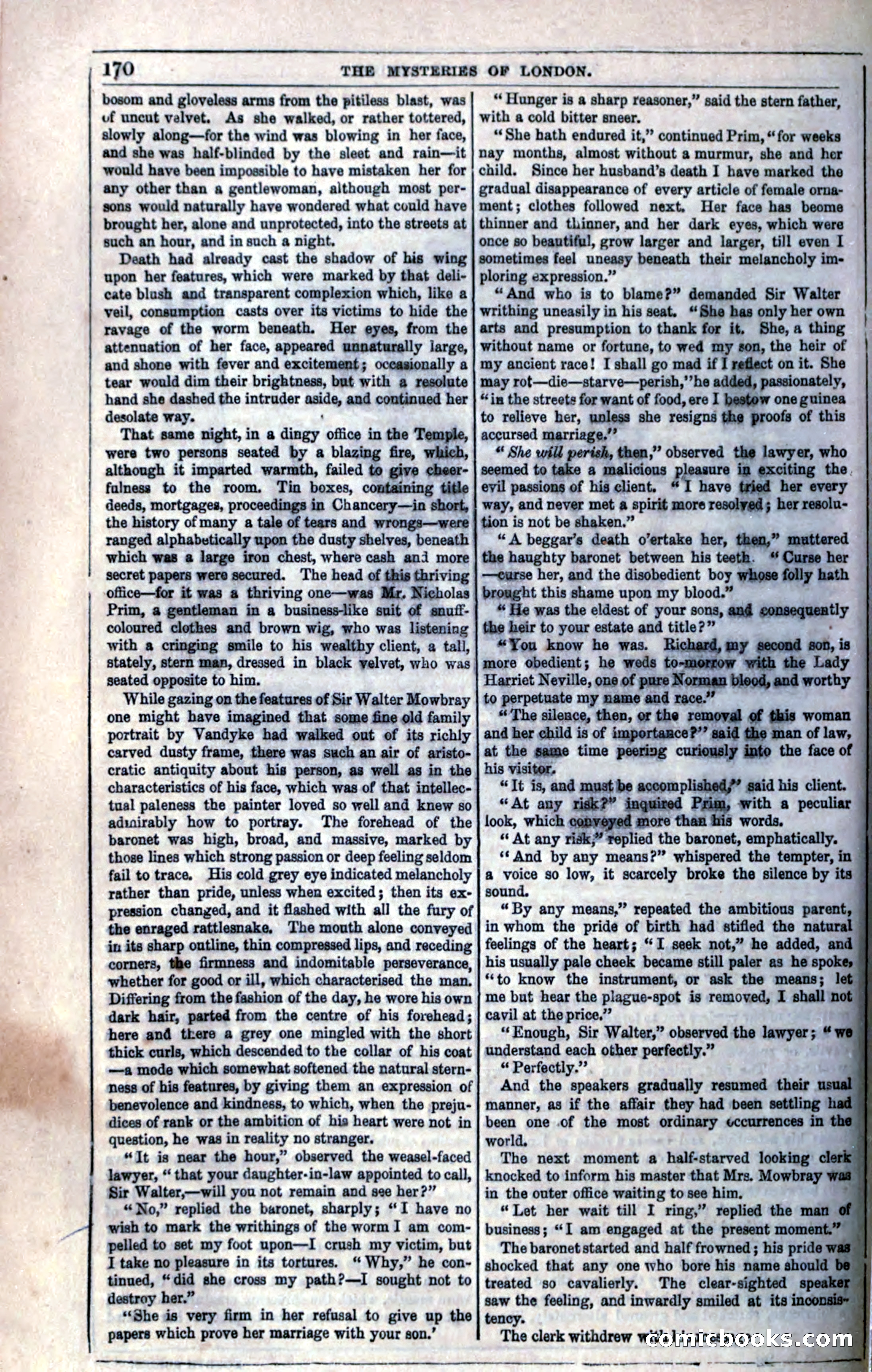
A restored page from Penny Dreadfuls, 1850. Page through the whole issue in the reader above.
📄 Transcribed text from this page (OCR, searchable)
Machine-transcribed from the original scan — historical spelling and the odd misread are preserved.
_ 170 bosom and gloveless arms from the pitiless blast, was uf uncut velvet. As she walked, or rather tottered, slowly along—for the wind was blowing in her face, and she was half-blinded by the sleet and rain—it would have been impossible to have mistaken her for any other than a gentlewoman, although most per- sons would naturally have wondered what could have brought her, alone and unprotected, into the streets at such an hour, and in such a night, Death had already cast the shadow of his w upon her features, which were marked by that deli- cate blush and transparent complexion which, like a veil, consumption casts over its victims to hide the ravage of the worm beneath. Her eyes, from the attenuation of her face, appeared unnaturally large, and shone with fever and excitement; oceasionally a tear would dim their brightness, but with a resolute hand she dashed the intruder aman, and continued her desolate way. That same night, in . aay office in the Temple, were two persons seated by a blazing fire, whieh, although it imparted warmth, failed te give ¢cheer- falness to the room. Tin boxes, containing title | deeds, mortgages, proceedings in Chancery—in short, the history of many a tale of tears and wrongs—were ranged alphabutically upon the dusty shelves, beneath which was a large iron chest, where cash ani more secret papers were secured. The head of this thriving oftice—for it was a thriving one—was Prim, a gentleman in a business-like suit of snuff- coloured clothes and brown wig, who was listening with a cringing smile to his wealthy client, a tall, stately, stern man, dressed in black yelvet, who was seated opposite to him. While gazing on the features of Sir Walter Mowbray one might have imagined that some fine old family portrait by Vandyke had walked out of its richly carved dusty frame, there was such an air of aristo- cratic antiquity about his person, as well as in the characteristics of his face, which was of that intellec- tual paleness the painter loved so well and knew so aduirably how to portray. The forehead of the baronet was high, broad, and massive, marked by those lines which strong passion or deep feeling seldom fail to trace. His cold grey eye indicated melancholy rather than pride, unless when excited; then its ex- pression changed, and it flashed with all the fury of the enraged rattlesnake, The mouth alone conveyed in its sharp outline, thin compressed lips, and receding corners, the firmness and indomitable perseverance, whether for good or ill, which characterised the man. Differing from the fashion of the day, he wore his own dark hair, parted from the centre of his forehead; here and there a grey one mingled with the short thick curls, which descended to the collar of his coat —a mode which somewhat softened the natural stern- ness of his features, by giving them an expression of benevolence and kindness, to which, when the preju- dices of rank or the ambition of his heart were not in question, he was in reality no stranger. “Jt is near the hour,” observed the weasel-faced lawyer, “that your daughter-in-law appointed to call, Sir Walter,—will you not remain and see her?” “No,” replied the baronet, sharply; “I have no wish to mark the writhings of the wormI am com- pelled to set my foot upon—I crush my victim, but ] take no pleasure in its tortures. “ Why,” he con- tinued, “did she cross my path?—I sought not to destroy her.” “She is very firm in her refusal to give up the papers which prove her marriage with your son.’ Mr. Nicholas -—= - THE MYSTERIES OF LONDON. “ Hunger is a sharp reasoner,” said the stern father, with a cold bitter sneer. “She hath endured it,” continued Prim, “for weeks nay months, almost without a murmur, she and her child. Since her husband’s death I have marked the gradual disappearance of every article of female orna- ment; clothes followed next, Her face has beome thinner and thinner, and her dark eyes, which were once so beautiful, grow larger and larger, till even I ing | sometimes feel uneasy beneath their melancholy im- ploring expression.” “And who is to blame?” demanded Sir Walter writhing uneasily in his seat. “She has only her own arts and presumption to thank for it, She, a thing without name or fortune, to wed my son, the heir of my ancient race! I shall go mad if I reflect on it. She may rot—die—starve—perish,”’he added, A “in the streets for want of food, ere I bestow one guinea to relieve her, unless she resigns the proofs of this accursed mar. riage,”’ “ She will Aonen ” observed the lawyer, who seemed to <= in ry Sore the. re Ee ti osent a have tried Te way, and never met a spirit more mb Sree tion is not be shaken.” “A beggar’s death o’ertake her, ” muttered the haughty baronet between his “Curse her — —curse her, and the disobedient boy whose folly hath | brought this shame upon my blood.” *“ He was the eldest of your sons, and amy ik more obedient; he vale Gee Harriet Neville, one of pure Norman and her child is of ‘of law, at the same time peering Sodiog culeaie ta the face of the heir to your estate +o vara to perpetuate my ned yr pion “You know he was. The silence, then, or the rex a ta te his visitor. “It is, and 1 a ange. ons client. | “At any risk? with a peculiar look, which cam more Ri s words. “ At any risk” replied the baronet, emphatically. ‘*And by any means?” whispered the tempter, in a voice so low, it scarcely broke the silence by its sound. “By any means,” repeated the ambitious parent, » in whom the pride of birth had stifled the natural feelings of the heart; “I seek not,” he added, and his usually pale cheek became still paler as he spokes “to know the instrument, or ask the means; let me but hear the plague-spot is removed, I shall not cavil at the price,” “Enough, Sir Walter,” observed the lawyer; “ understand each other perfectly.” “ Perfectly.” And the speakers gradually resumed their 1 manner, as if the affair they had been settling 1 been one of the most ordinary «ccurrences in t world, The next moment a half-starved looking c knocked to inform his master that Mrs. Mowbray w in the outer office waiting to see him. “Let her wait till I ring,” replied the mat business; “I am engaged at the present The baronet started and half frowned ; his pride shocked that any one who bore his name treated so cavalierly. The clear-sighted spea saw the feeling, and inwardly smiled at its ir tency The clerk withdrew wa’etis RE | eles <a —— — sete ati f 4 eo ". ry... <¢or on 8 CHOOKS —_—_—-——_— er