
Penny Dreadfuls, 1850 · page 178 of 394
The Mysteries of London; or, Lights and Shadows of London Life — page 178: what you’re looking at
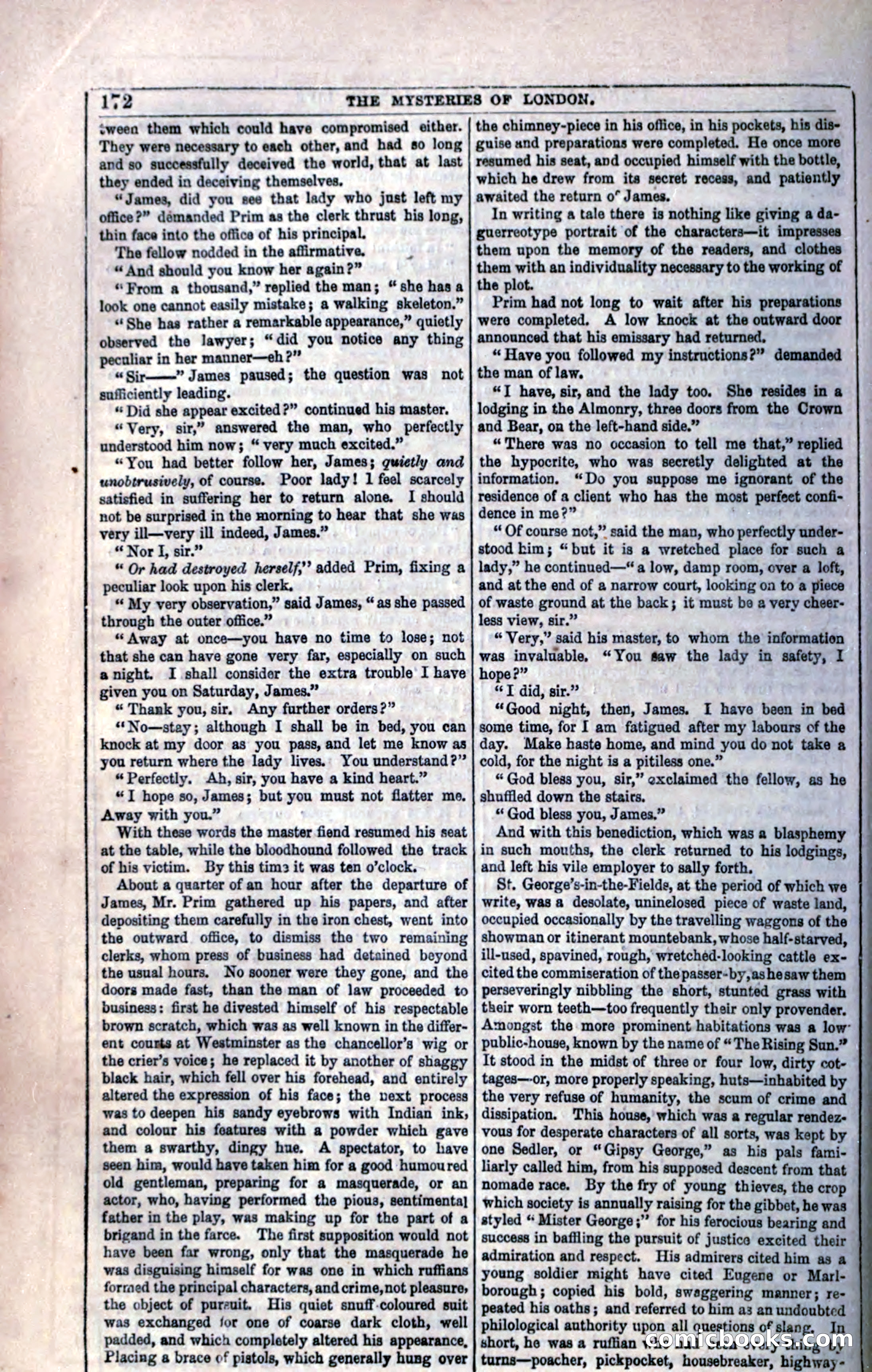
A restored page from Penny Dreadfuls, 1850. Page through the whole issue in the reader above.
📄 Transcribed text from this page (OCR, searchable)
Machine-transcribed from the original scan — historical spelling and the odd misread are preserved.
“472 tween them which could have compromised either. They were necessary to each other, and had so long and so successfully deceived the world, that at last they ended in deceiving themselves. “James, did you see that lady who just left my office?” démanded Prim as the clerk thrust his long, thin face into the office of his principal. The fellow nodded in the affirmative. [ “ And should you know her again?” “From a thousand,” replied the man; “she hasa look one cannot easily mistake; a walking skeleton,” “She has rather a remarkable appearance,” quietly observed the lawyer; “did you notice any thing peculiar in her manner—eh ?” “Sir——” James paused; the question was not sufficiently leading. “ Did she appear excited?” continued his master. “Very, sir,” answered the man, who perfectly understood him now; “ very much excited.” “You had better follow her, James; quietly and unobtrusively, of course. Poor lady! 1 feel scarcely satisfied in suffering her to return alone. I should not be surprised in the morning to hear that she was very ill—very ill indeed, James.” “ Nor I, sir.” “ Or had destroyed herself,’ added Prim, fixing a peculiar look upon his clerk, | “ My very observation,” said James, “as she passed through the outer office.” “ Away at once—you have no time to lose; not that she can have gone very far, especially on such anight. I shall consider the extra trouble I have given you on Saturday, James.” “ Thank you, sir. Any further orders?” ‘“‘No—stay; although I shall be in bed, you can knock at my door as you pass, and let me know as you return where the lady lives. You understand?” “Perfectly. Ah, sir, you have a kind heart.” “T hope so, James; but you must not flatter me. Away with you.” : With these words the master fiend resumed his seat at the table, while the bloodhound followed the track of his victim. By this tims it was ten o’clock. About a quarter of an hour after the departure of James, Mr. Prim gathered up his papers, and after depositing them carefully in the iron chest, went into the outward office, to dismiss the two remaining clerks, whom press of business had detained beyond the usual hours. No sooner were they gone, and the doors made fast, than the man of law proceeded to business: first he divested himself of his respectable brown scratch, which was as well known in the differ- ent counts at Westminster as the chancellor’s wig or the crier’s voice; he replaced it by another of shaggy black hair, which fell over his forehead, and entirely altered the expression of his face; the vext process was to deepen his sandy eyebrows with Indian ink, and colour his features with a powder which gave them a swarthy, dingy hue. A spectator, to have seen him, would have taken him for a good humoured old gentleman, preparing for a masquerade, or an actor, who, having performed the pious, sentimenta] father in the play, was making up for the part of a brigand in the farce. The first supposition would not have been far wrong, only that the masquerade he was disguising himself for was one in which ruffians forraed the principal characters, and crime,not pleasure, the object of pureuit. His quiet snuff-coloured suit was exchanged for one of coarse dark cloth, well padded, and which completely altered his appearance, Placing a brace of pistols, which generally hung over —_ Ace. AL. i. a Ca, til. THE MYSTERIES OF LONDON, the chimney-piece in his office, in his pockets, his dis- guise and preparations were completed. He once more resumed his seat, and occupied himself with the bottle, which he drew from its secret recess, and patiently awaited the return o° James. In writing a tale there is nothing like giving a da- guerreotype portrait of the characters—it impresses them upon the memory of the readers, and clothes them with an individuality necessary to the working of the plot. Prim had not long to wait after his preparations were completed. A low knock at the outward door announced that his emissary had returned, “ Have you followed my instructions?” demanded the man of law. “T have, sir, and the lady too. She resides in a lodging in the Almonry, three doors from the Crown and Bear, on the left-hand side.” ! “There was no occasion to tell me that,” replied the hypocrite, who was secretly delighted at the information. “Do you suppose me ignorant of the residence of a client who has the most perfeet confi- dence in me?” “ Of course not,” said the man, who perfectly under- stood kim; “but it is a wretched place for such a lady,” he continued—* a low, damp room, over a loft, and at the end of a narrow court, looking on to a piece of waste ground at the back; it must be a very cheer- less view, sir.” “Very,” said his master, to whom the information was invaluable, “You saw the lady in safety, I hope?” | “T did, sir.” “Good night, then, James. I have been in bed some time, for I am fatigued after my labours of the day. Make haste home, and mind you do not take a cold, for the night is a pitiless one.” “ God bless you, sir,” exclaimed the fellow, as he shuffled down the stairs. “ God bless you, James,” And with this benediction, which was a blasphemy in such mouths, the clerk returned to his lodgings, and left his vile employer to sally forth. St. George’s-in-the-Fields, at the period of which we write, was a desolate, uninelosed piece of waste land, occupied occasionally by the travelling waggons of the showman or itinerant mountebank, whose half-starved, ill-used, spavined, rough, wretchéd-looking cattle ex- cited the commiseration of the passer-by, ashesaw them perseveringly nibbling the short, stunted grass with their worn teeth—too frequently their only provender. Amongst the more prominent habitations was a low: public-house, known by the name of “The Rising Sun.” — It stood in the midst of three or four low, tages—-or, more properly speaking, huts—inhabited by the very refuse of humanity, the scum of crime and dissipation. This house, which was a regular rendez- vous for desperate characters of all sorts, was kept by one Sedler, or “Gipsy George,” as his pals fami- liarly called him, from his supposed descent from that nomade race. By the fry of young thieves, the crop which society is annually raising for the gibbet, he was styled “ Mister George ;” for his ferocious borough; copied his bold, swaggering manner; re- peated his oaths; and referred to him as an undoubted — philological authority upon all questi f COMICHOO and — success in baffling the pursuit of justice excited their — admiration and respect. His admirers cited him as a young soldier might have cited Eugene or Marl- i be 0 St a