
Penny Dreadfuls, 1850 · page 185 of 394
The Mysteries of London; or, Lights and Shadows of London Life — page 185: what you’re looking at
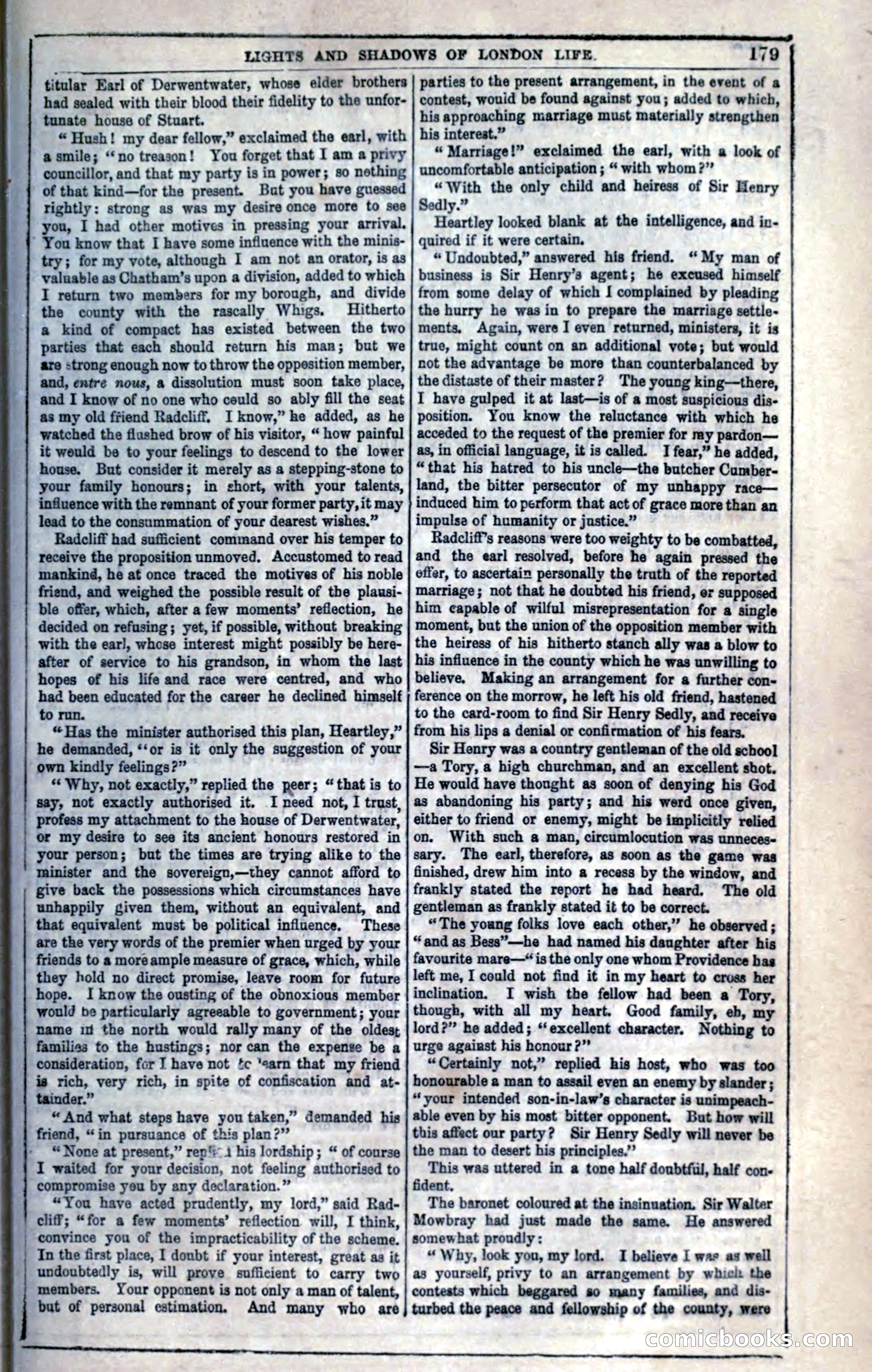
A restored page from Penny Dreadfuls, 1850. Page through the whole issue in the reader above.
📄 Transcribed text from this page (OCR, searchable)
Machine-transcribed from the original scan — historical spelling and the odd misread are preserved.
~~ i - i ' a) * ’ ad es err | > LIGHTS AND SHADOWS OF LONDON LIFE. titular Earl of Derwentwater, whose elder brothers had sealed with their blood their fidelity to the unfor- tunate house of Stuart. “ Hush! my dear fellow,” exclaimed the earl, with asmile; “no treason! You forget that I am a privy councillor, and that my party is in power; so nothing of that kind—for the present. But you have guessed rightly: strong as was my desire once more to see ou, I had other motives in pressing your arrival. ou know that I have some influence with the minis- try; for my vote, although I am not an orator, is as valuable as Chatham’s upon a division, added to which I return two members for my borough, and divide the county with the rascally Whigs. Hitherto a kind of compact has existed between the two parties that each should return his man; but we are strong enough now to throw the oppesition member, and, entre nous, a dissolution must soon take place, and I know of no one who ceuld so ably fill the seat as my old friend Radcliff, I know,” he added, as he watched the flushed brow of his visitor, “ how painful it weuld be to your feelings to descend to the lower house. But consider it merely as a stepping-stone to your family honours; in short, with your talents, influence with the remnant of your former party, it may lead to the consummation of your dearest wishes.” Radcliff had sufficient command over his temper to receive the proposition unmoved. Accustomed to read mankind, he at once traced the motives of his noble friend, and weighed the possible result of the plausi- ble offer, which, after a few moments’ reflection, he decided on refusing; yet, if possible, without breaking with the earl, whose interest might possibly be here- after of service to his grandson, in whom the last hopes of his life and race were centred, and who had been educated for the career he declined himself to run. “Has the minister authorised this plan, Heartley,” he demanded, ‘‘or is it only the suggestion of your own kindly feelings?” “Why, not exactly,” replied the peer; “that is to say, not exactly authorised it. I need not, I trust, profess my attachment to the house of Derwentwater, or my desire to see its ancient honours restored in your person; but the times are trying alike to the mainister and the sovereign,—they cannot afford to give back the possessions which circumstances have unhappily given them, without an equivalent, and that equivalent must be political influence. These are the very words of the premier when urged by your friends to a more ample measure of grace, which, while they hold no direct promise, leave room for future hope. I know the ousting of the obnoxious member would be particularly agreeable to government; your name i the north would rally many of the oldest | families to the hustings; nor can the expense be a consideration, for I have not tc ‘earn that my friend is rich, very rich, in spite of confiscation and at- tainder.” “ And what steps have you taken,” demanded his friend, “in pursuance of this plan?” “None at present,” ren‘ 4 his lordship; “ of course I waited for your decision, not feeling authorised to compromise you by any declaration.” “You have acted prudently, my lord,” said Rad- cliff; “for a few moments’ reflection will, I think, convince you of the impracticability of the scheme. In the first place, I doubt if your interest, great as it undoubtedly is, will prove sufficient to carry two members. Your opponent is not only a man of talent, but of personal estimation. And many who are 179 parties to the present arrangement, in the event of a contest, would be found against you; added to which, his approaching marriage must materially strengthen his interest.” “ Marriage!” exclaimed the earl, with a look of uncomfortable anticipation ; “ with whom ?” “With the only child and heiress of Sir Henry Sedly.” Heartley looked blank at the intelligence, and in- quired if it were certain. “ Undoubted,” answered his friend. ‘“ My man of business is Sir Henry’s agent; he excused himself from some delay of which I complained by pleading the hurry he was in to prepare the marriage settle- ments. Again, were I even returned, ministers, it is true, might count on an additional vote; but would not the advantage be more than counterbalanced by the distaste of their master? The young king—there, I have gulped it at last—is of a most suspicious dis- position. You know the reluctance with which he acceded to the request of the premier for my pardon— as, in official language, it is called. I fear,” he added, “that his hatred to his uncle—the butcher Cumber- land, the bitter persecutor of my unhappy race— induced him to perform that act of grace more than an impulse of humanity or justice.” Radcliff’s reasons were too weighty to be combatted, and the earl resolved, before he again pressed the offer, to ascertain personally the truth of the reported marriage; not that he doubted his friend, er supposed him capable of wilful misrepresentation for a single moment, but the union of the opposition member with the heiress of his hitherto stanch ally was a blow to his influence in the county which he was unwilling to believe. Making an arrangement for a further con- ference on the morrow, he left his old friend, hastened to the card-room to find Sir Henry Sedly, and receive from his lips a denial or confirmation of his fears. Sir Henry was a country gentleman of the old school —a Tory, a high churchman, and an excellent shot. He would have thought as soon of denying his God as abandoning his party; and his werd once either to friend or enemy, might be implicitly relied on. With such a man, circumlocution was unneces- sary. The earl, therefore, as soon as the game was A finished, drew him into a recess by the window, and | frankly stated the report he had heard. The old gentleman as frankly stated it to be correct. “The young folks love each other,” he observed; “and as Bess”—he had named his daughter after his favourite mare—* is the only one whom Providence bas left me, I could not find it in my heart to cross her inclination. I wish the fellow had been a Tory, though, with all my heart. Good family, eb, my lord?” he added; ‘excellent character. Nothing to urge against his honour?” “Certainly not,” replied his host, who was too honourable a man to assail even an enemy by slander; “your intended son-in-law’s character is unimpeach- able even by his most bitter opponent. But how will this affect our party? Sir Henry Sedly will never be the man to desert his principles.’”’ This was uttered in a tone half doubtful, half con- fident. The baronet coloured at the insinuation. Sir Walter Mowbray had just made the same. He answered somewhat proudly: “ Why, look you, my lord. I believe I was as well as yourself, privy to an arrangement by which the contests which beggared so many families, and dis- turbed the peace and fellowship of the county, were GOmiiGsdoo < (©) * ee see erent ereneneses-suesr“estsmconmnm ost emuiaam * -