
Penny Dreadfuls, 1850 · page 188 of 394
The Mysteries of London; or, Lights and Shadows of London Life — page 188: what you’re looking at
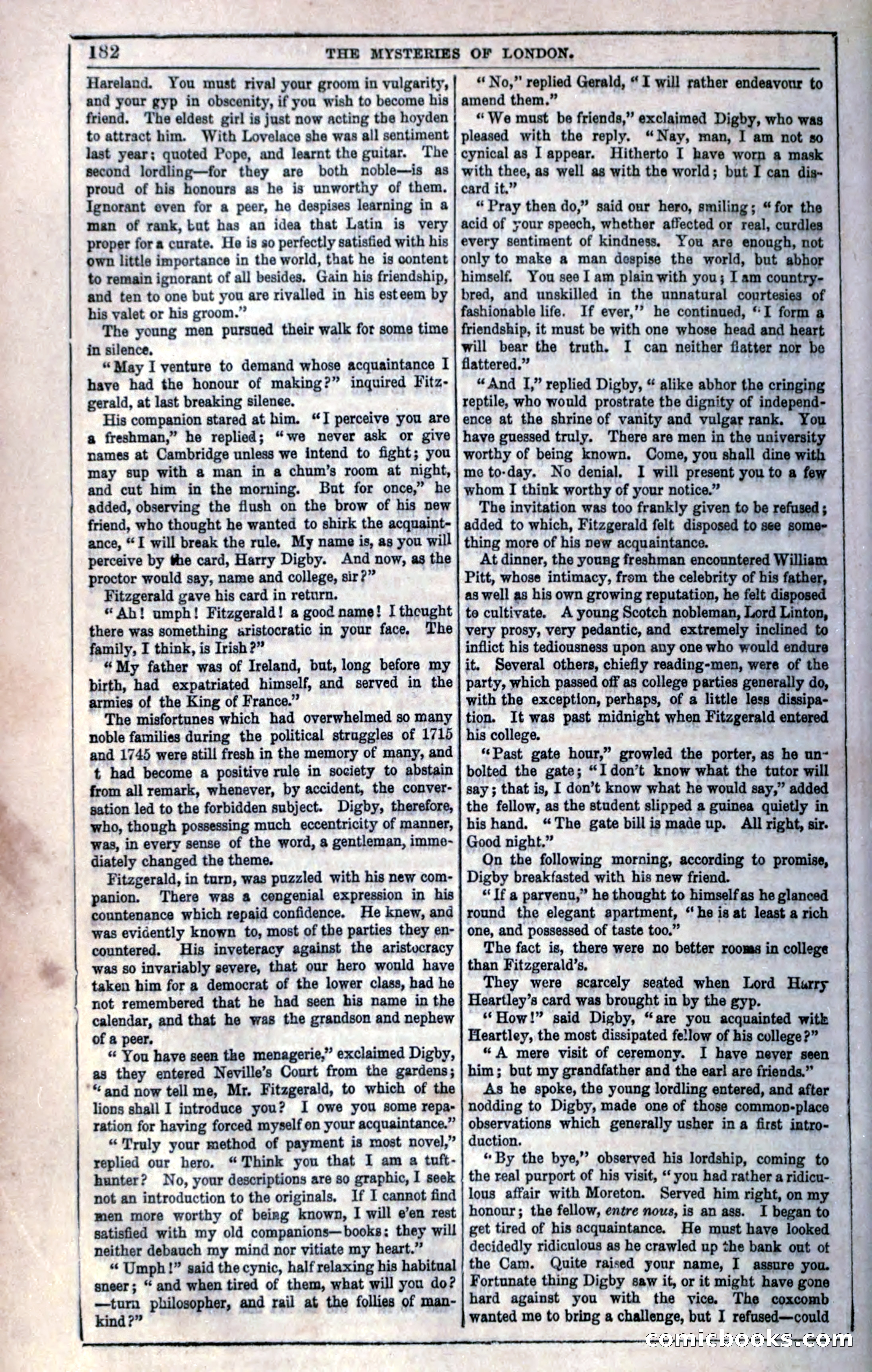
A restored page from Penny Dreadfuls, 1850. Page through the whole issue in the reader above.
📄 Transcribed text from this page (OCR, searchable)
Machine-transcribed from the original scan — historical spelling and the odd misread are preserved.
SN — TT, 182 Hareland. You must rival your groom in vulgarity, and your gyp in obscenity, if you wish to become his friend. The eldest girl is just now acting the hoyden to attract him. With Lovelace she was all sentiment last year; quoted Pope, and learnt the guitar. The second lordling—for they are both noble—is as proud of his honours as he is unworthy of them. Ignorant even for a peer, he despises learning in a man of rank, but has an idea that Latin is very proper fora curate. He is so perfectly satisfied with his own little importance in the world, that he is content to remain ignorant of all besides. Gain his friendship, and ten to one but you are rivalled in his esteem by his valet or his groom.” The young men pursued their walk for some time in silence. “May I venture to demand whose acquaintance I have had the honour of making?” inquired Fitz- gerald, at last breaking silenee. 3 His companion stared at him. “I perceive you are a freshman,” he replied; “we never ask or give names at Cambridge unless we intend to fight; you may sup with a man in a chum’s room at night, and cut him in the morning. Bnt for once,” he added, observing the flush on the brow of his new friend, who thought he wanted to shirk the acquaint- ance, “I will break the rule, My name is, as you will perceive by #he card, Harry Digby. And now, as the proctor would say, name and college, sir dy Fitzgerald gave his card in return. “Ah! umph! Fitzgerald! a good name! | theught there was something aristocratic in your face. The family, I think, is Irish ?” _ “My father was of Ireland, but, long before my birth, had expatriated himself, and served in the armies of the King of France.” The misfortunes which had overwhelmed so many noble families during the political struggles of 1715 and 1745 were still fresh in the memory of many, and t had become a positive rule in society to abstain from all remark, whenever, by accident, the conver- gation led to the forbidden subject. Digby, therefore, who, though possessing much eccentricity of manner, was, in every sense of the word, a gentleman, imme- diately changed the theme. Fitzgerald, in turn, was puzzled with his new com- panion. There was a congenial expression in his countenance which repaid confidence. He knew, and was evidently known to, most of the parties they en- countered. His inveteracy against the aristocracy was so invariably severe, that our hero would have taken him for a democrat of the lower class, had he not remembered that he had seen his name in the calendar, and that he was the grandson and nephew of a peer. “ You have seen the menagerie,” exclaimed Digby, as they entered Neville’s Court from the gardens; ‘* and now tell me, Mr, Fitzgerald, to which of the lions shall I introduce you? I owe you some repa- ration for having forced myself on your acquaintance.” “Truly your method of payment is most novel,” replied our hero. “Think you that I am a tuft- hunter? No, your descriptions are so graphic, I seek not an introduction to the originals, If I cannot find men more worthy of being known, I will e’en rest satisfied with my old companions—books; they will neither debauch my mind nor vitiate my heart.” “ Umph!” said the cynic, half relaxing his habitual sneer; “ and when tired of them, what will you do? —turn philosopher, and rail at the follies of man- kind?” THE MYSTERIES OF LONDON, “No,” replied Gerald, “ I will rather endeavour to amend them.” “We must be friends,” exclaimed Digby, who was pleased with the reply. “Nay, man, I am not so cynical as I appear. Hitherto I have a@ mask wis thee, as well as with the world; but I can dig- card it,” “ Pray then do,” said our hero, smiling; “ acid of your speech, whether affected rig My cardio every sentiment of kindness, You are enough, only to make a man dospise the world, but shor himself, You see I am plain with you; I am country- bred, and unskilled in the unnatural ped ot. . of fashionable life. If ever,” he continued, “I form a friendship, it must be with one whose head and he: will bear the truth. I can neither flatter nor flattered.” | “And I,” replied Digby, “ alike abhor the cringing reptile, who would prostrate the dignity of independ- ence at the shrine of vanity and vulgar rank. have guessed truly. There are men in the uni io worthy of being known. Come, you shall dine me to-day. No denial, I will present you to a few whom I think worthy of your notice.” The invitation was too frankly given to be refused ; added to which, Fitzgerald felt disposed wen some~ thing more of his new acquaintance. t dinner, the young freshman encountered William Pitt, whose intimacy, from the celebrity of his fathe as well as his own growing reputation, he felt di to cultivate. A young Scotch nobleman, Lord Linton very prosy, very pedantic, and extremely inflict his tediousness upon any one who it. Several others, chiefly reading-men, were of the party, which passed off as college parties generally do, with the exception, perhaps, of a little less dissipa- tion. It was past midnight when Fitzgerald entered his college. a ‘‘Past gate hour,” growled the porter, as he un- bolted the gate; “Idon’t know what the tutor will — say ; that is, I don’t know what he would say,” added the fellow, as the student slipped a guinea quietly in his hand. “The gate billis made up. All right, sir. Good night.” On the following morning, according to promise, Digby breakfasted with his new friend. “If a parvenu,” he thought to himselfas he glanced round the elegant apartment, “ he is at least a rich one, and possessed of taste too.” The fact is, there were no better rooms in college than Fitzgerald’s, They were scarcely seated when Lord Hurry Heartley’s card was brought in by the gyp. “How!” said Digby, “are you acquainted with Heartley, the most dissipated fellow of his college?” “A mere visit of ceremony. I have neyer seen him; but my grandfather and the earl are friends.” As he spoke, the young lordling entered, and after nodding to Digby, made one of those commop-place observations which generally usher in a first intro- duction. | “ By the bye,” observed his lordship, coming to the real purport of his visit, ‘‘ you had rather a ridicu- lous affair with Moreton. Served him right, on my honour; the fellow, entre nous, is an ass. I began to get tired of his acquaintance. He must have i decidedly ridiculous as he crawled up the bank out ot the Cam. Quite raised your name, I assure you. Fortunate thing Digby saw it, or it might have gone hard against you with the vice. The coxcomb wanted me to bring a challenge, but I refused—could PGES Ses ee ee OE et = comicbooks.com ed fo — endure —— = - wa aii, enti