
Penny Dreadfuls, 1850 · page 198 of 394
The Mysteries of London; or, Lights and Shadows of London Life — page 198: what you’re looking at
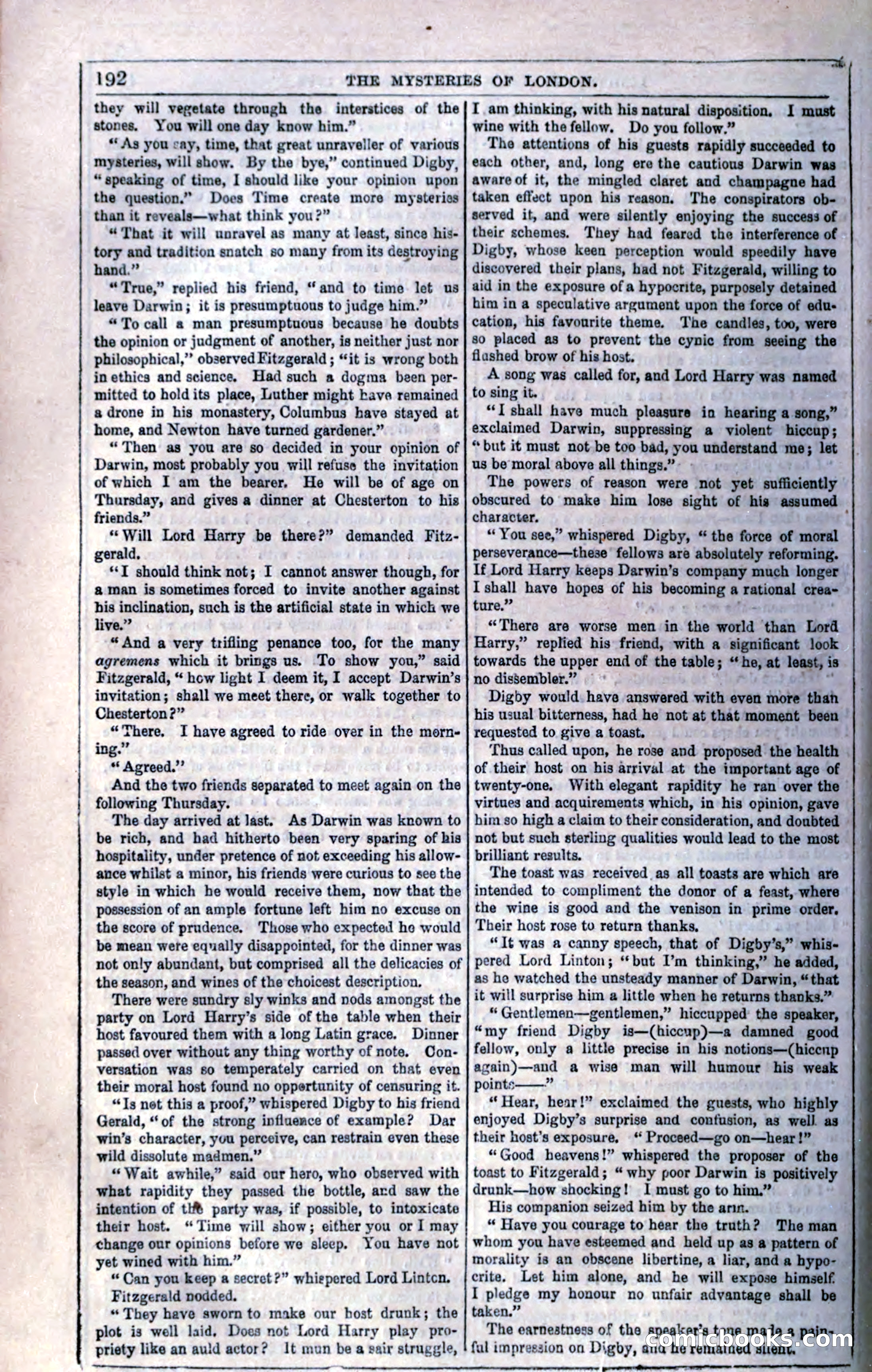
A restored page from Penny Dreadfuls, 1850. Page through the whole issue in the reader above.
📄 Transcribed text from this page (OCR, searchable)
Machine-transcribed from the original scan — historical spelling and the odd misread are preserved.
— ———— + ee 192 they will vegetate through the interstices of the stones. You will one day know him.” “As you cay, time, that great unraveller of various mysteries, will show. By the bye,” continued Digby, “speaking of time, I should like your opinion upon the question.” Does Time create more mysteries than it reveals—what think you?” “That it will unravel as many at least, since his- tory and tradition snatch so many from its destroying hand.” “True,” replied his friend, “and to time let us leave Darwin; it is presumptuous to judge him.” “To call a man presumptuous because he doubts the opinion or judgment of another, is neither just nor philosophical,” observed Fitzgerald ; “it is wrong both in ethics and science, Had such a dogma been per- mitted to hold its place, Luther might have remained a drone in his monastery, Columbus have stayed at home, and Newton have turned gardener.” “Then as you are so decided in your opinion of Darwin, most probably you will refuse the invitation of which I am the bearer. He will be of age on Thursday, and gives a dinner at Chesterton to his friends.” ‘* Will Lord Harry be there?” demanded Fitz- gerald, | “IT should think not; I cannot answer though, for a man is sometimes forced to invite another against his inclination, such is the artificial state in which we live.”’ “And a very trifling penance too, for the many agremens which it brings us. To show you,” said Fitzgerald, “ how light I deem it, I accept Darwin’s invitation; shall we meet there, or walk together to Chesterton?” “There, I have agreed to ride over in the morn- “ Agreed.”’ And the two friends separated to meet again on the following Thursday. The day arrived at last. As Darwin was known to be rich, and had hitherto been very sparing of his hospitality, under pretence of not exceeding his allow- ance whilst a minor, his friends were curious to see the style in which he would receive them, now that the possession of an ample fortune left him no excuse on the score of prudence. Those who expected he would be mean were equally disappointed, for the dinner was not only abundant, but comprised all the delicacies of the season, and wines of the choicest description, There were sundry sly winks and nods amongst the party on Lord Harry’s side of the table when their host favoured them with a long Latin grace. Dinner passed over without any thing worthy of note. Con- versation was so temperately carried on that even their moral host found no oppertunity of censuring it. “Ts net this a proof,” whispered Digby to his friend Gerald, “of the strong influence of example? Dar win’s character, you perceive, can restrain even these wild dissolute madmen.” “Wait awhile,” said our hero, who observed with what rapidity they passed the bottle, ard saw the intention of tl party was, if possible, to intoxicate their host. “Time will show; either you or I may change our opinions before we sleep. You have not yet wined with him.” “Can you keep a secret?” whiepered Lord Lintcn. Fitzgerald nodded. “ They have sworn to make our host drunk; the plot is well laid, Does not Lord Harry play pro- priety like an auld actor? lt mun be a sair struggle, —_——_- —— e ee e - e e ful impression on Digby, a —_— OO re oh THE MYSTERIES OF LONDON, Iam thinking, with his natural disposition, 1 must wine with the fellow. Do you follow.” The attentions of his guests rapidly succeeded to each other, and, long ere the cautious Darwin was — aware of it, the mingled claret and champagne had taken effect upon his reason. The conspirators ob- served it, and were silently enjoying the success of | their schemes. They had feared the interference of Digby, whose keen perception would speedily have discovered their plans, had not Fitzgerald, willing to aid in the exposure of a hypocrite, purposely detained him in a speculative argument upon the force of edu- cation, his favourite theme. The candles, too, were | * so placed as to prevent the cynic from seeing the flashed brow of his host. A song was called for, and Lord Harry was named to sing it. | “I shall have much pleasure in hearing a song,” exclaimed Darwin, suppressing a violent hiccup; “but it must not be too bad, you understand ‘me; det us be moral above all things.”» - The powers of reason were not yet sufficiently obscured to make him lose sight of his assumed, character. “You see,” whispered Digby, “ the fies of nite. i perseverance—these fellows are absolutely reforming. | If Lord Harry keeps Darwin’s company much longer I shall have hopes of his Reger: a igri creas» ' ture.” f “There are worse men in the outa ‘than Lord | | Harry,” replied his friend, with a significant look towards the upper end of the table ; cig xc no dissembler.” =~ Digby would have answered with even ‘bbe? thigh his usual bitterness, had he not at that Stems been requested to give a toast. — ‘Thus called upon, he rose and oxen the health | of their host on his arrival at the important age of twenty-one. With elegant rapidity he ran over the virtues and acquirements which, in his opinion, gave - him so high a claim to their consideration, and doubted © not but such sterling qualities would lead to the most brilliant results. The toast was received as all toasts are which are intended to compliment the donor of a feast, where | the wine is good and the venison in prime order. — Their host rose to return thanks, “It was a canny speech, that of Digby's,” whis- pered Lord Linton; “but I’m thinking,” ts ded, as he watched the unsteady manner of Darwin, “that it will surprise him a little when he returns thanks,” “ Gentlemen—gentlemen,” hiccupped the speaker, — “my friend Digby is—(hiccup)—a damned good fellow, only a little precise in his notions—(hicenp again)—and a wise man will humour his weak — points 4: “ Hear, hear!” exclaimed the guests, who highly | enjoyed Digby’s surprise and confusion, as well. as their host’s exposure, “ Proceed—goon—hear!” “Good heavens!” whispered the proposer of the toast to Fitzgerald; “why poor Darwin is a a drunk—how shocking ! I must go to him,” His companion seized him by the ann. . “ Have you courage to hear the truth? The nial t whom you have esteemed and held up as a pattern of morality is an obscene libertine, a liar, and a hypo- — crite. Let him alone, and he will expose himself I pledge my honour no unfair advantage ot a taken.” . The earnestness of the Gomi pre Cre ee Oe