
Penny Dreadfuls, 1850 · page 211 of 394
The Mysteries of London; or, Lights and Shadows of London Life — page 211: what you’re looking at
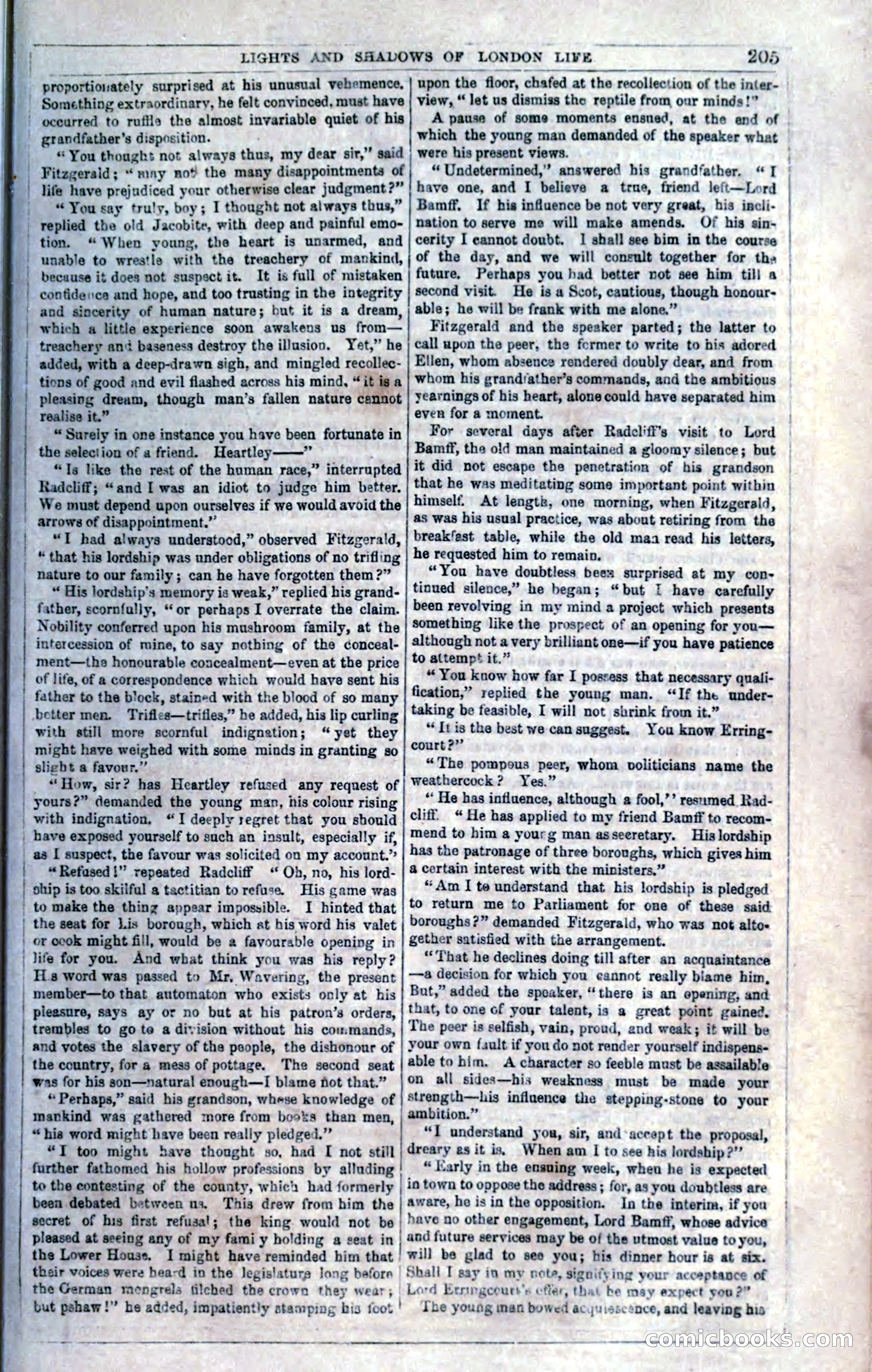
A restored page from Penny Dreadfuls, 1850. Page through the whole issue in the reader above.
📄 Transcribed text from this page (OCR, searchable)
Machine-transcribed from the original scan — historical spelling and the odd misread are preserved.
, = \ 4 \ ' ee the country, for a mess of pottage. | proportionately surprised at his unusual vebemence, Something extraordinary, he felt convinced, must have - eceurred to ruffle the almost invariable quiet of his grandfather's disposition. ; “You thought not always thus, my dear sir,” said Fitzgerald; “ may not the many disappointments of life have prejudiced your otherwise clear judgment?” “You say truly, boy; I thought not always thus,” replied the old Jacobite, with deep and painful emo- | tion. “When young, the heart is unarmed, and | unable to wrestle with the treachery of mankind, because it does not suspect it. It is full of mistaken | confidence and hope, and too trusting in the integrity and sincerity of human nature; but it is a dream, which a little experience soon awakens us from— treachery and baseness destroy the illusion. Yet,” he added, with a deep-drawn sigh, and mingled recollec- tions of good and evil flashed across his mind, Be a 1 pleasing dream, though man’s fallen nature cannot “Surely in one instance you have been fortunate in the selection of a friend. Heartley-——~” ' “Tg like the rest of the human race,” interrupted Radcliff; “and I was an idiot to judge him better. We must depend upon ourselves if we would avoid the arrows of disappointment.” “TI had always understood,” observed Fitzgerald, * that his lordship was under obligations of no trifling nature to our family; can he have forgotten them ?” “ His lordship’s memory is weak,” replied his grand- father, scornfully, “or perhaps I overrate the claim. Nobility conferred upon his mushroom family, at the intercession of mine, to say nothing of the conceal- ment—the honourable concealment—even at the price of life, of a correspondence which would have sent his father to the block, stained with the blood of so many better men. Trifles—trifles,” he added, his lip curling with still more scornful indignation; “yet they might have weighed with some minds in granting so slight a favorr.” _ “How, sir? has Heartley refused any request of yours?” demanded the young man, his colour rising with indignation. “I deeply regret that you should have exposed yourself to such an insult, especially if, as I suspect, the favour was solicited on my account.” “Refused” repeated Radcliff ‘“ Ob, no, his lord- Ship is too skilful a tactitian to refuse. His game was to make the thing appear impossible. I hinted that the seat for Lis borough, which at his word his valet or ccok might fill, would be a favourable opening in life for you. And what think you was his reply? His word was passed to Mr, Wavering, the present member—to that automaton who exists only at his pleasure, says ay or no but at his patron’s orders, trembles to go te a division without his coumands, and votes the slavery of the people, the dishonour of The second seat was for his son—natural enough—I blame fot that.” ' “Perhaps,” said his grandson, whese knowledge of mankind was gathered more from books than men, “hia word might have been really pledged.” “TI too might have thought so, had [I not still further fathomed his hollow professions by alluding to the contesting of the county, which had formerly been debated between us. This drew from him the secret of his first refusal; the king would not be pleased at seeing any of my fami y holding a eeat in the Lower House. I might have reminded him that | their voices were heard in the legislature long before '{ the German mongrels filched the crown they wear; ch but pshaw !” he added, impatiently stamping bis foot ——_— —--—————— ese eee eee EE LIGHTS AND SHALOWS OF LONDON LIVE — 205 upon the floor, chafed at the recollection of the inter- view, “ let us dismiss the reptile from our minds!” A pause of some moments ensned, at the and of which the young man demanded of the speaker what were his present views. “ Undetermined,” answered his grandfather. “I have one, and I believe a true, friend left—Lord Bamff. If his influence be not very great, his incli- nation to serve me will make amends. Of his sin- cerity I cannot doubt. I shall see bim in the course of the day, and we will consult together for the — future, Perhaps you had better not see him till a | second visit. He is a Scot, cautious, though honour- able; he will be frank with me alone,” Fitzgerald and the speaker parted; the latter to call upon the peer, the former to write to his adored Ellen, whom absence rendered doubly dear, and from whom his grand/ather’s commands, and the ambitious yearnings of his heart, alone could have separated him even for a moment. For several days after Radcliff’s visit to Lord Bamff, the old man maintained a gloomy silence; but it did not escape the penetration of his grandson that he was meditating some important point within himself. At length, one morning, when Fitzgerald, as was his usual practice, was about retiring from the breakfast table, while the old maa read his letters, he requested him to remain, “You have doubtless bees surprised at my con- tinued silence,” he began; “but I have carefully been revolving in my mind a project which presents something like the prospect of an opening for you— although not a very brilliant one—if you have patience to attempt it.” “You know how far I possess that necessary quali- fication,” replied the young man. “If the under- taking be feasible, I will not shrink from it.” “It is the best we can suggest. You know Erring- court?” “The pompous peer, whom ovoliticians name the weathercock? Yes.” “ He has influence, although a fool,’’ resumed Rad- cliff. “He has applied to my friend Bamff to recom- mend to him a yourg man asseeretary. His lordship has the patronage of three boroughs, which gives him & certain interest with the ministers,” “Am I te understand that his lordship is pledged to return me to Parliament for one of these said boroughs?” demanded Fitzgerald, who was not altos gether satisfied with the arrangement. “That he declines doing till after an acquaintance —a decision for which you cannot really blame him, But,” added the spoaker, “there is an epening, and that, to one of your talent, is a great point gained, The peer is selfish, vain, proud, and weak; it will be your own fault if you do not render yourself indispens- able to him. A character so feeble must be assailable on all sides—his weakness must be made your strength—his influence the stepping-stone to your ambition.” “I understand you, sir, and accept the proposal, dreary es it is. When am I to see his lordship?” “arly in the ensuing week, when he is expected in town to oppose the address ; for, as you doubtless are aware, he is in the opposition. In the interim, if you have no other engagement, Lord Bamff, whose advice and future services may be of the utmost value to you, will be glad to see you; his dinner hour is at six. Shall I say in my note, signifying your acceptance of Lord Erringcourt’s offer, that be may expect you?” Tbe young man bowed acyuisscence, and leaving his Co [RAVICEL OOO) Se — « KS (E©) me ey