
Penny Dreadfuls, 1850 · page 221 of 394
The Mysteries of London; or, Lights and Shadows of London Life — page 221: what you’re looking at
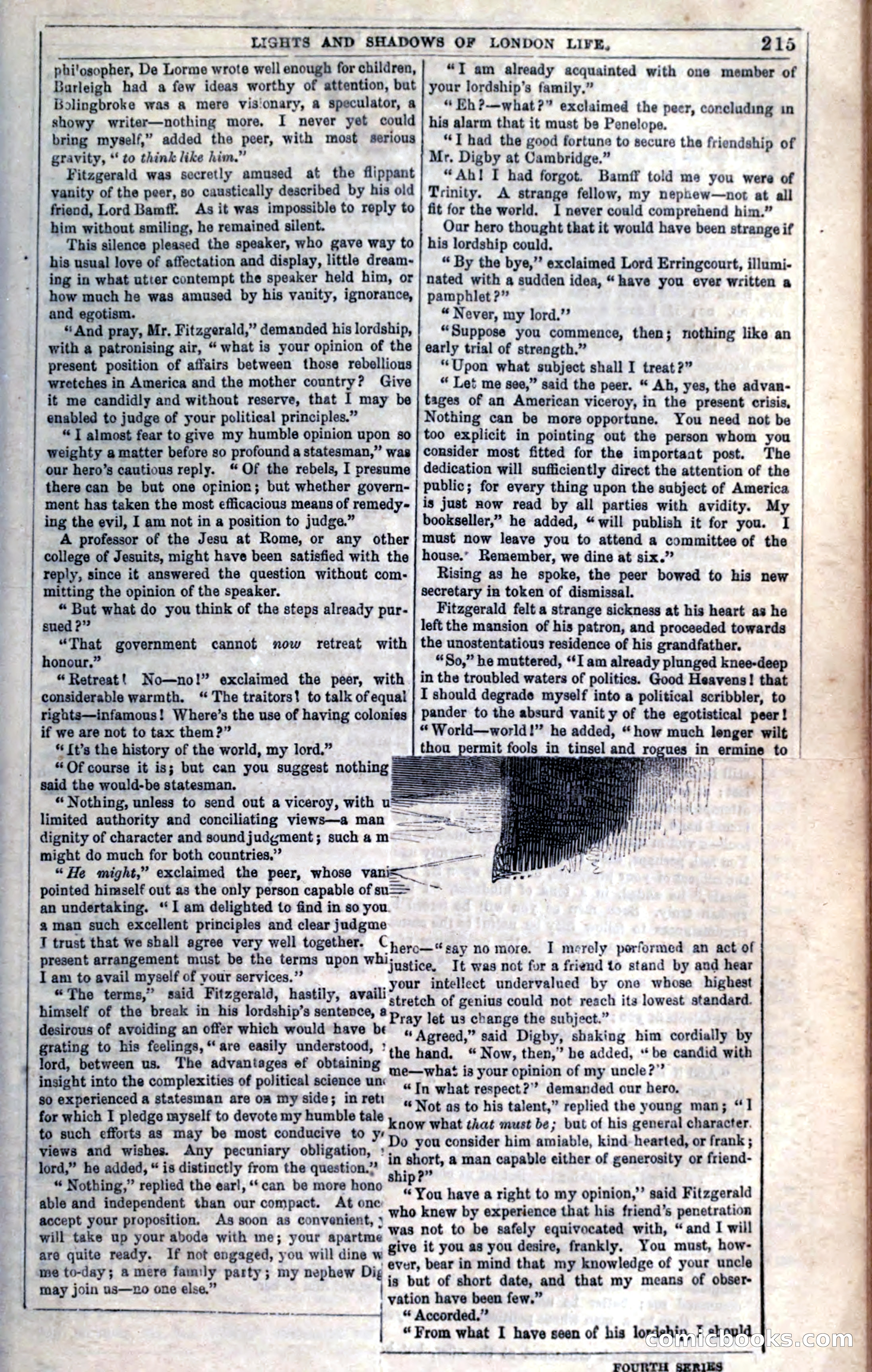
A restored page from Penny Dreadfuls, 1850. Page through the whole issue in the reader above.
📄 Transcribed text from this page (OCR, searchable)
Machine-transcribed from the original scan — historical spelling and the odd misread are preserved.
LIGHTS AND SHADOWS OF LONDON LIFE, 215 A AT! eC TAN ne RR Ee tama phi'osopher, De Lorme wrote well enough for children, Barleigh had a few ideas worthy of attention, but Bolingbroke was a mere visionary, a speculator, a showy writer—nothing more, I never yet could bring myself,” added the peer, with most serious gravity, * to think like him.” ‘ Fitzgerald was secretly amused at the flippant vanity of the peer, so caustically described by his old friend, Lord Bamff. As it was impossible to reply to him without smiling, he remained silent. This silence pleased the speaker, who gave way to his usual love of affectation and display, little dream~ ing in what utter contempt the speaker held him, or how much he was amused by his vanity, ignorance, ye pray, Mr. Fitzgerald,” demanded his lordship, with a patronising air, “ what is your opinion of the present position of affairs between those rebellious wretches in America and the mother country? Give it me candidly and without reserve, that I may be enabled to judge of your political principles.” “ T almost fear to give my humble opinion upon so weighty a matter before so profound a statesman,” was our hero’s cautious reply. “ Of the rebels, I presume there can be but one opinion; but whether govern- ment has taken the most efficacious means of remedy- ing the evil, I am not in a position to judge.” A professor of the Jesu at Rome, or any other college of Jesuits, might have been satisfied with the ply, since it answered the question without com- tting the opinion of the speaker. “ But what do you think of the steps already pur- sned ?”” “That government cannot now retreat with honour,” “Retreat! No—no!l” exclaimed the peer, with considerable warmth. “The traitors! to talk of equal rights—infamous! Where’s the use of having colonies if we are not to tax them?” * {t’s the history of the world, my lord.” “ Of course it is; but can you said the would-be statesman. limited authority and conciliating views—a man dignity of character and sound judgment; such a m= might do much for both countries.” “He might,” exclaimed the peer, whose vani<—_ pid | pointed himself out as the only person capable of su= an undertaking. “1 am delighted to find in so you. aman such excellent principles and clear judgme T trust that we shall agree very well together. C}..._ «. an eared present arrangement must be the terms upon Whiivstice, I am to avail myself of your services.” desirous of avoiding an offer which would have be 7 ting to his feelings, “are easily understood, ford, between us. The advantages ef obtaining insight into the complexities of political science un: $0 experienced a statesman are om my side; in reti “ Nothing,” replied the ear!, ‘can be more hono able and independent than our compact. At one accept your proposition. As soon as convenient, ) will take up your abode with me; your apartme are quite ready. If not engaged, you will dine w me to-day; a mere famly party; my nephew Dig suggest nothing S== “Nothing, unless to send out a viceroy, with u=—=—— a ee <__ .,. your intellect undervalued by one whose highest “The terms,” said Fitzgerald, hastily » availi stretch of genius could not reach its lowest standard. himself of the break in his lordship’s sentence, a, ray lét us change the subject.” “ Agreed,” said Digby, shaking him cordially by "the hand. “ Now, then,” be added, “be candid with me—what is your opinion of my uncle?” “Tn what respect?’ demanded our hero, “‘ Not as to his talent,” replied the young man; “ for which } pledge myself to devote my Bumble tale know wt that must be ; at of his pine. character. Rags em Se =~ | Meee ary cialaien Do you consider him amiable, kind hearted, or frank ; ws and w ind © ; ; ‘wa 5, lord,” he added, “ is distinctly from the question.” - short, a man capable either of generosity or friend “ You have a right to my opinion,”’ said Fitzgerald who knew by experience that his friend’s penetration was not to be safely equivocated with, “and I will give it you as you desire, frankly. You must, how- ever, bear in mind that my knowledge of your uncle “T am already acquainted with one member of your lordship’s family,” “Eh ?-—what?” exclaimed the peer, concluding in his alarm that it must be Penelope. “T had the good fortune to secure the friendship of Mr. Digby at Cambridge.” “Ah! I had forgot. Bamff told me you were of Trinity. A strange fellow, my nephew—not at all fit for the world. I never could comprehend him.” Our hero thought that it would have been strange if his lordship could. “ By the bye,”’ exclaimed Lord Erringcourt, illumi- nated with a sudden idea, “have you ever written a pamphlet ?” “ Never, my lord.” “Suppose you commence, then; nothing like an early trial of strength.” “Upon what subject shall I treat?” “ Let me see,” said the peer. “ Ah, yes, the advan- tages of an American viceroy, in the present crisis, Nothing can be more opportune. You need not be too explicit in pointing out the person whom you consider most fitted for the importaat post. The dedication will sufficiently direct the attention of the public; for every thing upon the subject of America is just now read by all parties with avidity. My bookseller,” he added, “will publish it for you. I must now leave you to attend a committee of the house.” Remember, we dine at six.” Rising as he spoke, the peer bowed to his new secretary in token of dismissal. Fitzgerald felt a strange sickness at his heart as he left the mansion of his patron, and proceeded towards the unostentatious residence of his grandfather. “So,” he muttered, “I am already plunged knee-deep in the troubled waters of politics. Good Heavens! that I should degrade myself into a political scribbler, to pander to the absurd vanit y of the egotistical peer! “ World—world!” he added, “how much lenger wilt — thou permit fools in tinsel and rogues in ermine to | i it) e 4ehed mt a | aut fe i ‘ Hin i i eute.s 6 | rte,’ Me foi) | yaiet FOE aa ‘ i i . — Fatt —_ = I merely performed an act of Tt was not for a friend to stand by and hear is but of short date, and that my means of obser- vation have been few.” “ Accorded,” may join us—no one else,” Or ne OP Ot 6 ew ee eee boaaks (EO) “From what I have seen of his lords, F FPOURTH SERIES Cee