
Penny Dreadfuls, 1850 · page 224 of 394
The Mysteries of London; or, Lights and Shadows of London Life — page 224: what you’re looking at
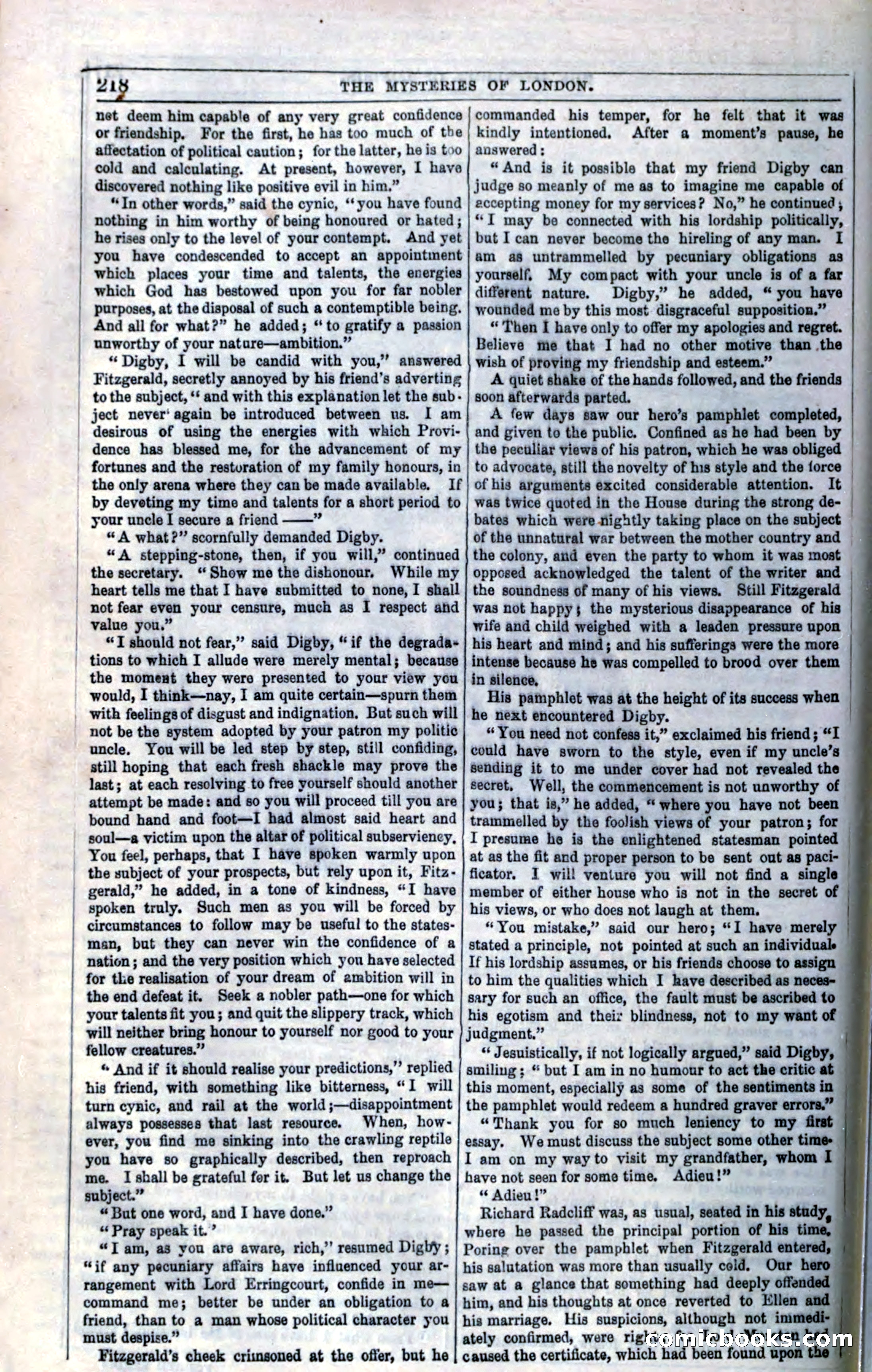
A restored page from Penny Dreadfuls, 1850. Page through the whole issue in the reader above.
📄 Transcribed text from this page (OCR, searchable)
Machine-transcribed from the original scan — historical spelling and the odd misread are preserved.
= J Ee ECC tee ee 218 THE MYSTERIES OF LONDON. : net deem him capable of any very great confidence or friendship, For the first, he has too much of the affectation of political caution; for the latter, he is too At present, however, I have cold and calculating. discovered nothing like positive evil in him.” “In other words,” said the cynic, ‘‘ you have found nothing in him worthy of being honoured or hated; he rises only to the level of your contempt. And yet you have condescended to accept an appointment which places your time and talents, the energies which God has bestowed upon you for far nobler | purposes, at the disposal of such a contemptible being, _ And all for what?” he added; “ to gratify a passion unworthy of your nature—ambition.” «Digby, I will be candid with you,” answered _ Fitzgerald, secretly annoyed by his friend’s adverting tothe subject, ‘* and with this explanation let the sub- ject never' again be introduced between us. I am desirous of using the energies with which Provi- dence has blessed me, for the advancement of my fortunes and the resturation of my family honours, in the only arena where they can be made available. If by deveting my time and talents for a short period to your uncle I secure a friend ——” “A what?” scornfully demanded Digby. “A stepping-stone, then, if you will,” continued While my heart tells me that I have submitted to none, I shall not fear even your censure, much as I respect ahd “ Show me the dishonour, the secretary. value you,” “TI should not fear,” said Digby, “if the degrada- tions to which I allude were merely mental; because the moment they were presented to your view you would, I think—nay, I am quite certain—spurn them | with feelings of disgust and indignation. But such will not be the system adopted by your patron my politic You will be led step by step, still confiding, still hoping that each fresh shackle may prove the last; at each resolving to free yourself should another attempt be made: and so you will proceed till you are bound hand and foot—I had almost said heart and uncle, soul—a victim upon the altar of political subserviency, You feel, perhaps, that I have spoken warmly upon _ the subject of your prospects, but rely upon it, Fitz- gerald,” he added, in a tone of kindness, “I have spoken truly. Such men as you will be forced by circumstances to follow may be useful to the states- man, but they can never win the confidence of a nation; and the very position which you have selected for the realisation of your dream of ambition will in the end defeat it. Seek a nobler path—one for which your talents fit you; and quit the slippery track, which will neither bring honour to yourself nor good to your fellow creatures.” « And if it should realise your predictions,”’ replied his friend, with something like bitterness, “1 will turn cynic, and rail at the world ;—disappointment always possesses that last resource. When, how- ever, you find me sinking into the crawling reptile you have so graphically described, then reproach me. I shall be grateful fer it. But let us change the subject.” “ But one word, and I have done.” “Pray speak it.’ “JT am, a8 you are aware, rich,’’ resumed Digby ; “if any pecuniary affairs have influenced your ar- rangement with Lord Erringcourt, confide in me— command me; better be under an obligation to a friend, than to a man whose political character you must despise.” Fitzgerald’s cheek crismsoned at the offer, but he commanded his temper, for he felt that it was kindly intentioned, After a moment’s pause, he answered ; “And is it possible that my friend Digby can | — judge so meanly of me as to imagine me capable of | — accepting money for my services? No,” he continued; | — “TI may be connected with his lordship politically, but I can never become the hireling of any man. I am a8 untrammelled by pecuniary obligations as yourself, My compact with your uncle is of a far different nature. Digby,” he added, “ you have wounded me by this most disgraceful supposition,” “Then I have only to offer my apologies and regret. Believe me Nat I had no other motive than the wish of pro ving my friendship and esteem.” A quiet of the hands followed, and the friends soon afterwards parted. A few days ay oe our hero’s Spy erort: completed, and given to the public. Confined as he had been by the peculiar views of his patron, which he was obliged to advocate, still the novelty of his style and the force of his arguments excited considerable attention. It was twice quoted in the House during the strong de- bates which were nightly taking place on the subject of the unnatural war between the mother country and the colony, and even the party to whom it was most opposed acknowledged the talent of the writer and the soundness of many of his views. Still Fitzgerald was not happy; the mysterious disappearance of his wife and child weighed with a leaden pressure upon his heart and ; and his sufferings were the more intense because he Wes compelled to brood over them in silence, His pamphlet was at the height of its success when he next encountered Digby. | “You need not confess it,” exclaimed his friend; “I could have sworn to the style, even if my uncle’s sending it to me under cover had not revealed the secret, Well, the commencement is not unworthy of | you; that is,” he added, * where a trammelled by the foolish views of your patron; for I presume he is the enlightened state pointed at as the fit and proper person to be sent out as paci- ficator. I will venture you will not find a single member of either house who is not in the secret of © his views, or who does not laugh at them. , “You mistake,” said our hero; “I have merely stated a principle, not pointed at such an individuale If his lordship assumes, or his friends choose to assign to him the qualities which I have described as neces- sary for such an office, the fault must be ascribed to his egotism and their blindness, not to my want of judgment,” “ Jesuistically, if not logically argued,” said Digby, smiling; * but I am in no humour to act the critic at this moment, especially as some of the sentiments in the pamphlet would redeem a hundred errors.” “Thank you for so much leniency to my first | essay. We must discuss the subject some other time> I am on my way to visit my grandfather, whom I have not seen for some time. Adieu!” “ Adieu !” Richard Radcliff was, as usual, seated in his “al where he passed the principal portion of his t ee mm a a a Poring over the pamphlet when Fitzgerald entere ~ his salutation was more than usually cold. Our t ro saw at a glance that something had deeply offended him, and his thoughts at once reverted to Yillen ne re his marriage. His suspicions, ea aaron te - ately confirmed, were righao)'y4) 90.0, COM diam ta certificate, me COL 1X ‘the :