
Penny Dreadfuls, 1850 · page 24 of 394
The Mysteries of London; or, Lights and Shadows of London Life — page 24: what you’re looking at
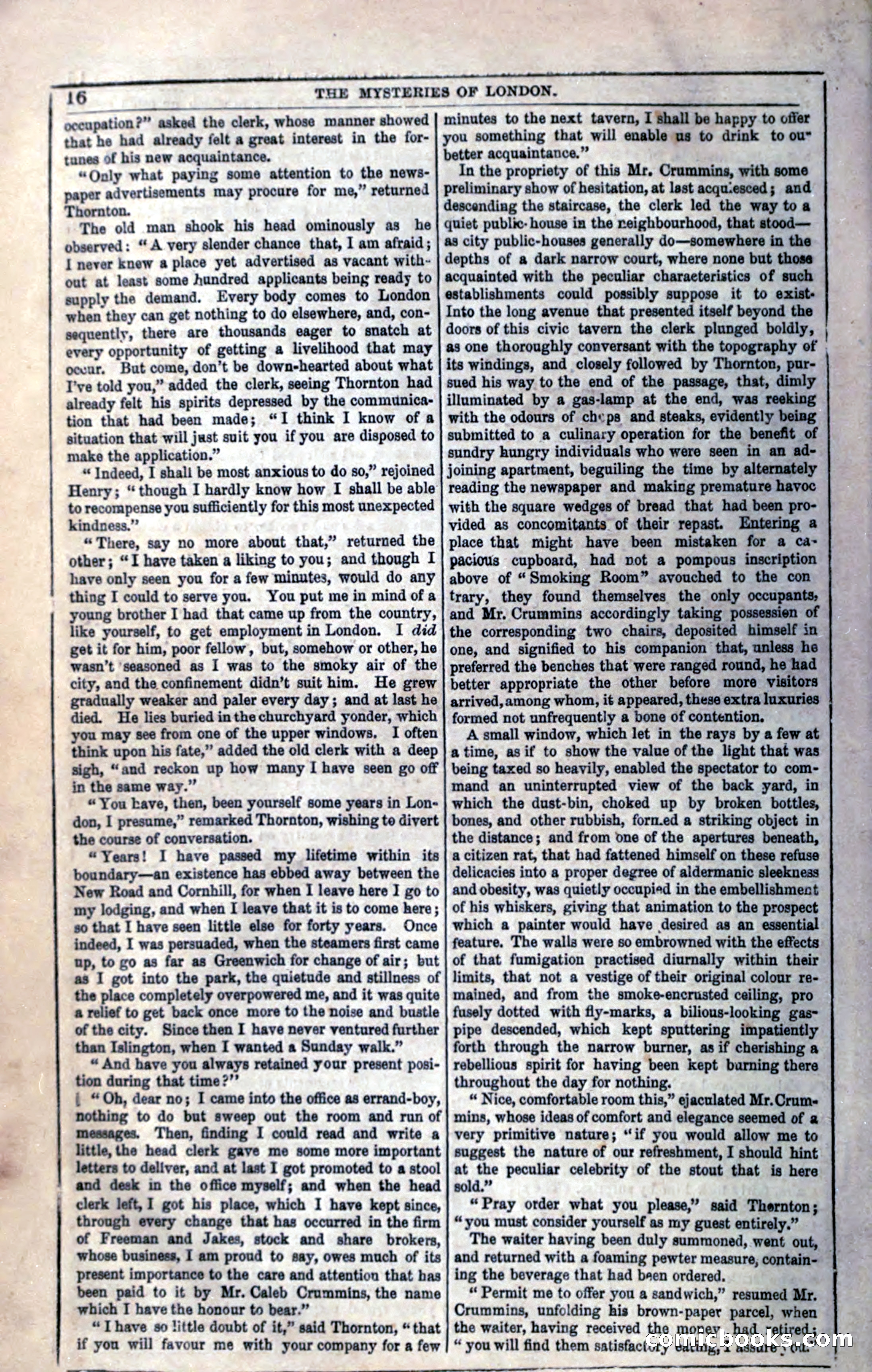
A restored page from Penny Dreadfuls, 1850. Page through the whole issue in the reader above.
📄 Transcribed text from this page (OCR, searchable)
Machine-transcribed from the original scan — historical spelling and the odd misread are preserved.
Nee RTE TE EE EE SSS STI GS ; THE MYSTERIES OF LONDON, : anne minutes to the next tavern, I Shall be happy to offer you something that will enable us to drink to ou better acquaintance.” 16 . occupation?” asked the clerk, whose manner showed that he had already felt a great interest in the for- tunes of his new acquaintance. “Only what paying some attention to the news- paper advertisements may procure for me,” returned Thornton. The old man shook his head ominously as he observed: “A very slender chance that, I am afraid; I never knew a place yet advertised as vacant with- out at least some hundred applicants being ready to supply the demand. Every body comes to London when they can get nothing to do elsewhere, and, con- sequently, there are thousands eager to snatch at every opportunity of getting a livelihood that may oceur. But come, don’t be down-hearted about what I've told you,” added the clerk, seeing Thornton had already felt his spirits depressed by the communica- tion that had been made; “I think I know ofa situation that will just suit you if you are disposed to make the application.” “ Indeed, I shali be most anxious to do so,” rejoined Henry; “though I hardly know how I shall be able to recompense you sufficiently for this most unexpected kindness.” “There, say no more about that,” returned the other; “I have taken a liking to you; and though I have only seen you for a few minutes, would do any thing I could to serve you. You put me in mind of a young brother I had that came up from the country, like yourself, to get employment in London. I did get it for him, poor fellow, but, somehow or other, he wasn’t ‘seasoned as I was to the smoky air of the city, and the confinement didn’t suit him. He grew gradually weaker and paler every day; and at last he died. He lies buried inthe churchyard yonder, which you may see from one of the upper windows, I often think upon his fate,” added the old clerk with a deep sigh, “and reckon up how many I have seen go off in the same way.” “You kave, then, been yourself some years in Lon- don, I presume,” remarked Thornton, wishing te divert the course of conversation. “Years! I have passed my lifetime within its boundary—an existence has ebbed away between the New Road and Cornhill, for when I leave here I go to my lodging, and when I leave that it is to come here ; so that I have seen little else for forty years. Once indeed, I was persuaded, when the steamers first came np, to go as far as Greenwich for change of air; but as I got into the park, the quietude and stillness of the place completely overpowered me, and it was quite a relief to get back once more to the noise and bustle of the city. Since then I have never ventured further than Islington, when I wanted a Sunday walk.” “ And have you always retained your present posi- tion during that time ?’’ | “Oh, dear no; I came into the office as errand-boy, nothing to do but sweep out the room and run of messages. Then, finding I could read and write a little, the head clerk gave me some more important letters to deliver, and at last I got promoted to a stool and desk in the office myself; and when the head clerk left, I got his place, which I have kept since, through every change that has occurred in the firm of Freeman and Jakes, stock and share brokers, whose business, I am proud to say, owes much of its present importance to the care and attention that has been paid to it by Mr. Caleb Crommins, the name which I have the honour to bear.” “T have so little doubt of it,” said Thornton, “that if you will favour me with your company for a few ee ee sued his way to the end of the passage, that, dimly illuminated by a gas-lamp at the end, was reeking submitted to a culinary operation for the benefit of sundry hungry individuals who were seen in an ad- joining apartment, beguiling the time by alternately reading the newspaper and making premature havoc with the square wedges of bread that had been pro- vided as concomitants of their repast. Entering a place that might have been mistaken for a ca~ | In the propriety of this Mr. Crummins, with some preliminary show of hesitation, at last acquiesced; and descending the staircase, the clerk led the way toa quiet public: house im the neighbourhood, that stood— as city public-houses generally do—somewhere in the depths of a dark narrow court, where none but those acquainted with the peculiar charaeteristics of such establishments could possibly suppose it to exist- Into the long avenue that presented itself beyond the doors of this civic tavern the clerk plunged boldly, as one thoroughly conversant with the topography of with the odours of cheps and steaks, evidently being - pacious cupboard, had not a pompous inscription above of “Smoking Room” avouched to the con trary, they found themselves the only occupants, and Mr. Crummins accordingly taking possessien the corresponding two chairs, deposited himself in one, and signified to his com hat, unless | preferred the benches that were ranged round, he had better appropriate the other before more visit arrived, among whom, it appeared, these extra luxuries formed not unfrequently a bone of contention. A small window, which let in the rays by a few at atime, asif to show the value of the light that was being taxed so heavily, enabled the spectator to com- mand an uninterrupted view of the back yard, in which the dust-bin, choked up by broken bottles, bones, and other rubbish, forn.ed a striking object in the distance; and from one of the apertures a citizen rat, that had fattened himself on these refuse delicacies into a proper degree of aldermanic sleekness and obesity, was quietly occupied in the embellishment of his whiskers, giving that animation to the prospect which a painter would have desired as an essential feature. The walls were so embrowned with the effects. of that fumigation practised diurnally within their limits, that not a vestige of their original colour re- mained, and from the smoke-encrusted ceiling, pro fusely dotted with fly-marks, a bilious-looking gas- pipe descended, which kept sputtering impatiently forth through the narrow burner, as if cherishing a rebellious spirit for having been kept burning there throughout the day for nothing. “ Nice, comfortable room this,” ejaculated Mr.Crum- mins, whose ideas of comfort and elegance seemed of a very primitive nature; “if you would allow me to suggest the nature of our refreshment, I should hint - the peculiar celebrity of the stout that is here d,” “Pray order what you please,” said Thernton; “you must consider yourself as my guest entirely.” The waiter having been duly summoned, went out, and returned with a foaming pewter measure, contain- | ing the beverage that had been ordered. “ Permit me to offer you a sandwich,” resumed Mr, Crummins, unfolding his brown-paper parcel, when — the waiter, having received the : “ you will find them ae e-WEO mieb ssburt --.- eee i