
Penny Dreadfuls, 1850 · page 246 of 394
The Mysteries of London; or, Lights and Shadows of London Life — page 246: what you’re looking at
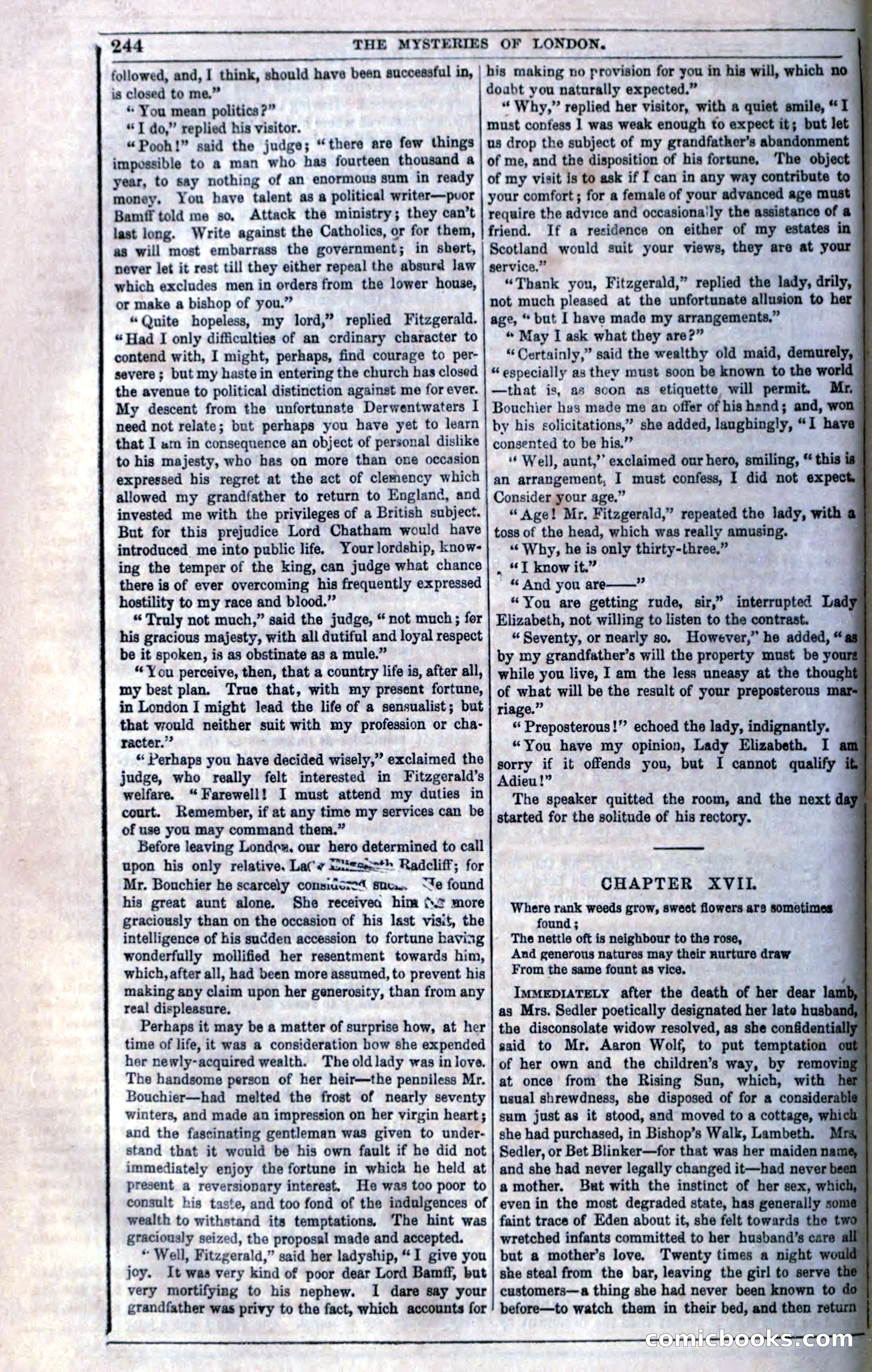
A restored page from Penny Dreadfuls, 1850. Page through the whole issue in the reader above.
📄 Transcribed text from this page (OCR, searchable)
Machine-transcribed from the original scan — historical spelling and the odd misread are preserved.
244 Te followed, and, I think, should have been successful in, | his making no provision for you in his will, which no is closed to me.” “ You mean politics?” “T do,” replied his visitor. “Pooh!” said the judge; “there are few things impossible to a man who has fourteen thousand a year, to say nothing of an enormous sum in ready money, You have talent as a political writer—pvor Bamff told me so. Attack the ministry; they can’t last long. Write against the Catholics, or for them, as will most embarrass the government; in shert, never let it rest till they either repeal the absurd law which excludes men in orders from the lower house, or make a bishop of you.” “Quite hopeless, my lord,” replied Fitzgerald. “Had I only difficulties of an ordinary character to contend with, I might, perhaps, find courage to per- severe; but my haste in entering the church has closed the avenue to political distinction against me for ever. My descent from the unfortunate Derwentwaters I need not relate; but perhaps you have yet to learn that I um in consequence an object of personal dislike to his majesty, who has on more than one occasion expressed his regret at the act of clemency which allowed my grandfather to return to England, and invested me with the privileges of a British subject. But for this prejudice Lord Chatham would have introduced me into public life, Your lordship, know- ing the temper of the king, can judge what chance there is of ever overcoming his frequently expressed hostility to my race and blood.” “Truly not much,” said the judge, “ not much ; for his gracious majesty, with all dutiful and loyal respect be it spoken, is as obstinate as a mule.” “You perceive, then, that a country life is, after all, my best plan. True that, with my present fortune, in London I might lead the life of a sensualist; but that would neither suit with my profession or cha- racter.” | “ Perhaps you have decided wisely,” exclaimed the judge, who really felt interested in Fitzgerald’s welfare. “Farewell! I must attend my duties in court. Remember, if at any time my services can be of use you may command them.” Before leaving Londea, our hero determined to call upon his only relative. La(¢ Zuisssch Radcliff; for Mr. Bouchier he scarcely consiucre4 suc. <*e found his great aunt alone. She receivea him (ct more graciously than on the occasion of his last visit, the intelligence of his sudden accession to fortune having wonderfully mollified her resentment towards him, which, after all, had been more assumed, to prevent his making any claim upon her generosity, than from any real displeasure. Perhaps it may be a matter of surprise how, at her time of life, it was a consideration bow she expended her newly-acquired wealth. The oldlady was in love. The handsome person of her heir—the penniless Mr. Bouchier—had melted the frost of nearly seventy winters, and made an impression on her virgin heart; and the fascinating gentleman was given to under- stand that it would be his own fault if he did not immediately enjoy the fortune in which he held at present a reversiopary interest. He was too poor to consult his taste, and too fond of the indulgences of wealth to withstand its temptations, The hint was graciously seized, the proposal made and accepted. * Well, Fitzgerald,” said her ladyship, “I give you joy. It was very kind of poor dear Lord Bamff, but very mortifying to his nephew. I dare say your grandfather was privy to the fact, which accounts for ie nnn E(B THE MYSTERIES OF LONDON, doabt you naturally expected.” “ Why,” replied her visitor, with a quiet smile, “1 must confess ] was weak enough to expect it; but let us drop the subject of my grandfather’s abandonment of me, and the disposition of his fortune. The object of my visit is to ask if I can in any way contribute to your comfort; for a female of your advanced age must require the advice and occasiona'ly the assistance of a friend. If a residence on either of my estates in Scotland would suit your views, they are at your service,” “Thank you, Fitzgerald,” replied the lady, drily, not much pleased at the unfortunate allusion to her age, * but I have made my arrangements,” “ May I ask what they are?” “ Oertainly,” said the wealthy old maid, demurely, “ especially as they must soon be known to the world —that is, as scon as etiquette will permit. Bouchier hes made me an offer of his hand; and, won by his solicitations,” she added, laughingly, “I hay consented to be his,” ‘* Well, aunt,’’ exclaimed our hero, smiling, * this an arrangement, I must confess, I did not expec Consider your age.” . “Age! Mr. Fitzgerald,” repeated the lady, with ¢ toss of the head, which was really amusing. . “Why, he is only thirty-three.” . “I know it.” And you are——” | “You are getting rude, sir,” interrupted Elizabeth, not willing to listen to the contrast. “ Seventy, or nearly so, However,” he added, *: by my grandfather’s will the property must be your while you live, I am the less uneasy at the though of what will be the result of your preposterous mai riage.” ‘“‘ Preposterous!”’ echoed the lady, indignantly. — “You have my opinion, Lady Elizabeth. I an sorry if it offends you, but I cannot qualify i Adieu!” | The speaker quitted the room, and the next da started for the solitude of his rectory. CHAPTER XVII. Where rank weeds grow, sweet flowers ars sometimes 4 found ; } The nettle oft is neighbour to the rose, And generous natures may their nurture draw From the same fount as vice, IMMEDIATELY after the death of her dear lam as Mrs. Sedler poetically designated her late husba the disconsolate widow resolved, as she confider said to Mr. Aaron Wolf, to put temptation of her own and the children’s way, by removi at once from the Rising Sun, which, with h usual shrewdness, she disposed of for a consideral sam just as it stood, and moved to a cottage, which she had purchased, in Bishop’s Walk, Lambeth. M Sedler, or Bet Blinker—for that was her maiden nam and she had never legally changed it—had never b a mother. But with the instinct of her sex, whi even in the most degraded state, has son faint trace of Eden about it, she felt towards the t wretched infants committed to her husband’s care. but a mother’s love. Twenty times a night wo she steal from the bar, leaving the girl to | customers—a thing she had never been known to before—to watch them in their bed, and then ot TEC DOO, agers % lz