
Penny Dreadfuls, 1850 · page 250 of 394
The Mysteries of London; or, Lights and Shadows of London Life — page 250: what you’re looking at
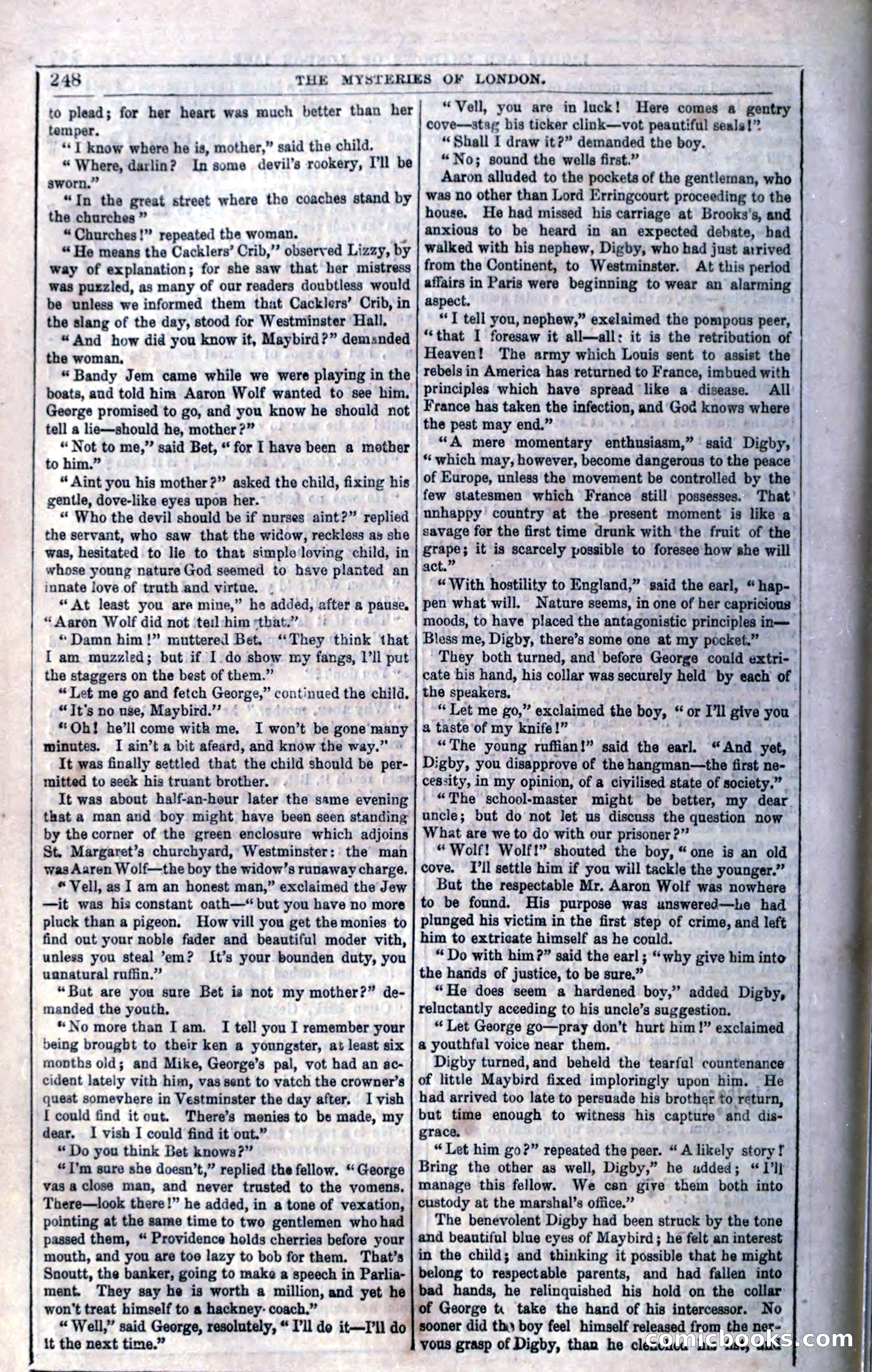
A restored page from Penny Dreadfuls, 1850. Page through the whole issue in the reader above.
📄 Transcribed text from this page (OCR, searchable)
Machine-transcribed from the original scan — historical spelling and the odd misread are preserved.
——— 245 ee to plead; for her heart was SS better than her temper. ‘‘T know where he is, mother,” said the child. “ Where, darlin? In some devil’s rookery, I'll be sworn.” “In the great street where the coaches stand by the churches ” “Churches!” repeated the woman. “ He means the Cacklers’ Crib,” observed Lizzy, by way of explanation; for she saw that her mistress was puzzled, as many of our readers doubtless would be unless we informed them that Cacklers’ Crib, in the slang of the day, stood for Westminster Hall, “And how did you know it, Maybird?” demanded the woman. “Bandy Jem came while we were playing in the boats, and told him Aaron Wolf wanted to see him. George promised to go, and you know he should not tell a lie—should he, mother ?” “ Not to me,” said Bet, “ for I have been a mother to him.” “ Aint you his mother?” asked the child, fixing his gentle, dove-like eyes upon her. ““ Who the devil should be if nurses aint?” replied the servant, who saw that the widow, reckless as she was, hesitated to lie to that simple loving child, in whose young nature God seemed to have pesueest an innate love of truth and virtue. . “At least you are mine,” he added, after a pause. “Aaron Wolf did not teil:him that.” “Damn him!” muttered Bet. “They think that { am muzzled; but if I. do show my fangs, Vil put the staggers on the best of them. ‘ , “Let me go and fetch George,” cont tied the child. “It’s no nse, Maybird.”” © * Oh! he’ll come with me, I writ be gone many minutes. I ain’t a bit afeard, and know the way.’ It was finally settled that the child should be per- mitted to seek his truant brother. It was about half-an-hour later the same evening that a man and boy might have been seen standing by the corner of the green enclosure which adjoins St. Margaret’s churchyard, Westminster: the man was Aaren Wolf—the boy the widow’s runaway charge. * Vell, as I am an honest man,” exclaimed the Jew —it was his constant oath—* but you have no more pluck than a pigeon. How vill you get the monies to find out your noble fader and beautiful moder vith, unless you steal ’em? It’s your bounden duty, you unnatural ruffin.” “But are you sure Bet is not my mother?” de- manded the youth. “No more than Tam. I tell you I remember your being brougbt to their ken a youngster, at least six months old; and Mike, George’s pal, vot had an ac- cident lately vith him, vas sent to vatch the crowner’s quest somevhere in Vestminster the day after. I vish 1 could find it out. There’s monies to be made, my dear, I vish I could find it out.” “ Do you think Bet knows?” “I’m sure she doesn’t,” replied the fellow. “George vas a close man, and never trusted to the vomens. There—look there!” he added, in a tone of vexation, pointing at the same time to two gentlemen who had passed them, “ Providence holds cherries before your mouth, and you are too lazy to bob for them. That’s Snoutt, the banker, going to make a speech in Parlia- ment. They say he is worth a million, and yet he won't treat himself to a hackney: coach,” “ Well,” said George, resolutely, “ I’ll do it—I’ll do it the next time.” THE MYSTERIES OF LONDON, of George t take the hand of his intercessor. ae ew ee a Vell, you are in luck! Here comes a ge cove—stag bis ticker clink—vot peautiful seals!” “Shall I draw it?” demanded the boy. “No; sound the wells first.” Aaron alluded to the pockets of the gentleman, who was no other than Lord Erringcourt proceeding to the house. He had missed his carriage at Brooks's, and anxious to be heard in an expected debate, had walked with his nephew, Digby, who had just arrived from the Continent, to Westminster. At this period affairs in Paris were beginning to wear an alarming aspect, “T tell you, nephew,” exelaimed the pompous peer, “that I foresaw it all—all: it is the retribution of Heaven! The army which Louis sent to assist the rebels in America has returned to France, imbued with principles which have spread like a disease. All France has taken the infection, and God knows where the pest may end.” “A mere momentary enthusiasm,” said Digby, “which may, however, become dangerous to the peace’ of Europe, unless the movement be controlled by the few statesmen which France still possesses. That’ nnhappy country at the present moment is like a savage for the first time drunk with the fruit of the’ Srape ; it is scarcely possible to foresee: how she will act. “ With hostility to England,” ssid the earl, “hap- pen what will. Nature seems, in one of her moods, to have placed the antagonistic principles in— Bless me, Digby, there’s some one at my pocket.” They both turned, and before George could extri- cate his hand, his collar was securely held by each of the speakers, “Let me go,” exclaimed the boy, 4 or I'll give you, a taste of my knife!” — “The young ruffian!” said the earl. “And ‘yet, Digby, you disapprove of the hangman—the first ne- cessity, in my opinion, of a civilised state of society.” ' “The school-master might be better, my dear uncle; but do not Jet us discuss the question now What are we to do with our prisoner?” “Wolf! Wolf!” shouted the boy, “one is an old cove. I'll settle him if you will tackle the younger.” But the respectable Mr. Aaron Wolf was nowhere to be found. His purpose was unswered—he had plunged his victim in the first step of crime, and left him to extricate himself as he could. “Do with him?” said the earl 5 “why give him into the hands of justice, to be sure.” 3 “He does seem a hardened boy,” added Digby, reluctantly aceeding to his uncle’s suggestion. “ Let George go—pray don’t hurt him!” exclaimed a youthfal voice near them. Digby turned, and beheld the tearful countenance of little Maybird fixed imploringly upon him. _ He had arrived too late to persuade his brother to return, but time enough to witness his capture’ and dis- grace, “Let him go?” repeated the peer. “A likely story! Bring the other as well, Digby,” he added; “I’ly manage this fellow. We can giye them both into custody at the marshal’s office.” The benevolent Digby had been struck by the tone and beautiful blue eyes of Maybird; he felt an interest in the child; and thinking it possible that he might belong to respectable parents, and had fallen into bad hands, he relinquished his hold on the collar sooner did th boy feel =EeErcomicho fous grasp of Dighy, than he chs Lic xy. el