
Penny Dreadfuls, 1850 · page 261 of 394
The Mysteries of London; or, Lights and Shadows of London Life — page 261: what you’re looking at
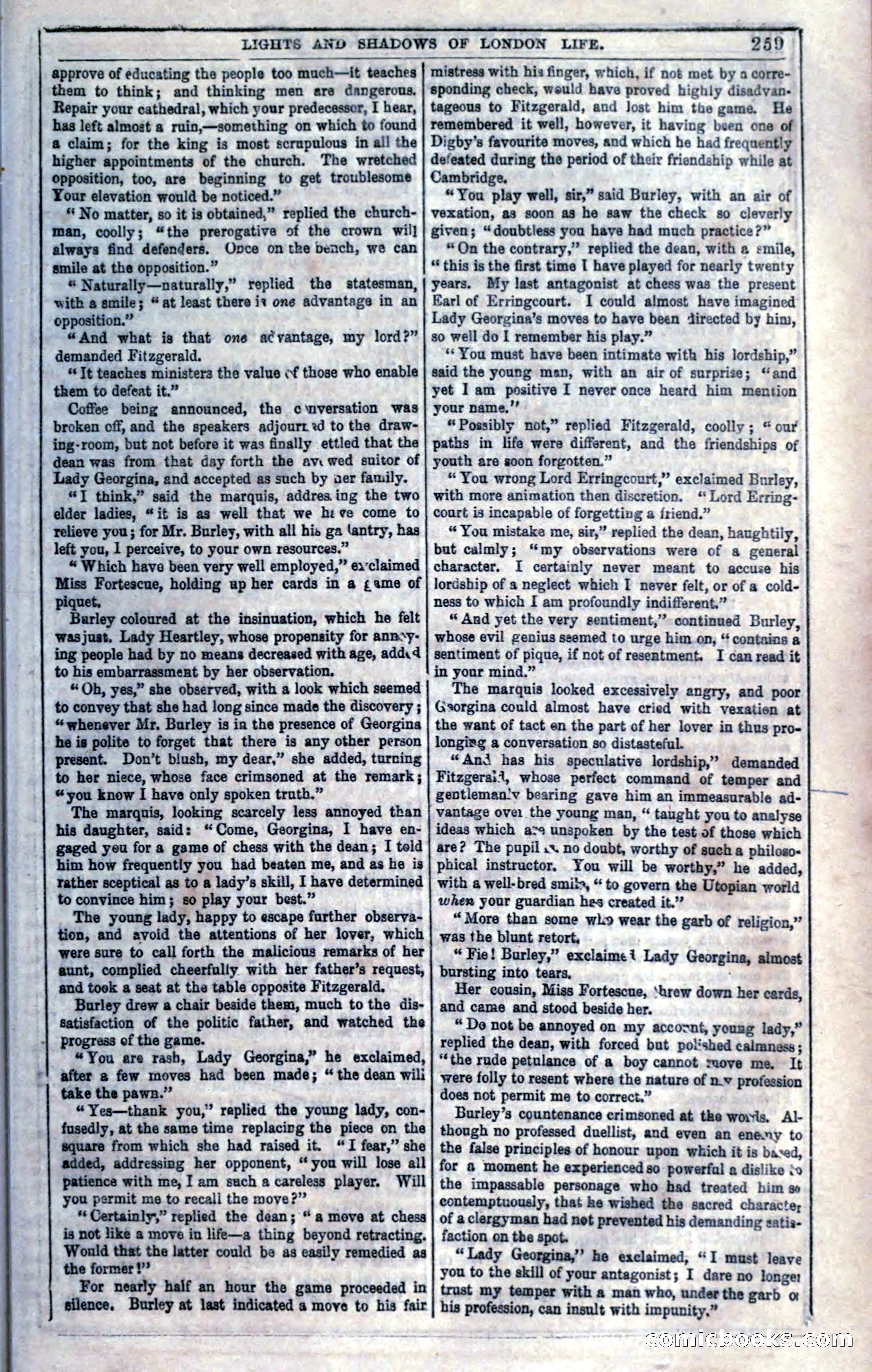
A restored page from Penny Dreadfuls, 1850. Page through the whole issue in the reader above.
📄 Transcribed text from this page (OCR, searchable)
Machine-transcribed from the original scan — historical spelling and the odd misread are preserved.
se a LIGHTS AND SHADOWS OF LONDON approve of educating the people too much—it teaches them to think; and thinking men ere dangerous. Repair your cathedral, which your predecessor, I hear, has left almost a ruin,—something on which to found a claim; for the king is most scrupulous in all the higher appointments of the church. The wretched Opposition, too, are beginning to get troublesome Your elevation would be noticed.” * No matter, so it is obtained,” replied the church- man, coolly; “the prerogative of the crown wil] always find defenders. Once on the bench, we can smile at the opposition.” with a smile; “at least there it one advantage in an “And what is that one acvantage, my lord?” demanded Fitzgerald. It teaches ministers the value of those who enable them to defeat it.” Coffee being announced, the c\nversation was broken off, and the speakers adjourr%d to the draw- ing-room, but not before it was finally ettled that the was from that day forth the av. wed suitor of Georgina, and accepted as such by aer family. “T think,” said the marquis, addres.ing the two elder ladies, “it is as well that we hive come to relieve you; for Mr. Burley, with all his ga ‘antry, has left 1 perceive, to your own resources.” “ Which have been very well employed,” ex’claimed Miss Fortescue, holding up her cards in a game of coloured at the insinuation, which he felt was just. Lady Heartley, whose propensity for ann«y- ing people had by no means decreased with age, addid to his embarrassment by her observation. * Oh, yes,” she observed, with a look which seemed to convey that she had long since made the discovery ; “whenever Mr. Burley is in the presence of Georgina he is polite to forget that there is any other person present. Don’t blush, my dear,” she added, turning to her niece, whose face crimsoned at the remark; “you know I have only spoken troth.” The marquis, looking scarcely less annoyed than his daughter, said: “Come, Georgina, I have en- gaged you fora game of chess with the dean; I teld him how frequently you had beaten me, and as he is rather sceptical as to a lady’s skill, I have determined to convince him; 80 play your best.” The young lady, happy to escape further observa- tion, and avoid the attentions of her lover, which were sure to call forth the malicious remarks of her aunt, complied cheerfully with her father’s request, and took a seat at the table cpposite Fitzgerald. Burley drew a chair beside them, much to the dis- Satisfaction of the politic father, and watched the progress of the game. “You are rash, Lady Georgina,” he exclaimed, | after a few moves had been made; “the dean wili take the pawn.” “Yes—thank you,” replied the young lady, con- fusedly, at the same time replacing the piece on the sq) from which she had raised it. “I fear,” she l, addressing her opponent, “ you will lose all patience with me, I am such a careless player. Will you permit me to recall the move?” ** Certainly,” replied the dean; “a move at chess is not like a move in life—a thing beyond retracting. Wonld that the latter could be as easily remedied as the former!” For nearly half an hour the game proceeded in silence. Burley at last indicated a move to his fair 259 mistress with his finger, which, if not met by a corre- sponding check, would have proved highly disadvan- tageous to Fitzgerald, and Jost him the game, He remembered it well, however, it having been one of Digby’s favourite moves, and which he had frequently defeated during the period of their friendship while at Cambridge. “You play well, sir,” said Burley, with an air of vexation, as soon as he saw the check so cleverly given; “doubtless you have had much practice?” “On the contrary,” replied the dean, with a smile, “ this is the first time I have played for nearly twenty years. My last antagonist at chess was the present Earl of Erringcourt. I could almost have imagined Lady Georgina’s moves to have been directed by him, so well do I remember his play.” ‘* You must have been intimate with his lordship,” said the young map, with an air of surprise; “and yet I am positive I never once heard him mention your name,”’ * Possibly not,” replied Fitzgerald, coolly; “ our paths in life were different, and the friendships of youth are soon forgotten.” “You wrong Lord Erringcourt,” exclaimed Burley, with more animation then discretion. “ Lord Erring- court is incapable of forgetting a friend.” “ You mistake me, sir,” replied the dean, haughtily, but calmly; “my observations were of a general character. I certainly never meant to accuse his lordship of a neglect which I never felt, or of a cold- ness to which I am profoundly indifferent.” “ And yet the very sentiment,” continued Burley, whose evil genius seemed to urge him on, “ contains a sentiment of pique, if not of resentment. I can read it in your mind.” The marquis looked excessively angry, and poor Gsorgina could almost have cried with vexatien at the want of tact en the part of her lover in thus pro- longisg a conversation so distasteful. “Ani has his speculative lordship,” demanded Fitzgerai’, whose perfect command of temper and geptleman'v bearing gave him an immeasurable ad- vantage ove the young man, “ taught you to analyse ideas which ate unspoken by the test of those which are? The pupil .x. no doubt, worthy of such a philoso- phical instructor, You will be worthy,” he added, with 4 well-bred smiis, “to govern the Utopian world when your guardian hes created it.” “More than some who wear the garb of religion,” was the blunt retort, “ Fie! Burley,” exclaimei Lady Georgina, almost bursting into tears, Her cousin, Miss Fortescue, ‘hrew down her cards, and came and stood beside her. “ De not be annoyed on my accoznt, young lady,” replied the dean, with forced but polished calmness; “the rude petulance of a boy cannot move me, It were folly to resent where the nature of nv profession does not permit me to correct.” Burley’s countenance crimsoned at the wows, Al- though no professed duellist, and even an enemy to the false principles of honour upon which it is based, for & moment he experienced so powerfal a dislike {0 the impassable personage who had treated him se contemptuously, that ke wished the sacred characte; of a clergyman had net prevented his demanding satis- faction on the spot. “Lady Georgina,’ he exclaimed, “I must leave you to the skill of your antagonist; I dare no longer trust my temper with a man who, underthe garb o his profession, can insult with impunity,” LIFE. TT RL CONMICL LOCK) eS) (E©) m