
Penny Dreadfuls, 1850 · page 277 of 394
The Mysteries of London; or, Lights and Shadows of London Life — page 277: what you’re looking at
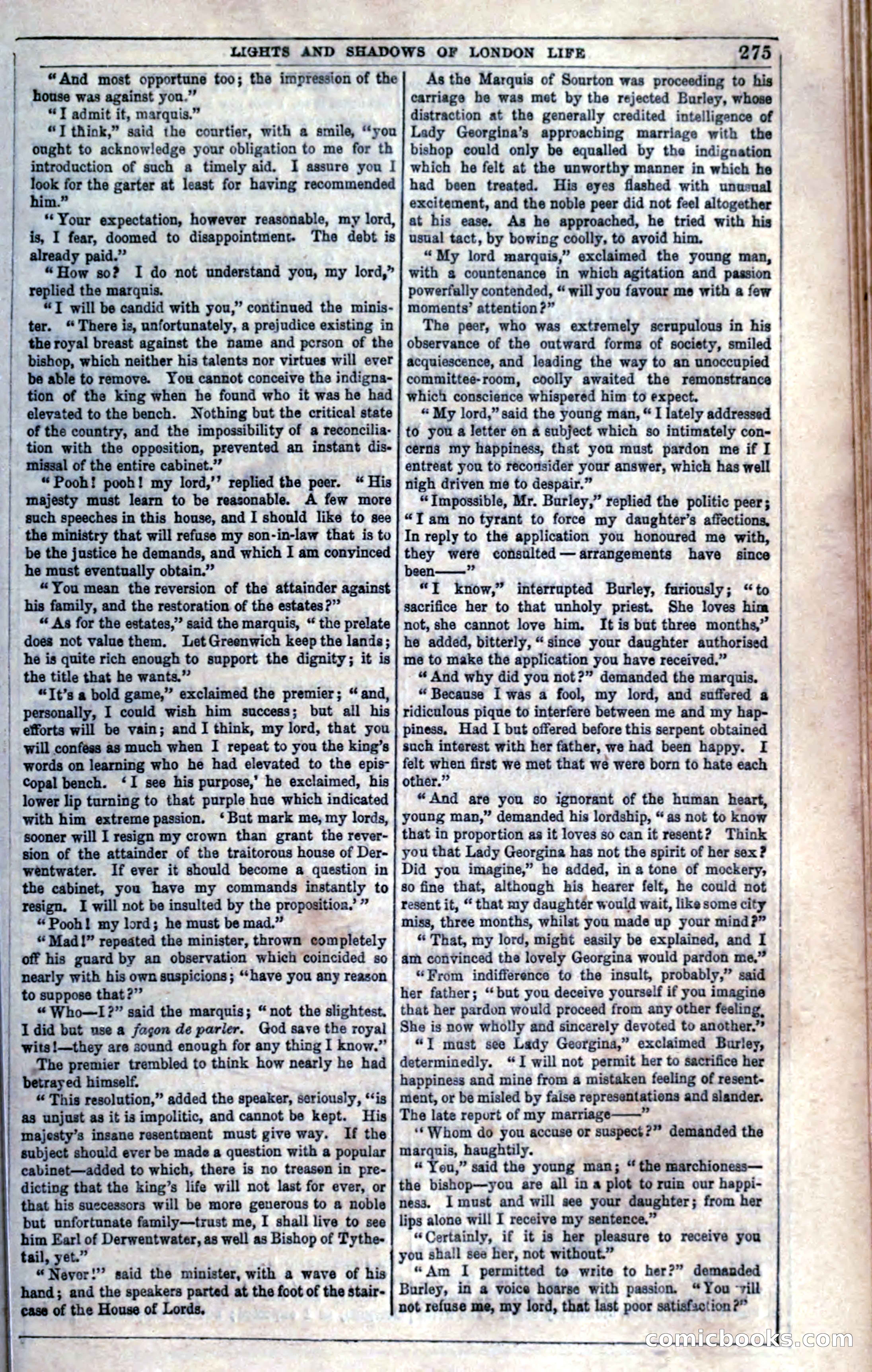
A restored page from Penny Dreadfuls, 1850. Page through the whole issue in the reader above.
📄 Transcribed text from this page (OCR, searchable)
Machine-transcribed from the original scan — historical spelling and the odd misread are preserved.
Fe — A Ee LIGHTS AND SHADOWS OF LONDON LIFE 275 “And most opportune too; the impression of the| As the Marquis of Sourton was proceeding to his hotise was against you.” “T admit if, marquis.” “T think,” said the courtier, with a smile, “you ought to acknowledge your obligation to me for th introduction of such a timely aid. I assure you | ieee 8 anita ot least for having recommended m . Your expectation, however reasonable, my lord, is, I fear, doomed to disappointment. The debt is already paid. How 30? I do not understand you, my lord,” I will be candid with you,” continued the minis- ter. “There is, unfortunately, a prejudice existing in the royal breast against the name and person of the “You mean the reversion of the attainder against his family, and the restoration of the estates?” “ As for the estates,” said the marquis, “ the prelate ;| he added, bitterly, “since your daughter authorised “Tt’s a bold game,” exclaimed the premier; “ and, personally, I could wish him success; but all his efforts will be vain; and I think, my lord, that you will conféss as much when I repeat to you the king’s words on learning who he had elevated to the epis- Copal bench. ‘I see his purpose,’ he exclaimed, his lower lip turning to that purple hue which indicated with him extreme passion. ‘But mark me, my lords, sooner will I resign my crown than grant the rever- ion of the attainder of the traitorous house of Der- wentwater. If ever it should become a question in the cabinet, you have my commands instantly to resign. I will not be insulted by the proposition.’ ” “Pooh! my lord; he must be mad.” “ Mad!” repeated the minister, thrown completely off his guard by an observation which coincided so nearly with his own suspicions; “‘have you any reason to suppose that?” “ Who—1?” said the marquis; “not the slightest. | I did but use a fagon de parler. God save the royal wits!—they are sound enough for any thing I know.” ‘The premier trembled to think how nearly he had betrayed himself. “ This resolution,” added the speaker, seriously, ‘‘is as unjust as it is impolitic, and cannot be kept. His majesty’s insane resentment must give way. If the subject should ever be made a question with a popular cabinet—added to which, there is no treasen in pre- dicting that the king’s life will not last for ever, or that his successors will be more generous to a noble but unfortunate family—trust me, I shall live to see him Earl of Derwentwater, as well as Bishop of Tythe- tail, yet.” “ Néyor!” said the minister, with a wave of his hand; and the speakers parted at the foot of the stair- case of the House of Lords, carriage be was met by the rejected Burley, whose distraction at the generally credited intelligence of Lady Georgina’s approaching marriage with the | bishop could only be equalled by the indignation | which he felt at the unworthy manner in which he had been treated. His eyes flashed with unusual excitement, and the noble peer did not feel altogether at his ease, As he approached, he tried with his usual tact, by bowing coolly, to avoid him. “My lord marquis,” exclaimed the young man, with a countenance in which agitation and passion powerfully contended, “ will you favour me with a few moments’ attention ?” The peer, who was extremely scrupulous in his observance of the outward forms of society, smiled | acquiescence, and leading the way to an unoccupied committee-room, coolly awaited the remonstrance which conscience whispered him to expect. “ My lord,” said the young man, “I lately addressed to you a letter on a subject which so intimately con- cerns my happiness, that you must pardon me if I entréat you to réconsider your answer, which has well nigh driven me to despair.” “Impossible, Mr. Burley,” replied the politic peer; “Tam no tyrant to foree my daughter’s affections, In reply to the application you honoured me with, they were consulted— arrangements have since been——’”’ “YT know,” interrupted Burley, furiously; “to sacrifice her to that unholy priest. She loves him not, she cannot love him. It is but three months,” meé to make the application you have received.” “ And why did you not?” demanded the marquis. “ Because I was a fool, my lord, and suffered a ridiculous pique to interfere between me and my hap- piness, Had I but offered before this serpent obtained such interest with her father, we had been happy. I felt when first we met that we were born to hate each other.” “And afte you so ignorant of the human heart, young man,” demanded his lordship, “as not to know that in proportion as it loves so can it resent? Think you that Lady Georgina has not the spirit of her sex ? Did you imagine,” he added, in a tone of mockery, so fine that, although his hearer felt, he could not resént it, “ that my daughtér would wait, like some city miss, three months, whilst you made up your mind?” “ That, my lord, might easily be explained, and I am convinced the lovely Georgina would pardon me,” “From indifference to the insult, probably,” said her father; “but you deceive yourself if you imagine that her pardon would proceed from any other feeling, She is now wholly and sincerely devoted to another.” “J must see Lady Georgina,” exclaimed Burley, determinedly. “I will not permit her to sacrifice her happiness and mine from a mistaken feeling of resent- ment, or be misled by false representations and slander. The late report of my marriage——” ‘‘ Whom do you accuse or suspect?” demanded the marquis, haughtily. “ You,” said the young man; “ the marchioness— the bishop—you are all in a plot to ruin our happi- ness. I must and will see your daughter; from her lips alone will I receive my sentence,” “Certainly, if it is her pleasure to receive you you shall see her, not without.” “Am I permitted to write to her?” demanded Burley, in a voice hoarse with passion, “You -vill not refuse me, my lord, that last poor satisfaction ?” | '