
Penny Dreadfuls, 1850 · page 279 of 394
The Mysteries of London; or, Lights and Shadows of London Life — page 279: what you’re looking at
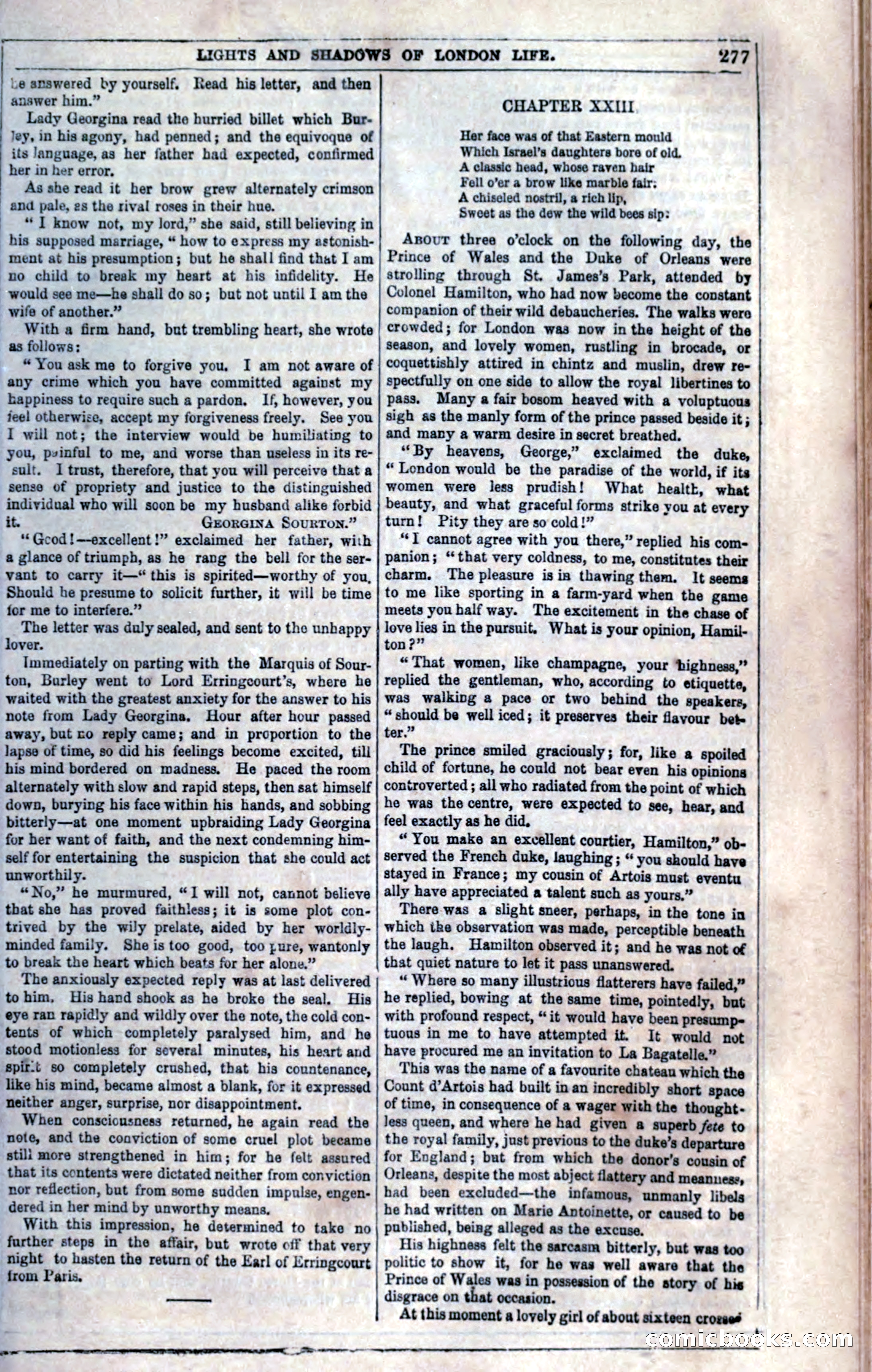
A restored page from Penny Dreadfuls, 1850. Page through the whole issue in the reader above.
📄 Transcribed text from this page (OCR, searchable)
Machine-transcribed from the original scan — historical spelling and the odd misread are preserved.
ue amswered by yourself. Read his letter, and then answer him.” Lady Georgina read the hurried billet which Bur- Jey, in his agony, had penned; and the equivoque of its Janguage, as her father had expected, confirmed her in her error, As she read it her brow grew alternately crimson and pale, 2s the rival roses in their hue. “1 know not, my lord,” she said, still believing in his supposed marriage, “ how to express my astonish- ment at his presumption; but he shall find that I am no child to break my heart at his infidelity. He would see me—he shall do so; but not until I am the wife of another.” With a firm hand, but trembling heart, she wrote as follows: “You ask me to forgive you. I am not aware of any crime which you have committed against my happiness to require such a pardon. If, however, you jeel otherwise, accept my forgiveness freely. See you I will not; the interview would be humiliating to you, pyinful to me, and worse than useless in its re- sult. 1 trust, therefore, that you will perceive that a sense of propriety and justice to the distinguished individual who will soon be my husband alike forbid it. GrorGrina SourrTon.” ““Gcod!—excellent!” exclaimed her father, with a glance of triumph, as he rang the bell for the ser- vant to carry it—* this is spirited—worthy of you, Should he presume to solicit further, it will be time for me to interfere.” The letter was duly sealed, and sent to the unhappy lover. Immediately on parting with the Marquis of Sour- ton, Barley went to Lord Erringcourt’s, where he waited with the greatest anxiety for the answer to his note from Lady Georgina. Hour after hour passed away, but co reply came; and in proportion to the lapse of time, so did his feelings become excited, till his mind bordered on madness. He paced the room alternately with slow and rapid steps, then sat himself down, burying his face within his hands, and sobbing bitterly—at one moment upbraiding Lady Georgina for her want of faith, and the next condemning him- self for entertaining the suspicion that she could act unworthily. “No,” he murmured, “I will not, cannot believe that she has proved faithless; it is some plot con- trived by the wily prelate, aided by her worldly- minded family. She is too good, too ,ure, wantonly to break the heart which beats for her alone.” The anxiously expected reply was at last delivered tohim, His hand shook as he broke the seal. His eye rap rapidly and wildly over the note, the cold con- tents of which completely paralysed him, and he stood motionless for several minutes, his heart and ‘spit:t so completely crushed, that his countenance, like his mind, became almost a blank, for it expressed neither anger, surprise, nor disappointment. When consciousness returned, he again read the note, and the conviction of some cruel plot became stili more strengthened in him; for he felt assured that its contents were dictated neither from conviction nor reflection, but from some sudden impulse, engen- dered in her mind by unworthy means, With this impression, he determined to take no further steps in the affair, but wrote off that very night to hasten the return of the Earl of Erringcourt from Paris. . ee ee ee er eee ee —— -—< LIGHTS AND SHADOWS OF LONDON LIFE. - —— 277 CHAPTER XXIII Her face was of that Eastern mould Which Israel’s daughters bore of old. A classic head, whose raven hair Fell o’er a brow like marble fair: A chiseled nostril, a rich lip, Sweet as the dew the wild bees sip: AsouTt three o’clock on the following day, the Prince of Wales and the Duke of Orleans were strolling through St. James’s Park, attended by Colonel Hamilton, who had now become the constant companion of their wild debaucheries. The walks were crowded; for London was now in the height of the season, and lovely women, rustling in brocade, or coquettishly attired in chintz and muslin, drew re- spectfully on one side to allow the royal libertines to pass. Many a fair bosom heaved with a voluptuous sigh as the manly form of the prince passed beside it ; and mapy a warm desire in secret breathed. ‘“‘By heavens, George,” exclaimed the duke, “London would be the paradise of the world, if its women were less prudish! What healtk, what beauty, and what graceful forms strike you at every turn! Pity they are so cold!” “ cannot agree with you there,” replied his com- panion; “‘that very coldness, to me, constitutes their charm. The pleasure isis thawing them. It seems to me like sporting in a farm-yard when the game meets you half way. The excitement in the chase of love lies in the pursuit, What is your opinion, Hamil- ton?” “That women, like champagne, your highness,” replied the gentleman, who, according to etiquette, was walking a pace or two behind the speakers, “should be well iced; it preserves their flayour bete ter.” The prince smiled graciously; for, like a spoiled child of fortune, he could not bear even his opinions controverted ; all who radiated from the point of which he was the centre, were expected to see, hear, and feel exactly as he did, “You make an excellent courtier, Hamilton,” ob- served the French duke, laughing ; “ you should have stayed in France; my cousin of Artois must eventu ally have appreciated a talent such as yours,” There was a slight sneer, perhaps, in the tone in which tke observation was made, perceptible beneath the laugh. Hamilton observed it; and he was not of that quiet nature to let it pass unanswered. “ Where so many illustrious flatterers have failed,” he replied, bowing at the same time, pointedly, but with profound respect, “it would have been presump- tuous in me to have attempted it. It would not have procured me an invitation to La Bagatelle,” This was the name of a favourite chateau which the Count d’Artois had built in an incredibly short space of time, in consequence of a wager with the thought - less queen, and where he had given a superb fete to the royal family, just previous to the duke’s for England; but from which the donor's cousin of Orleans, despite the most abject flattery and meanness, had been excluded—the infamous, unmanly libels published, being alleged as the excuse. His highness felt the sarcasm bitterly, but was too politic to show it, for he was well aware that the | : ' ' Prince of Wales was in possession of the story of his — disgrace on occasion. At this moment a lovely girl of about sixteen crogses Pa GCOMichoOo he had written on Marie Antoinette, or caused to be TTI ee ee oe - S (E©)