
Penny Dreadfuls, 1850 · page 282 of 394
The Mysteries of London; or, Lights and Shadows of London Life — page 282: what you’re looking at
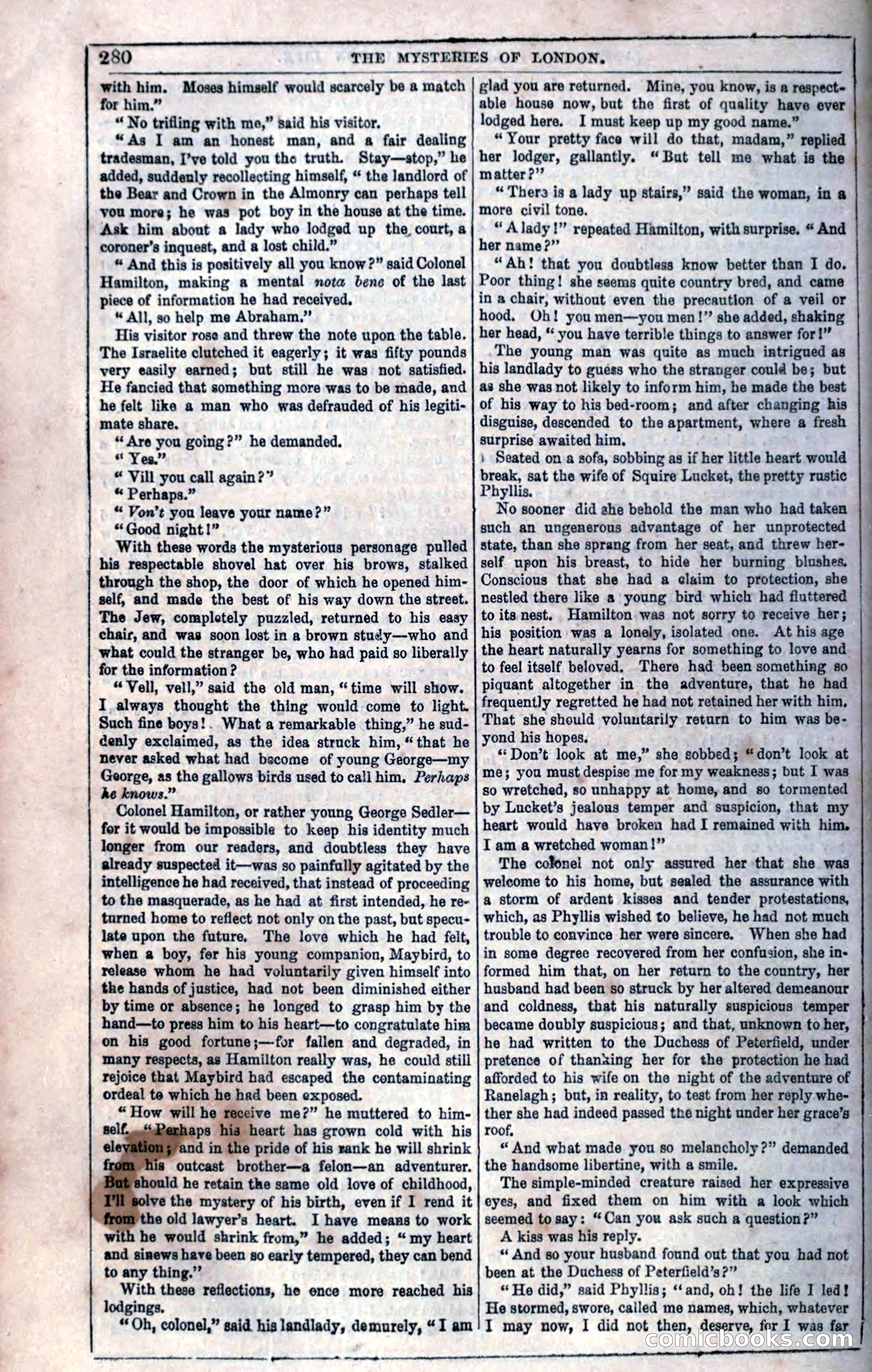
A restored page from Penny Dreadfuls, 1850. Page through the whole issue in the reader above.
📄 Transcribed text from this page (OCR, searchable)
Machine-transcribed from the original scan — historical spelling and the odd misread are preserved.
280 with him. Moses himself would scarcely be a match for him.” “ No trifling with me,” said his visitor. “As I am an honest man, and a fair dealing tradesman, I’ve told you the truth. Stay—stop,” he added, suddenly recollecting himself, “ the landlord of the Bear and Crown in the Almonry can perhaps tell you more; he was pot boy in the house at the time. Ask him about a lady who lodged up the court, a coroner’s inquest, and a lost child.” * And this is positively all you know ?” said Colonel Hamilton, making a mental nota bene of the last piece of information he had received, “ All, so help me Abraham.” His visitor rose and threw the note upon the table. The Israelite clutched it eagerly; it was fifty pounds very easily earned; but still he was not satisfied. He fancied that something more was to be made, and he felt like a man who was defrauded of his legiti- mate share. “ Are you going?” he demanded. st Yes.”’ “ Vill you call again?” “ Perhaps.” “ Von’t you leave your name?” “Good night!” With these words the mysterious personage pulled his respectable shovel hat over his brows, stalked through the shop, the door of which he opened him- self, and made the best of his way down the street. The Jew, completely puzzled, returned to his easy chair, and was soon lost in a brown stuey—who and what could the stranger be, who had paid so liberally for the information ? “Vell, vell,” said the old man, “time will show. I always thought the thing would come to light. Such fine boys!. What a remarkable thing,” he sud- denly exclaimed, as the idea struck him, “that he never asked what had become of young George—my George, as the gallows birds used to call him, Perhaps he knows.” Colonel Hamilton, or rather young George Sedler— for it would be impossible to keep his identity much longer from our readers, and doubtless they have already suspected it—was so painfully agitated by the intelligence he had received, that instead of proceeding to the masquerade, as he had at first intended, he re- turned home to reflect not only on the past, but specu- late upon the future, The love which he had felt, when a boy, fer his young companion, Maybird, to release whom he had voluntarily given himself into the hands of justice, had not been diminished either by time or absence; he longed to grasp him by the hand—to press him to his heart—to congratulate him on his good fortune;—for fallen and degraded, in many respects, as Hamilton really was, he could still rejoice that Maybird had escaped the contaminating ordeal te which he had been exposed. “How will he ve me?” he muttered to him- ps heart has grown cold with his pride of his rank he will shrink outcast brother—a felon—an adventurer. d he retain the same old love of childhood, the mystery of his birth, even if I rend it e old Jawyer’s heart. I have means to work he would shrink from,” he added; “ my heart and sinews have been so early tempered, they can bend to any thing.” With these reflections, he ence more reached his lodgings. mes ee “Oh, colonel,” said his landlady, demurely, “I am!I may now, I did not then, de Sa «: tah comichooks THE MYSTERIES OF LONDON. ———— lodged here. I must keep up my good name.” “Your pretty face will do that, madam,” replied her lodger, gallantly. “But tell me what is the matter ?”’ “Thera is a lady up stairs,” said the woman, in a more civil tone. “Alady!” repeated Hamilton, with surprise. “ And her name ?”’ “Ah! that you doubtless know better than I do. Poor thing! she seems quite country bred, and came in a chair, without even the precaution of a veil or hood. Oh! you men—you men!” she added, shaking her head, “ you have terrible things to answer for!” The young man was quite as much intrigued as his landlady to guéss who the stranger could be; but as she was not likely to inform him, he made the best of his way to his bed-room; and after changing his disguise, descended to the apartment, where a fresh surprise awaited him. | Seated on a sofa, sobbing as if her little heart would saa sat the wife of Squire Lucket, the pretty rustic yllis. No sooner did she behold the man who had taken such an ungenerous advantage of her unprotected state, than she sprang from her seat, and threw her- self upon his breast, to hide her burning blushes. Conscious that she had a elaim to protection, she nestled there like a young bird which had fluttered to its nest. Hamilton was not sorry to receive her; his position was a lonely, isolated one. At his age the heart naturally yearns for something to love and to feel itself beloved, There had been something 80 piquant altogether in the adventure, that he had frequently regretted he had not retained her with him, That she should voluntarily return to him was be- yond his hopes. ‘Don’t look at me,” she sobbed; “don’t look at me; you must despise me for my weakness; but I was so wretched, so unhappy at home, and so tormented | by Lucket’s jealous temper and suspicion, that my heart would have broken had I remained with him. I am a wretched woman!” The colonel not only assured her that she was welcome to his home, but sealed the assurance with a storm of ardent kisses and tender protestations, which, as Phyllis wished to believe, he had not much trouble to convince her were sincere. When she had in some degree recovered from her confusion, she in- formed him that, on her return to the country, her husband had been so struck by her altered demeanour and coldness, that his naturally suspicious temper became doubly suspicious; and that, unknown fo her, he had written to the Duchess of Peterfield, under pretence of thanzing her for the protection he had afforded to his wife on the night of the adventure of Ranelagh; but, in reality, to test from her reply whe- ther she had indeed passed the night under her grace’s roof, “And what made you so melancholy?” demanded the handsome libertine, with a smile. The simple-minded creature raised her expressive eyes, and fixed them on him with a look which seemed tosay: “Can you ask such a question?” A kiss was his reply. “ And so your husband found out that you had not been at the Duchess of Peterfield’s?” “He did,” said Phyllis; ‘‘and, oh! the life I led! He stormed, swore, cailed me names, which, whatever <SiiG (LI glad you are returned. Mine, you know, is a respect- ' able house now, but the first of quality have ever | r1I was far om P paw a ———$—$ are