
Penny Dreadfuls, 1850 · page 288 of 394
The Mysteries of London; or, Lights and Shadows of London Life — page 288: what you’re looking at
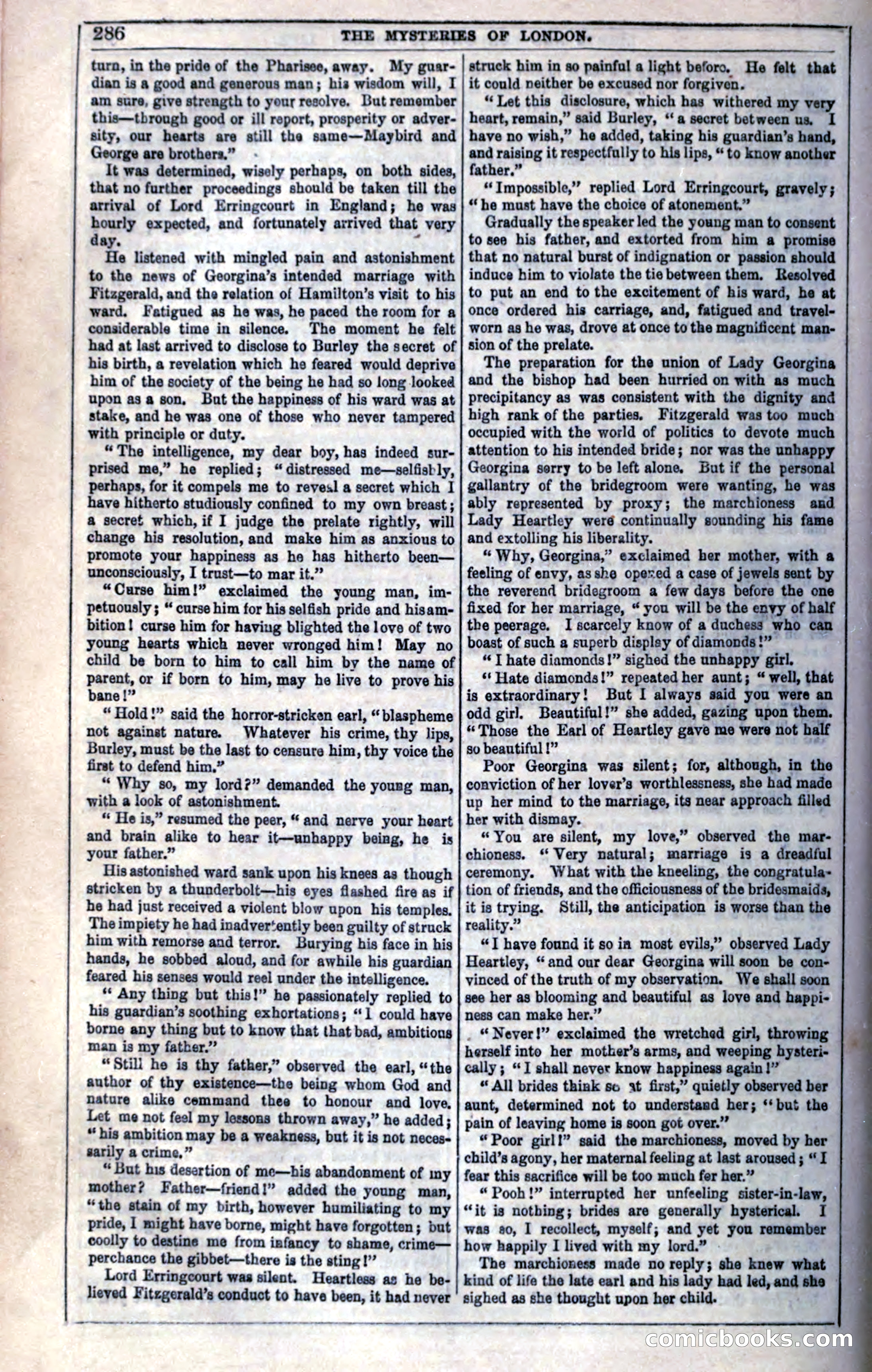
A restored page from Penny Dreadfuls, 1850. Page through the whole issue in the reader above.
📄 Transcribed text from this page (OCR, searchable)
Machine-transcribed from the original scan — historical spelling and the odd misread are preserved.
286 turn, in the pride of the Pharisee, away. My guar- dian is a good and generous man; his wisdom will, I am sure, give strength to your resolve. But remember this—tbrough good or ill report, prosperity or adver- sity, our hearts are still the same—Maybird and George are brothers,” It was determined, wisely perhaps, on both sides, that no further proceedings should be taken till the arrival of Lord Erringcourt in England; he was hourly expected, and fortunately arrived that very day. . He listened with mingled pain and astonishment to the news of Georgina’s intended marriage with Fitzgerald, and the relation of Hamilton’s visit to his ward. Fatigued as he was, he paced the room for a considerable time in silence. The moment he felt had at last arrived to disclose to Burley the secret of his birth, a revelation which he feared would deprive him of the society of the being he had so long looked upon asa son, But the happiness of his ward was at stake, and he was one of those who never tampered with principle or duty. “The intelligence, my dear boy, has indeed sur- prised me,” he replied; “distressed me—selfisbly, perhaps, for it compels me to reyesl a secret which I have hitherto studiously confined to my own breast; a secret which, if I judge the prelate rightly, will change his resolution, and make him as anxious to promote your happiness as he has hitherto been— unconsciously, I trust—to mar it.” “Curse him!” exclaimed the young man, im- petuously ; “ curse him for his selfish pride and hisam- bition! curse him for having blighted the love of two young hearts which never wronged him! May no child be born to him to call him by the name of parent. or if born to him, may he live to prove his ane |” “ Hold!” said the horror-stricken earl, “ blaspheme not against nature. Whatever his crime, thy lips, Burley, must be the last to censure him, thy voice the firat to defend him,” “Why so, my lord?” demanded the young man, with a look of astonishment. “ He is,” resumed the peer, “ and nerve your heart and brain alike to hear it—unhappy being, he is your father.” His astonished ward sank upon his knees as though stricken by a thunderbolt—his eyes flashed fire as if he had just received a violent blow upon his temples. The impiety he had inadvertently been guilty of struck him with remorse and terror. Burying his face in his hands, he sobbed aloud, and for awhile his guardian feared his senses would reel under the intelligence. “‘ Any thing but this!” he passionately replied to his guardian’s soothing exhortations; “1 could have borne any thing but to know that that bad, ambitions man is my father.” “Still he is thy father,” observed the earl, “the author of thy existence—the being whom God and nature alike command thee to honour and love, Let me not feel my lessons thrown away,” he added ; “his ambition may be a weakness, but it is not neces- sarily a crime,” “ But his desertion of me—his abandonment of iny mother? Father—friend!” added the young man, “the stain of my birth, however humiliating to my pride, 1 might have borne, might have forgotten; but coolly to destine me from infancy to shame, crime— perchance the gibbet—there is the sting!” Lord Erringeourt was silent. Heartless as he be- lieved Fitegerald’s conduct to have been, it had never ee ee oem oe ae ee + ree + =e ee eee ee a ——e et eee THE MYSTERIES OF LONDON, struck him in so painful a light beforo, He felt that it could neither be excused nor forgiven. | “Let this disclosure, which has withered my y heart, remain,” said Burley, “a secret between us, have no wish,” he added, taking his guardian’s hand, and raising it respectfully to his lips, “to know another father.” “Impossible,” replied Lord Erringcourt, gravely; “he must have the choice of atonement.” Gradually the speaker led the young man to consent to see his father, and extorted from him a promi that no natural burst of indignation or passion shoul induce him to violate the tie between them. Resolved to put an end to the excitement of his ward, he at once ordered his carriage, and, fatigued and travel- worn as he was, drove at once to the magnificent man- sion of the prelate. ' The preparation for the union of Lady Georgina and the bishop had been hurried on with as muc precipitancy as was consistent with the dignity and high rank of the parties. Fitzgerald was too much occupied with the world of politics to devote much 7 f es attention to his intended bride; nor was the unhay Georgina sorry to be left alone. But if the person: gallantry of the bridegroom were wanting, he was ably represented by proxy; the marchioness and Lady Heartley weré continually sounding his fame and extolling his liberality. a “ Why, Georgina,” srelaimed ber mother, with a feeling of envy, asshe opered a case of jewels sent by the reverend bridegroom a few days before bat one fixed for her marriage, “ you will be the eyo on the peerage. I scarcely know of a duch boaat of ah a superb displey of diamonds! “IT hate diamonds!” sighed the unhappy girl. ‘‘ Hate diamonds!” repeated her aunt; “ well, that is extraordinary! But I always said you were an odd girl. Beautiful!” she added, gazi. apes ae “Those the Earl of Heartley gave me were not hal so beautiful !” Poor Georgina was silent; for, although, in the conviction of her lover’s worthlessness, she had made up her mind to the marriage, its near approach filled her with dismay. “You are silent, my love,” observed the mar- chioness. “ Very natural; marriage is a drea ceremony. What with the kneeling, the congratula- tion of friends, and the officiousness of the bridesmaids it is trying. Still, the anticipation is worse than reality.” “] have found it so in most evils,” observed Lady Heartley, “and our dear Georgina will soon be con- | vinced of the truth of my observation. We shall soon | see her as blooming and beautiful as love ness can make her.” * . “Never!” exclaimed the wretched girl, throwing | herself into her mother’s arms, and weeping hysteri- | cally ; “I shall never know happiness again!” “ All brides think se st first,” quietly observed ber aunt, determined not to understand her; ‘* but the pain of leaving home is soon got over.” 7 “Poor girl!” said the marchioness, moved by her | child’s agony, her maternal feeling at last aroused; “I | fear this sacrifice will be too much fer her.” | “Pooh!” interrupted her unfeeling sister-in-law, — “it is nothing; brides are generally hysterical. I was 80, I recollect, myself; and yet you remember | how happily I lived with my lord.” . j The marchioness made no reply; she knew what — kind of life the late earl and his lady had led, and sighed as she thought upon her child. « 7 com MIGbooks (EO)